
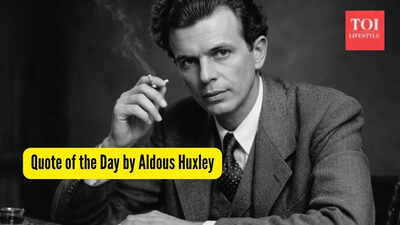
If one could get into the mind of Aldous Huxley-or at least try to write like someone who spent too many late nights thinking about his books-one would start by saying that the man was a prophet in glasses. Huxley was born in 1894 into a family of intellectuals in Surrey, England. He wasn’t just a dusty philosopher; he was a seer who cut open the soul of the 20th century before most people even knew it had one. As a kid he went blind from keratitis at 16 and had to go to school with only half of his vision. He still became one of the smartest people of his time. He wrote his first novel, Crome Yellow, in 1920. This was the start of a career that combined satire, science fiction, and mysticism into something very human—flawed, funny, and eerily accurate.
Even though Aldous had trouble seeing, he read a lot of books, from Shakespeare to biochemistry. He went to Eton and Oxford before becoming a journalist and writer. In the 1920s, he was a literary darling in London’s glamorous scene, hanging out with the Bloomsbury set. But he was always the observer, sketching caricatures of high society in books like Antic Hay (1923) and Point Counter Point (1928). These early works? Sharp satires of England after World War I, when people chased sex, art, and status like it was all a big joke.
The most important one came next: Brave New World in 1932. Huxley later called it a “sad prediction,” but it was spot on for our world. In this dystopia, people are made in hatcheries, sorted into castes (Alphas at the top, Epsilons as factory fodder), and kept calm with a drug called Soma. “Community, Identity, Stability” is all you need. No families, no books. Henry Ford is their god, and they don’t want babies anymore.
Huxley took ideas from things that were popular at the time, like Ford’s assembly lines, behaviorism from people like Pavlov and Watson, and eugenics that was all the rage. He said these things directly in essays like “Science, Liberty and Peace” (1946), where he warned that technology could take away freedom. At first, the book didn’t sell very well, but after World War II, it took off as people saw similarities between consumerism and propaganda. There are more than 60 translations of it, and it has been turned into plays, operas, and even an NBC miniseries in 2020. Huxley himself went back to it in Brave New World Revisited (1958) and said that nuclear weapons and too many people made his made-up horrors seem tame.
But Huxley wasn’t all bad. He made a big change in the middle of his life. He didn’t like Europe after living in Fascist Italy, so he moved to the U.S.
in 1937. He wrote scripts for stars like Walt Disney in Hollywood (yes, he wrote treatments for Alice in Wonderland). There, with the help of his wife Maria and Indian philosopher Gerald Heard, he got very interested in mysticism. He tried mescaline, which is well-known because of the book The Doors of Perception (1954), which inspired Jim Morrison’s band name and the whole psychedelic vibe of the 1960s. Fact: Psychiatrist Humphry Osmond, who came up with the term “psychedelic,” was in charge of his mescaline trip on May 5, 1953. Huxley thought it was a quick way to reach a higher state of being by combining Eastern Vedanta with Western science. The Perennial Philosophy (1945) and other books said that all religions lead to the same truth: ego-death and unity with the divine.
He died of cancer on November 22, 1963, the same day as JFK and C.S. Lewis.
Huxley wrote more than 50 books, including novels, essays, poetry, biographies, and screenplays.
He also gave lectures. He was a strong supporter of humanism, ecology, and peace. He helped start the Congress of Cultural Freedom. At first, he criticized shallow hedonism; later, he promoted spiritual education as a way to fight totalitarianism. He wrote about how art affects mental health in Music at Night (1931) and Adonis and the Alphabet (1956). He warned of overpopulation in Brave New World and essays like “The Double Crisis” (1960), predicting wars over resources—spot-on, as UN reports today echo his math on exponential growth. He was politically neutral but against authority. He had an effect on everyone from Orwell (who fought with him over dystopias) to Steve Jobs, who read The Doors every year. Check the facts: In his autobiography, Jobs said it changed his life. Huxley’s 1984 was like Orwell’s 1984, but with more pain and less pleasure. In bioethics (debates about genetic engineering) and philosophy (how biotech can make people happy), academics use him as a source.
He mixed satire with science, bringing up Proust, quantum physics, and Tantra all at once. Sentences twist like vines: they are beautiful, ironic, and never preachy. “A gramme is better than a damn” from Brave New World is short, punchy, and easy to remember. His voice knows everything but is also kind, making fun of bad behavior while feeling sorry for victims. Non-fiction reads like conversations by the fire—intimate and probing.
He stayed away from melodrama; even in utopia’s hell, the characters feel real and flawed. People like Cyril Connolly praised his “civilized intelligence. ” He made philosophy easy to understand without making it too simple.
It’s from Chapter 3 of Brave New World Revisited (1958), word for word.
Not from Brave New World itself, but it fits the book’s theme: people who use Soma go after happiness directly and end up numb. Huxley got ideas from mystics like Lao Tzu (“Those who seek it won’t find it”) and psychologists like William James, who said that joy sneaks up on people when they are in flow states. Like a person taking it apart? Remember your own life. Have you ever gone after “happiness” head-on, like getting a new job, finding the perfect partner, or going on endless vacations, only to fail? Huxley gets it right: direct pursuit changes it. If you focus too much on happiness, you will create anxiety, comparison, and expectation. It’s like trying to hold smoke; the more you squeeze, the less you have. Instead, he says, do “other things” that you love, like work, friends, making art, or even boring chores that you do with care. Happiness is not the goal; it comes out as overflow.
This goes against consumer traps in his world. Huxley saw it in the feelies and soma of Brave New World. Advertisers sell happiness through things. True happiness? From a goal. His mescaline visions confirmed this: holding on to your ego stops it; giving in to the moment (like hiking or writing) lets it flow in. Huxley experienced it. He could have given up when he went blind, but he kept writing with all his heart. Late-life mysticism wasn’t about finding happiness; it came from experiments that gave us new ideas.
In this time of scroll addiction, it’s gold: log off and make something real, and happiness will follow.