

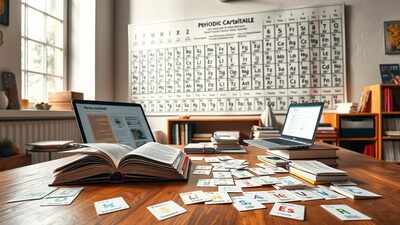
As the Class 10th Science board exam nears, students all over the country are always in a time race to cement their grasp on the basic concepts, with the foremost being the periodic table. This is the famous periodic table of elements, proposed by Dmitri Mendeleev; it is not merely a table, but it is a map of the building blocks of matter. Although its memorisation is a daunting task, it can be made a manageable and even a creative task by approaching it strategically.
The periodic table is not just a list of element names, but it enclosed profound chemical reasoning, recognizing elements with similar characteristics and tendencies of reactivity, atomic size, and valence.
The ability to understand such patterns is not only important in answering questions in chemistry in Class 10 science, but also in answering numerical questions and reactions.
Divide and conquer: Break down the table
Among the best approaches to handling huge amounts of information is the ability to divide it into smaller, manageable chunks:
- Sections and blocks
: Work in one row (period) or one vertical column (group) at a time and not the entire table.
- Visual segmentation
: Visualise s-block, p-block, d-block, and f-block elements using colour-coded charts; the elements are colour-coded to provide visual messages that are memorable.
- Incremental sets
: Begin with the initial 1020 items and master one of the chunks before proceeding to the next.
This division of the task is the most effective in both short-term recall exams and long-term retention of future learning of science.
Mnemonic tools: The friend of your memory
Creative memory aids, known as mnemonics, transform abstract symbols or symbols into an excellent, memorable phrase or a pattern. They operate by relating the new information to the already held mental anchors and can be recalled more quickly when the person is on a tight time frame.
A common mnemonic that is used to recall the first nine elements (hydrogen to fluorine) is:
Happy Hector Likes Beer But Could Not Obtain Food.
H – Hydrogen
He – Helium
Li – Lithium
Be – Beryllium
B – Boron
C – Carbon
N – Nitrogen
O – Oxygen
F – Fluorine
Not only does this serve to tie the symbols together, but does so in a coherent sentence which is easier to remember than individual letters.
Elements: H, Li, Na, K, Rb, Cs, Fr
Happy Little Naresh Kindly Rubs Cats Fur.
This droll line corresponds to each symbol sequentially, a mnemonic which is not complex and suggestive.
Elements: Be, Mg, Ca, Sr, Ba, Ra
Bright Spellsmen Spell Bankside Eternally.
This phrase helps memorize by linking each symbol in the word to the first letter.
Other than words: Multisensory methodology
Although the use of mnemonic is strong, using it together with other learning techniques multiplies its effectiveness:: Use a symbol or atomic number with one side of the card and write the element on the other. Tests that are self-administered strengthen memory. : Some learners discover that assigning names to elements to a song; or even singing a song they create is a dramatic enhancement to memory. : Regularly fill in a blank outline of the periodic table; this not only tests memory but also helps to develop a mental map of where each element is located.
Memorising the periodic table and passing science exams should certainly not be the only purpose. Chemistry is based on the order and patterns of the chemical elements, and the periodic table is the ultimate illustration of that. With well, planned division, fun mnemonics, and a lively reviewing scheme a periodic table, even a very extensive one, may become a mental tool rather than a nightmare.
Ready to navigate global policies? Secure your overseas future. Get expert guidance now!


