
Governments around the world reacted with caution after the US Supreme Court invalidated President Donald Trump’s broad emergency tariffs, with some reaffirming existing agreements and others taking a wait-and-see approach to evaluate his next steps.
South Korea said the ruling voids the 15% “reciprocal” tariff currently applied to its goods, while adding that it would continue talks on the implementation of last year’s trade agreement. Indonesia, which finalized its deal on Thursday locking in a 19% duty on its American exports, said it’s monitoring the court decision and Trump’s subsequent move to impose a 10% global tariff under a different statute.
While primarily disrupting Trump’s domestic economic agenda, the court dealt a blow to his regular use of threats of import taxes to bring allies and adversaries to heel on geopolitical issues ranging from unrest in the Mideast and sovereignty in Greenland to purchases of Russian oil. Whether he can maintain that immediate leverage with slower and narrower tariff authorities is the key question for his foreign policy.
Lawmakers in the European Union, which faced a 15% so-called reciprocal levy, will hold an emergency meeting Monday to reassess the bloc’s pending trade deal with the US. The EU Parliament’s trade committee had been expected to vote Tuesday to move forward with ratification of that agreement.
“We’ll look closely at the consequences and adapt accordingly,” French President Emmanuel Macron told reporters at an agricultural fair in Paris on Saturday. “So if that helps to pacify things, then that’s good. And I think we need to focus on calming things at the international level.”
Italian Foreign Minister Antonio Tajani, quoted by newswire Ansa, said “it’s always good news when tariffs are removed, but I don’t think there will be any major changes.”
A government spokesman for the UK, which was given the lowest reciprocal rate at 10%, said it will work with the US administration to understand the ruling’s impact on the bilateral relationship. As part of its deal with Trump, Britain had preferential tariffs on steel, pharmaceuticals and autos that remain intact.
“From the UK perspective the best option, and the one the government is likely to take, is to say very little at all,” said Sam Lowe, a trade specialist at strategic advisory firm Flint Global in London. “Our main interests with the US — cars and steel — are not affected by the ruling.”
USMCA Relief
The US’s two biggest trading partners, Mexico and Canada, were spared the new 10% rate, with the White House clarifying it’s leaving in place an exemption for many goods shipped under the US-Mexico-Canada Agreement. Still, that deal is under review this year and Washington has signaled there will be changes.
“We will carefully review the resolution and gladly give our opinion,” Mexico’s President Claudia Sheinbaum said.
Marcelo Ebrard, Mexico’s Economy Minister and top USMCA negotiator, called for “prudence” and recalled that more than 85% of Mexico’s exports to the US are not subject to tariffs, while steel, aluminum and cars are levied through other instruments untouched by the court’s ruling.
Brazil’s Vice President Geraldo Alckmin said negotiations with the US will continue, including on non-tariff issues such as data centers and strategic minerals. President Luiz Inácio Lula da Silva “has always defended dialog and negotiation. That continues,” Alckmin said. Lula and Trump are scheduled to meet in Washington in March.
In the midst of a long holiday for New Year celebrations, China had no immediate reaction. On the same day of the court’s ruling, Trump announced plans to travel to Beijing from March 31 to April 2 for a meeting with his counterpart Xi Jinping.
The world’s two largest economies will look to maintain a trade truce struck last year that widened beyond tariffs to export controls on goods like rare earths, jet engines and chip design software. Only this time, Trump won’t have as much immediate leverage in the talks as he did last year.
‘Proceed Cautiously’
Still, White House officials said they expected countries with deals already finalized to honor their pledges while the administration’s new tariff strategy is rolled out in coming weeks. The 10% rate is set to take effect Tuesday.
Malaysia, which has yet to ratify its trade pact with the US, also said it’s waiting for more clarity on the developments, while Cambodia said it will move forward with the ratification of its own agreement with Washington.
“I would expect most Asian partners to proceed cautiously, with existing agreements largely holding as both sides work through the implications in the coming weeks,” said Daniel Kritenbrink, partner at the Asia Group, who served most recently as US Assistant Secretary of State for East Asian and Pacific affairs. “The administration still has multiple ways to generate leverage in ongoing trade talks.”
In its 6-3 decision handed down Friday, the Supreme Court ruled that Trump’s use of a decades-old federal emergency-powers law to impose his so-called reciprocal tariffs was unlawful. Trump invoked the International Emergency Economic Powers Act, or IEEPA, last April to impose duties on dozens of US trading partners, ranging from 10% to 50%.
Trump’s Defiance
After the ruling, Trump on Friday moved quickly to preserve his trade agenda by announcing plans to impose the 10% global tariff on foreign goods. The new baseline tax under Section 122 of the Trade Act of 1974 grants the president unilateral ability to impose tariffs, but the untested legal provision puts a 150-day limit on how long the duties can remain in place.
The prospect for more punitive actions is underpinning the caution among Asian nations, many of which rely on US consumers to buy their goods. The new issues are raising new complexity for business and raising fresh questions about deals already struck, according to Deborah Elms, head of trade policy at the Hinrich Foundation.
“The uncertainty for trade partners is actually higher than it was before,” Elms said. “That uncertainty is going to be keeping up a lot of foreign governments over this weekend.”
According to a Bloomberg Economics estimate, the US government has so far has collected an estimated $170 billion in tariffs imposed by Trump using the IEEPA.
Thousands of importers are set to launch what could be a prolonged battle to try to recoup those payments.
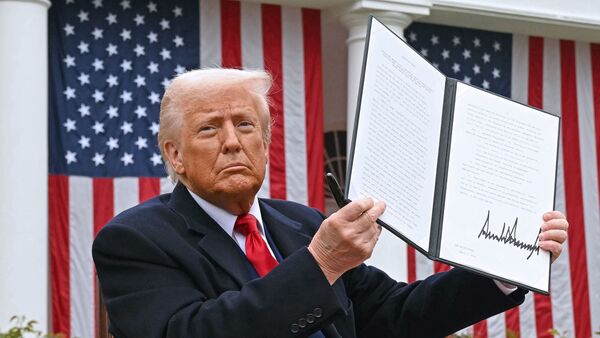
In a press conference Friday, Trump responded defiantly to the justices’ decision, indicated that any refund process would get bogged down in courts for years and said he’d use his other, more legally grounded tariff authorities to similar or even greater effect.
“We’re going forward, we will be able to take in more money and there’ll no longer be doubt,” he said at the White House. “The numbers could be far greater than the hundreds of billions we’ve already taken in.”
With assistance from Daniela Wei, Netty Ismail, Heesu Lee, Nectar Gan, Ben Otto, Suttinee Yuvejwattana, Fran Wang, Ramsey Al-Rikabi, Phil Serafino, Gonzalo Soto, Daniel Carvalho, Jorge Valero, Ellen Milligan, Philip Aldrick, Donato Paolo Mancini and Philip J. Heijmans.


