
Just three days into the conflict, the Iran war has become attritional. Waves of drone attacks by the Islamic Republic are putting pressure on the defenses of the US and its partners from Bahrain to the United Arab Emirates, depleting weapons stockpiles. The outcome of the fight may depend on which side runs out of munitions first.
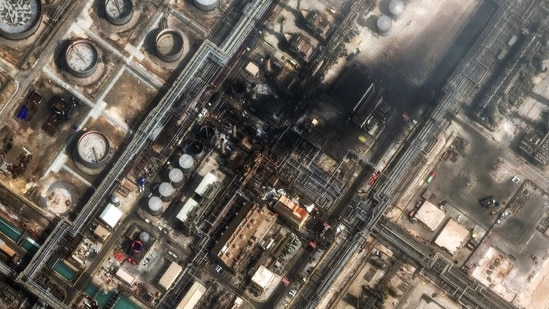
Shahed-136 one-way attack drones, small, rudimentary cruise missiles, continued to pound targets across the Middle East on Monday. The drones have in recent days hit US bases, oil infrastructure and civilian buildings, since the US and Israel air strikes on Iran — a barrage of cruise missiles, drones and precision-guided bombs — began on Saturday.
US-made Patriot air-defense missiles have been largely successful in stopping the Iranian Shaheds and other ballistic missiles, with interception rates over 90%, according to the UAE. But using $4 million missiles to destroy $20,000 drones illustrates a problem that has haunted Western military planners since early in the Ukraine war: The cheap weapons can chew up resources meant for much more complex threats.
The result is that both Iran and the US may run low on weapons in a matter of days or weeks. Whoever can last longer will gain a serious advantage.
Iran’s regional proxies were severely weakened by the war in Gaza and its missile capabilities damaged by the earlier Israel-US attacks in a 12-day war in June. Since then the emphasis for Iran has been to escalate its warnings about the consequences and costs of a Trump strike, knowing that his supporters are broadly opposed to drawn-out, messy wars. Iran’s Supreme Leader Ali Khamenei — who died in Saturday’s air strikes — warned that a US attack would lead to wider conflagration embroiling the whole region.
“Attrition strategy makes operational sense from Iran’s perspective,” said Kelly Grieco, a senior fellow at the Stimson Center think-tank. “They are calculating the defenders will exhaust their interceptors and the political will of Gulf states will crack and put pressure on the US and Israel to cease operations before they run out of missiles and drones.”
Qatar’s stocks of Patriot interceptor missiles will last four days at the current rate of use, according to an internal analysis seen by Bloomberg News. Doha has been privately urging a swift end to the conflict.
Iran was estimated to have about 2,000 ballistic missiles after last year’s conflict with Israel. It’s likely to have a much larger number of Shaheds, which Russia, the other main manufacturer, has been able to produce at a rate of several hundred per day, according to analysis by Becca Wasser, defense lead at Bloomberg Economics.
Tehran has fired more than 1,200 projectiles since the start of this year’s conflict, with many — perhaps most — of them being Shaheds. That suggests they could be saving more damaging ballistic missiles for sustained attacks, Wasser added.
Iran’s military is acting apparently without close or frequent coordination with the civilian leadership including the ministry of foreign affairs, according to Foreign Minister Abbas Araghchi.
“Our military units are now in fact independent and somehow isolated and they are acting based on instructions, general instructions given to them in advance,” Araghchi, a veteran of the Islamic Revolutionary Guard Corps, said in an interview to Al Jazeera on Sunday.
On the US side, Wasser added, strike planners are unlikely to have moved enough munitions to the region to continue for four weeks, as President Donald Trump has estimated they would.
US Defense Secretary Pete Hegseth said at a news conference on Monday that: “This is not Iraq, this is not endless.”
Defensively, Iran has little left to fight with. The aerial attacks in the opening hours of the war hit its surface-to-air batteries, the most modern of which were Russian-made S-300s. US and Israeli fighters have been operating in Iranian airspace without any reported difficulties since then.
The US and its regional partners mainly use Lockheed Martin Corp. Patriot air-defense systems firing PAC-3 missiles. Although the Pentagon has pushed to increase production, only about 600 PAC-3 missiles were built in 2025, according to Lockheed. Based on how many missiles and drones have been reported shot down, thousands of interceptors have most likely been fired in the Middle East since Saturday.
Saudi Arabia and the United Arab Emirates also operate THAAD, a Lockheed system designed to hit more advanced, faster moving missiles at the edges of the atmosphere. Those are unlikely to be used against anything else, and are even more expensive, at about $12 million per missile.
The US has also used patrols of fighter jets using Advanced Precision Kill Weapon System missiles, which cost $20,000 to $30,000 each plus the operating cost of the jets.
Purpose-built anti-drone defenses are less common in the region. Using lasers, automatic cannons or even other drones can be a cheaper way to protect towns, cities and installations, saving expensive systems for bigger problems.
The Iron Beam laser developed by Israeli defense company Rafael Advanced Defense Systems is meant to address this issue, but the Israel Defense Forces said on Monday it had not yet been used in the conflict.
If the current intensity of Iranian strikes continues, PAC-3 stockpiles in the region could run dangerously low within days, according to a person familiar with the matter who asked not to be identified discussing sensitive details. If offensive weapons do too, stalemate could take hold.
“In the meantime, Iran’s inventory of missiles and drones may draw down and the regime itself might be able to remain intact, if in chaos,” said Ankit Panda, a senior fellow at the Carnegie Endowment for International Peace. “This seems to be a likely outcome based on the first 60 hours of this war.”


