
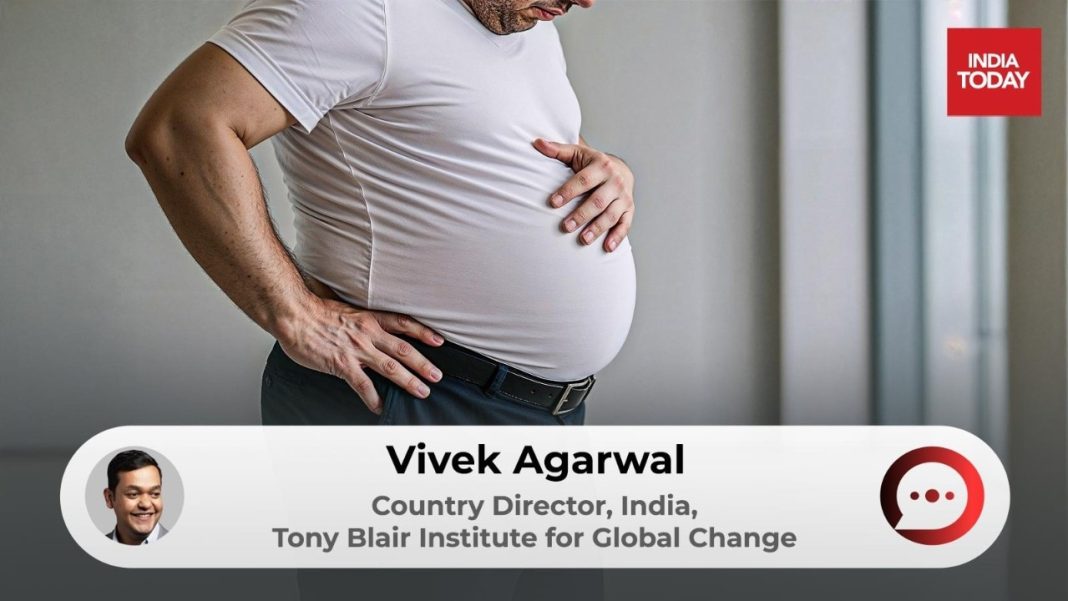
Millions of us ringed in the new year with a resolution or two: eat healthier, exercise more, lose a few pounds. Gyms were flooded in January and mostly will slim out by March.
But 2026 offers a chance to dream bigger than individual willpower. If people are committing to getting fitter, their government should commit to making the battle against obesity a national inflection point, not an outbreak of seasonal resolve.
That fight is already underway. A study by the Tony Blair Institute, Building on Success to Secure India’s Future Health, obesity and related chronic conditions cost India about $29 billion annually.
One in four Indians is overweight or obese, and lifestyle diseases are galloping.
The most potent drivers of ill health nowadays are sugar, salt and ultra-processed food. Just this month, the Indian Council of Medical Research (ICMR) initiated work on national obesity guidelines by reviewing current and emerging therapies, including GLP-1 drugs.
This study is not a bolt from the blue. It’s the latest bead to be strung on a decade-long strand of reforms that have had the state re-imagining health as a collective effort ever since.
One of these vast projects was International Yoga Day, the soft-power juggernaut launched in 2014, dispatched asanas gliding from Connaught Place to Copenhagen. The Khelo India Programme (2017) aimed to instil a sports culture among the youth, and the Fit India Movement (2019) sought to further “nudge” its citizens towards daily fitness by making them take a public “fitness pledge.”
Eat Right India reimaged nutrition as a national issue, leading to India’s chairing of the International Year of Millets and revitalizing traditional healthier staples.
In 2025, that arc sharpened.
To mark World Food Safety Day, the government kicked off the nationwide “Stop Obesity” campaign, based on the Prime Minister’s observation to reduce oil consumption by 10%. Schools were ordered to hang “sugar boards” highlighting the hidden sugar within everyday snacks; government offices, airports and railway stations would follow with information displays on oil use and sugar consumption.
From the ramparts of the Red Fort in August 2025, the Prime Minister had raised it to another level and described obesity as a “silent crisis” and suggested that freedom also means freedom from lifestyle disease. That speech was significant because it rewrote a health statistic into a political priority.
The sin tax adds some bite to that story. The GST Council’s 40% “health cess” on sugary drinks and junk foods in late 2025 is a major policy pivot. It says that obesity is no longer something considered by policymakers as simply a lifestyle choice, but a problem influenced by prices, environments, incentives, and so squarely within the realm of public policy.
A 35 cola is now almost 50; the bottled water price hasn’t changed. Price elasticity means that consumption will go down – maybe just a little at first, but then habitually. These were not about bans or diktats, but nudges to behaviour – little cues that recalibrate at the point of action.
WHAT NEXT?
The next step will have to be equally forward-looking. One positive signal is the ongoing process to formulate India’s first ever National Obesity Management Guidelines.
Classifying obesity as a chronic disease, and differentiating BMI thresholds, screening tools and treatment pathways towards Indian phenotypic profiles through the guidelines will thus ensure that prevention and care stand on evidence rather than an imported platform.
They should also help steer some tough choices coming up: how to regulate new anti-obesity drugs; how to incorporate prevention into primary care; and how to ensure that treatment does not displace lifestyle changes.
Next, movement must remain the foundation. Here, community-led initiatives offer a glimpse of what scale can look like. Singapore’s National Steps Challenge gave free trackers and shopping-voucher rewards to prod office workers into more than a thousand additional steps each day.
Every Sunday in Bogot, 120 kilometres of streets are closed to cars, as part of what’s known as the Ciclova, and two million people take over the roads for exercise. These efforts differ in concern one tugs at the wallet, another tickles dopamine.
India might gamify movement and credit 70,000 steps a fortnight to your UPI at the ration shop or metro gate. Municipalities above the population of one million could decide to institutionalise weekly car-free mornings.
Sprinkle local flavour – Garba cardio in Ahmedabad, hip-hop workshops in Hyderabad – so exercise reads as carnival, not a chore. Infrastructure will determine whether these habits stick. With its emphasis on mohalla playfields, open gyms and integrated sports complexes, the recently launched Khelo Bharat Niti-2025 charters the right course.
Dietary policy needs to close the loop. The specific tools of regulation matter, too. The UK’s Soft Drinks Industry Levy taxes producers – in contrast to India’s checkout sin tax – as a means of incentivising reformulation and lowering sugar content.
Following the introduction, sugar intake from soft drinks decreased by a third and yet sales remained constant.
Policymakers could also restrict aspirational ads targeted at children or those that sell high-sugar, high-fat products as status symbols. Taking a leaf from Singapore, there could be a front-of-pack food-rating system that would enable consumers to find their way through choices swiftly.
There are the outlines of a national resolution on fitness as we move to 2026. Tax what harms, subsidise what heals. Plan cities and schools for motion. Address obesity early on, based on science and free of stigma. Controlling weight, we have to remember, is not just about individual willpower – it’s also about transforming the environments that powerfully shape us.
Gandhi linked Swaraj to sanitation; Ambedkar connected dignity with social security. It’s our job to knit their moral sinews into 21st century policy: that the healthiest workforce is the most productive one, and individual desires can (and sometimes should) give way to collective wisdom.
If this proves successful, the state could spend less on treatment and more on needed services. Maybe then, 10 years from now, we will remember this year – the year citizens made resolutions and the state echoed them – with a glass of thanda nimbu pani raised for a republic that realised how to tax temptation and invest in vitality.
(Views expressed in this opinion piece are those of the author)


