
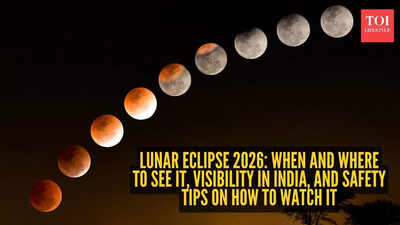
If you step out this evening and look up, the sky has something quietly dramatic lined up for you. March 3, 2026, brings the first lunar eclipse of the year, also known as Chandra Grahan. No loud build-up, no countdown clocks on your phone. Just the Earth, the Moon and a shadow doing what they’ve done for centuries.
Now here’s the honest part. In most parts of India, this is not going to be a long, all-night spectacle. You won’t see every stage from the beginning. But even a short glimpse can feel special, especially when you know what you’re looking at.
Let’s break it down simply.
When is the lunar eclipse (Chandra Grahan)?
The total lunar eclipse is happening today, March 3, 2026. Globally, it is classified as a total lunar eclipse. But what you see depends entirely on where you are standing.
What are Chandra Grahan timings in India (IST) today?
According to publicly available data by Time and Date, these are the eclipse phases in Indian Standard Time:
Start of penumbral phase: 4:58 PM IST
Start of totality: 4:58 PM IST
End of totality: 5:32 PM IST
End of penumbral phase: 7:53 PM IST
At first glance, the timings may seem a little confusing. How can totality begin at the same time as the penumbral phase? The reason is simple: by the time the Moon rises in many parts of India, the earlier stages are already underway.
Which means this: you are walking into the middle of the story.
For most cities across India, the Moon will rise while still under Earth’s shadow. So you will mostly catch the final stretch, as it slowly comes out of the shadow and regains its brightness.
The visible window in many areas is expected to last roughly 20 minutes, mainly around sunset. So no need to set alarms for midnight. Just step out around dusk.
Lunar Eclipse 2026 Date and Time in India: Sutak kaal, do’s and don’ts and significance of Chandra Grahan
Will the full lunar eclipse be visible in India?
Short answer: Purn Chandra Grahan will not be visible everywhere.
In most regions, you will only see the last phase of Chandra Grahan. The Moon will already be in eclipse when it appears above the horizon.
But if you are in the Northeast, you are in luck.
Dibrugarh, Assam
Dispur, Assam
Guwahati, Assam
Itanagar, Arunachal Pradesh
Shillong, Meghalaya
In these places, the total phase is reflected as fully visible in the available data. That means viewers there have a better chance of seeing the Moon fully covered by Earth’s shadow before it begins to brighten again.
For the rest of India, even a partially shadowed Moon against the evening sky can be quite a sight.
Why do people call it a “Blood Moon”?
Here’s where it gets interesting.
During a total lunar eclipse, the Earth moves between the Sun and the Moon. Direct sunlight is blocked. But some sunlight still bends around Earth and passes through its atmosphere before reaching the Moon.
The atmosphere filters the light. The shorter blue wavelengths scatter away, while the longer red wavelengths continue through. That filtered light can make the Moon appear reddish or deep orange.
That dramatic shade is why people often call it a “Blood Moon.”
Sometimes it looks faintly copper. Sometimes deeper red. It depends on atmospheric conditions.
What exactly is happening in the sky?
Picture this: the Sun, Earth and Moon line up in almost a straight line. Earth sits in the middle. Its shadow falls on the Moon.
First comes the penumbral phase, when the Moon enters the lighter outer part of Earth’s shadow. This part can be subtle.
Then comes totality, when the Moon is fully inside the darker central shadow. That’s when the colour shift can happen.
After that, the Moon slowly exits the shadow and returns to its normal brightness.
It sounds technical, but visually, it’s just the Moon dimming, glowing differently, and then slowly returning to itself.
Is it safe to watch Chandra Grahan?
Yes. Completely.
Unlike a solar eclipse, a lunar eclipse does not require protective glasses. You can watch it with the naked eye without any risk.
You are not looking at the Sun. You are simply watching Earth’s shadow fall on the Moon.
So step outside. Look up. No filters needed.
Do you need binoculars or a telescope to watch Chandra Grahan?
Not really.
If the sky is clear, you can see the change in brightness and colour without any equipment.
That said, binoculars can enhance the experience. They help you notice the gradual shading and surface details more clearly. A telescope will give you an even closer look, but it is absolutely optional.
This is one of those sky events that stays simple.
What if you miss the Lunar Eclipse?
If clouds roll in or buildings block your horizon, do not panic.
The full “blood moon” will be clearly visible in regions such as Australia, the Pacific region and western North America. Live streams and astronomy apps will also track the eclipse in real time.
But if you can, try to catch at least a few minutes in person. Screens never quite match the feeling of looking up yourself.
Why this eclipse still matters
Lunar eclipses happen a few times each year. But not all of them are visible from India. And even when they are, timing and geography change the experience.
This one may be brief in most Indian cities. It may not be dramatic or long. But it is still a reminder of something bigger.
The Sun, Earth and Moon moving with such precision that one casts a perfect shadow on the other. No noise. No announcement. Just alignment.
For many in India, Chandra Grahan also carries cultural and traditional meaning. Some households observe specific practices. Others simply watch in curiosity.
Either way, it offers a reason to pause.
So what should you do this evening?
Around sunset, step outside.
Look toward the eastern horizon.
Give it 15 to 20 quiet minutes.
Watch the Moon as it rises, still carrying the shadow, then slowly brightening as it moves out of it.
The March 3, 2026, lunar eclipse may not last long in India. But sometimes, even a short moment under the open sky feels like a reset.
And tonight, the sky is giving you exactly that.
The lunar eclipse on March 3, 2026, may be brief in most parts of India, but it is still worth watching. Even a short glimpse of the Moon under Earth’s shadow can feel special. No equipment is needed, just a clear sky and a few minutes of time. So step outside this evening, look up, and enjoy the quiet beauty of Chandra Grahan while it lasts.


