
The lottery was won. The approval arrived. For years, that sequence of events defined aspiration for thousands of Indian professionals, a ticket to the United States, a six-figure salary, and the promise of upward mobility. But in 2026, a simple Reddit post has unsettled that script.
An Indian professional selected in the March 2025 H-1B lottery under the H-1B visa has ignited a conversation that goes far beyond personal finance. Titled “Right time to stay in India?” the post questions whether relocating to the US still makes economic, or emotional sense.
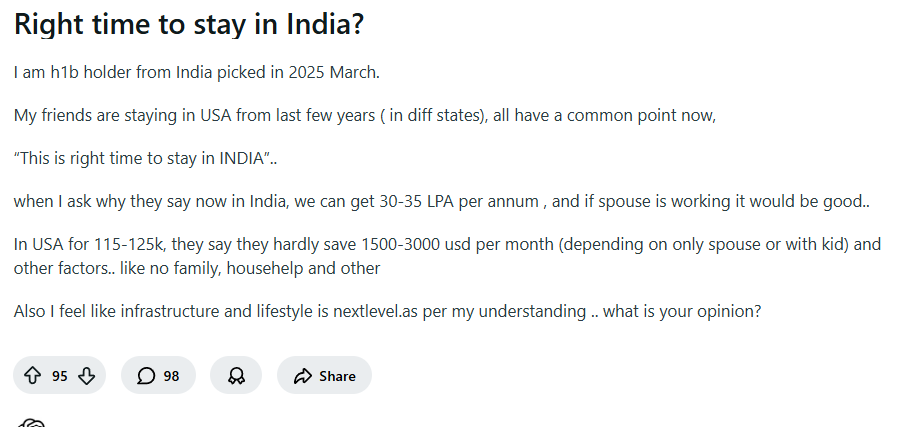
The premise is stark. In India, skilled professionals are reportedly earning ₹30–35 lakh per annum.
If both spouses work, the financial cushion thickens. In the United States, the same professional might earn $115,000 to $125,000 annually, roughly ₹1 crore to ₹1. 14 crore, yet save only $1,500 to $3,000 a month, depending on childcare costs, housing, and whether the spouse is employed.
When did the arithmetic of ambition change?
The shifting salary equation
For decades, the calculation was straightforward: higher nominal salaries in the US translated into superior long-term wealth creation.
But nominal income and real savings are not the same.
A $120,000 salary in cities such as San Francisco, Seattle, or New York can be absorbed quickly by rent or mortgage payments, health insurance premiums, daycare expenses, taxes, and transportation. Dual-income households may fare better, but childcare alone can cost thousands of dollars a month.
Contrast that with India’s evolving job market. Technology hubs such as Bengaluru, Hyderabad, and Pune now offer compensation packages that would have been unthinkable a decade ago. Remote work, global outsourcing, and multinational expansion have compressed the income gap.
If a professional in India earns ₹35 lakh annually, faces lower domestic help costs, has family support for childcare, and benefits from lower living expenses relative to income, does the US premium still justify the move?
The invisible cost of migration
Beyond pay slips lies a deeper question: What is the price of distance?
The Reddit user cited lack of family support and house help in the US, factors often dismissed in spreadsheets but deeply felt in daily life. In India, grandparents frequently step in for childcare. Domestic assistance remains accessible for middle-class families. Social networks are embedded, not built from scratch.
In the US, independence is empowering, but isolating. For young parents, every sick day, every school closure, every emergency becomes a logistical puzzle.
Does professional prestige compensate for the absence of community? Does autonomy outweigh support systems that money cannot easily replace?
The volatility factor
There is another layer to this debate: uncertainty. H-1B holders navigate visa renewals, employer sponsorship dependencies, and long green card backlogs. Career decisions are often intertwined with immigration timelines. A layoff can trigger a countdown clock.
Meanwhile, India’s economy, though not immune to cycles, offers citizens legal and professional continuity. No visa clock. No immigration paperwork anxiety.
Is stability at home more valuable than opportunity abroad? Or does the global exposure and long-term earning potential of the US still provide unmatched leverage?
The psychological pivot
Perhaps the most striking element of the Reddit post is not the numbers, it iis the sentiment. The user notes that friends who have spent years in the US are now saying, “This is right time to stay in INDIA.”
That statement would have sounded improbable a generation ago.
India’s rising startup ecosystem, expanding multinational footprint, improving infrastructure, and increasing consumption power are reshaping the narrative. Professional success is no longer geographically constrained.
Is this a temporary correction driven by inflation and cost-of-living pressures in the US? Or is it a structural shift where India is no longer a fallback option, but a first choice?
A generational recalibration
The H-1B pathway once symbolised upward mobility, security, and global validation. Today, the equation appears more nuanced.
What defines success in 2026, a US zip code or financial surplus at home?
Is global exposure worth delayed family milestones?
Does higher gross income matter if net savings are comparable?
And most importantly, what does “better life” truly mean?
The Reddit post may be anecdotal, but the debate it reflects is real. India’s professionals are no longer leaving purely out of economic necessity. Many are choosing, and that choice signals a transformation.
The American dream has not faded. But for some, the Indian resurgence is no longer a compromise. It is a contender.
Ready to navigate global policies? Secure your overseas future. Get expert guidance now!