
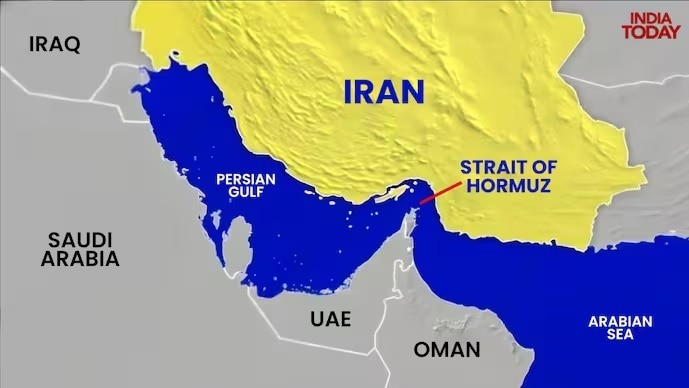
The Strait of Hormuz is once again at the centre of global attention as conflict in West Asia has pushed oil prices sharply higher and raised fears of supply disruption.
In economic and oil market discussions, West Asia usually refers to major energy-producing nations such as Saudi Arabia, Iran, Iraq, the UAE, Kuwait and Qatar, especially because of their role in global oil and gas exports and the importance of the Strait of Hormuz.
Oil markets reacted strongly on Monday after Iran launched retaliatory strikes across the region following military action by the United States and Israel. Reports of the death of Iranian Supreme Leader Ayatollah Ali Khamenei added to the volatility. Attacks on at least three vessels near the Strait of Hormuz further unsettled markets and disrupted tanker traffic through the narrow waterway.
Brent crude briefly rose above $82 per barrel, its highest level since January 2025, while US West Texas Intermediate climbed above $75 per barrel, the highest since June. Prices later slipped, with Brent falling below $79 and WTI below $72, as traders reassessed the actual risk to physical supply.
WHY THE STRAIT OF HORMUZ MATTERS
The Strait of Hormuz is a narrow waterway between Iran and Oman that connects the Gulf to the Arabian Sea. On a typical day, ships carrying oil equal to about one-fifth of global demand pass through it.
Nearly 20% of global oil and gas flows move through this route. For India, the exposure is even higher. More than 40% of India’s crude oil imports transit through the Strait.
Tankers carrying crude from Saudi Arabia, the UAE, Iraq, Iran and Kuwait use this route. It is also a key passage for diesel, jet fuel and petrol shipments to major Asian markets such as China and India.
More than 200 vessels, including oil and liquefied gas tankers, were reported to have dropped anchor outside the Strait. Three tankers were damaged and one seafarer was killed in attacks in Gulf waters. Iran has reportedly warned ships against passing through the Strait, leading several shipowners and traders to pause shipments as a precaution.
WHY OIL PRICES SPIKED
The sharp rise in prices reflects fears that supply through this critical chokepoint could be cut off.
Kaynat Chainwala of Kotak Securities said, “A sustained upside in prices would likely materialise only if oil flows through the Strait of Hormuz remain disrupted for an extended period, potentially 4–5 weeks.” She added that if traffic improves, the spike may prove temporary, but if it does not, “the supply shock could be significantly more pronounced.”
Oil prices had already risen strongly this year. Before Monday’s surge, Brent was up over 19% this year, while WTI had gained around 17%.
Although OPEC+ has agreed to raise output by 206,000 barrels per day from April, analysts say extra supply cannot fully offset the impact of a closure or serious restriction at a chokepoint that handles one-fifth of global energy trade.
RBC Capital analyst Helima Croft told Reuters that almost all OPEC+ producers are already producing at capacity, except Saudi Arabia.
GLOBAL ECONOMIC IMPACT
The conflict is also affecting growth outlooks in the region.
JPMorgan cut its outlook for non-oil growth across Gulf economies by 0.3 percentage points, with Bahrain and the UAE seeing the biggest reductions. The bank warned that risks are elevated and depend on how the conflict develops.
JPMorgan also changed its interest rate expectations. It no longer expects Turkey’s central bank to cut rates at its March meeting and revised its end-2026 policy rate forecast to 31% from 30%. Inflation in Turkey is now seen at 25% rather than 24% by that time. The bank also said it is unlikely that the Bank of Israel will cut rates in March given the direct involvement in the conflict.
Priyanka Sachdeva, senior analyst at Phillip Nova, told Reuters, “Markets are acknowledging the seriousness of the conflict, but are also signalling that, for now, this is a geopolitical shock, not a systemic crisis.”
The International Energy Agency has said it is in touch with major producers. Globally, visible oil inventories stand at 7.827 million barrels, enough for about 74 days of demand, which is close to historical averages, according to Goldman Sachs.
Citi analysts expect Brent to trade between $80 and $90 per barrel this week. They said their baseline view is that the conflict could ease within one to two weeks, which may limit further price spikes.
IMPACT ON INDIA
For India, the risks are clear and direct.
JM Financial Institutional Securities said, “Every USD 1 increase in crude raises India’s annual import bill by approximately USD 2bn.”
The brokerage added that prolonged tensions may raise logistics and marine insurance costs, disrupt Gulf shipping routes and put pressure on the trade balance.
It warned that the Indian rupee may face near-term pressure, with possible intervention by the Reserve Bank of India using foreign exchange reserves.
JM Financial explained the chain reaction. Higher crude prices increase inflation risk. Higher inflation pushes bond yields up. Rising yields then reduce equity valuations.
If the Strait of Hormuz remains open and traffic normalises, the price spike could remain short-lived. But if disruption continues for several weeks, the impact could be deeper, affecting fuel prices, inflation, currency stability and growth not only in India but across major importing nations.
For now, the Strait of Hormuz remains the key point of concern in global energy markets. Its stability is closely linked to oil prices, trade flows and economic confidence across the world.


