
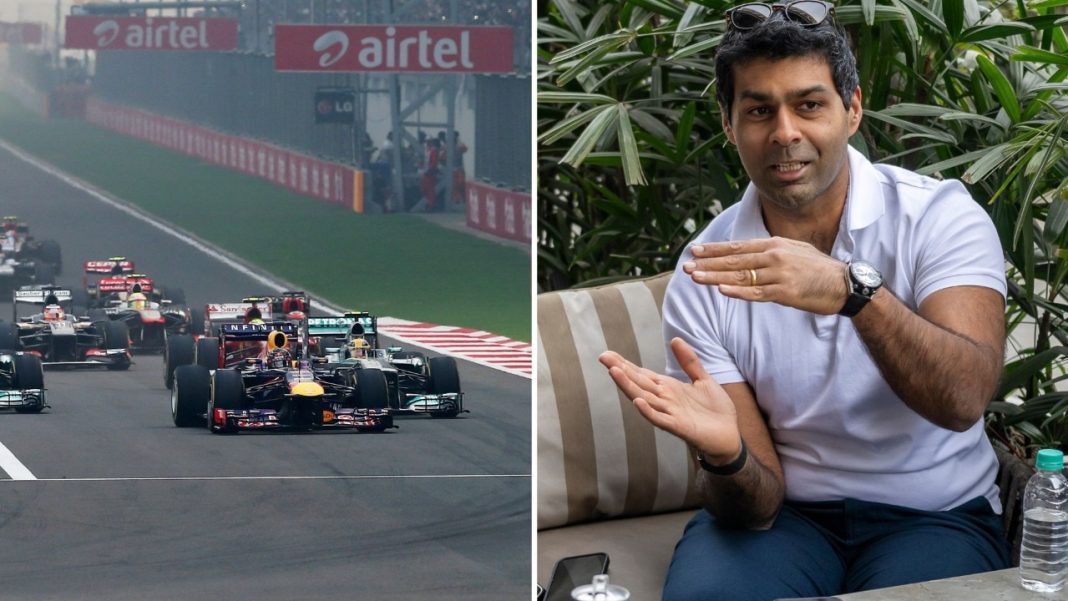
It lasted just three years. Three fleeting seasons of roaring engines, tyre smoke curling into Noida, and the intoxicating smell of fuel on a Sunday afternoon. Between 2011 and 2013, the Buddh International Circuit made India part of the most prestigious motorsport championship on the planet. Then, as quickly as it had arrived, Formula 1 was gone.
This weekend, Delhi NCR gets a small but evocative taste of what it once had. Sebastian Vettel’s 2012 RB8 – the very car that won the Indian Grand Prix that year – will fire up its naturally aspirated 2.4-litre V8 engine on Indian soil for the first time in 14 years. It will be driven by Arvid Lindblad, one of Formula 1’s most exciting young prospects, at the Red Bull Moto Jam on 1st March at the India Expo Centre in Greater Noida. For anyone in the stands, it will be less a motorsport demonstration and more an act of memory.
More than a decade after the Grand Prix disappeared, there are murmurs that Formula 1 could return for good. The Ministry of Youth Affairs and Sports is reportedly working to remove the tax and bureaucratic barriers that once derailed the Indian Grand Prix, as India Today reported earlier in February. For anyone who remembers the electricity of those early races, it is a thought worth indulging.
But Karun Chandhok – one of only two Indians to have raced in Formula 1 – urges caution alongside optimism. Speaking in a group media interaction, Chandhok was measured but clear. “I would love to see it happen,” he said. “But there are steps.”
HOW IT ALL FELL APART
The story of why the Indian Grand Prix disappeared is less about motorsport and more about money and policy. At the heart of the collapse was a classification dispute. The state government of Uttar Pradesh, along with central authorities, chose to treat Formula 1 as entertainment rather than sport. The consequences were devastating. Steep entertainment and luxury taxes were levied on the event. Financial incentives that major sporting occasions typically receive were stripped away. The promoter, Jaypee Sports International, had invested upwards of USD 400 million to build the circuit. They were left with mounting losses and no way out.
Import duties on racing equipment piled further costs onto teams and organisers. By 2013, it was over. The race was dropped, and the Buddh International Circuit fell quiet.
Vettel, who won all three editions for Red Bull, might remain the face of those years. But the more enduring legacy was a lesson in how not to host a world-class event.
REMEMBERING THE GOLDEN ERA OF MOTORSPORT IN INDIA
Chandhok speaks about that era with undisguised pride. The way you speak about something you knew was rare even while it was happening.
“We definitely had a purple patch between 2009 and 2012,” he recalls. “Narain and I were both in F1. Force India was on the grid. And we had the Indian Grand Prix.” He remembers 2011 vividly – when the sport commanded seven pages of newspaper coverage in a country that barely looked up from cricket. “In a cricket-obsessed country, that felt surreal. I remember thinking, how is this happening in India?”
Around 95,000 fans attended on race day in 2011. Numbers dipped in later years, settling around 65,000. Chandhok is keen to reframe that figure. “When you build a 120,000-seat facility and 60,000 show up, it looks half-empty. But 60,000 people at a sporting event in India is a strong number. Look at Bahrain or Qatar – they build grandstands for 30 to 40,000 and call it a sellout every year.”
The problem was never the fans. The problem was the framework that surrounded the whole spectacle.
WHAT DO WE NEED FOR F1 TO RETURN TO INDIA?
Chandhok sits on the board at Silverstone and helps run the British Grand Prix. He has thought carefully about what makes a race viable in the modern era.
“Money is only one factor,” he says. “Many cities are willing to pay hosting fees. You have to offer strategic value – market potential, fan engagement, government support, commercial viability, stability.” India, he argues, has those qualities. The fan base has grown since 2013. At the Singapore Grand Prix last year alone, the local promoter counted 14,000 Indian spectators. “I’m sure Bahrain, Qatar, and Abu Dhabi see similar numbers,” he adds.
The legislative piece remains non-negotiable. “Even if it’s privately funded, you need government cooperation on customs, visas, and taxation,” he says. The tax classification that killed the race the first time cannot be allowed to resurface.
Then there is the calendar. Formula 1’s schedule is ferociously competitive. “Personally, I don’t see an opening before 2029 or 2030,” Chandhok says. “The demand is huge. The calendar is full.”
Any return must also come with a long-term commitment. “We had F1 for three years. Formula E came once. MotoGP came once,” he notes. “What we need is a five-to-ten-year commitment to establish it properly.”
THE BIG PICTURE
Bringing Formula 1 back to India would be a spectacle. But Chandhok is careful not to overstate what it would achieve for the sport’s roots in the country. “Hosting a race and producing drivers are two different things,” he says. The three years of the Indian Grand Prix did not produce a boom in grassroots motorsport. “There’s an inspirational factor, of course. But motorsport is capital-intensive. It’s not buying a bat and ball.”
For India to put another driver on the grid, structured investment in young talent is needed. A proper pyramid, merit-based and sustained over years. The race, if it returns, can provide visibility. But visibility alone does not build careers.
Corporate support is also part of the equation. “It becomes a loop,” Chandhok says. “Cricket gets eyeballs. Because it gets eyeballs, money flows in. That brings more visibility, which attracts more sponsors.” Breaking that cycle requires more than a race on a calendar. It requires commitment from government, corporates, and the sport itself.
Chandhok believes the demand is there. The fan base is bigger than it was in 2013, the market is impossible to ignore, and the Buddh International Circuit still stands – a world-class facility sitting idle, waiting. But India has been here before. It had the race, it had the crowds, and it still lost it all to paperwork and short-termism. The opportunity, if it comes again, will not be won on enthusiasm alone. It will be won – or lost – in the fine print.


