
How close are we to manufacturing in space, and what possible advantages could that have?
Let’s take those questions one at a time.
One Subscription.
Get 360° coverage—from daily headlines
to 100 year archives.

E-Paper

Full
Archives

Full Access to
HT App & Website

Games
Already subscribed? Login
For years, space, by which we mean the International Space Station (ISS) and other manned laboratories in Low Earth Orbit, has been largely a place of small-scale experiments (on animals ranging from mice and fish to bacteria), and attempts at off- world agriculture and air and water recycling, much of it focused on eventual inter-planetary travel.
But as the ISS era draws to a close(check out the Wknd special on how this global effort is being decommissioned), and as private companies head to LEO, with plans for laboratories, hotels and other entertainment and research spaces, a new need is emerging: that of on-site manufacture.
There will be no way to keep prices down, or indeed keep the orbiting labs and hotels feasible, if every bolt and screw has to be jetted there from Earth. This is part of the reason efforts at in-space manufacturing (ISM) have intensified.
Another key reason: micro-gravity is turning out to have spectacular advantages in fields ranging from new materials to the making of artificial organs.
First, a quick recap. About 400 km from the surface, Earth’s pull is about 90% as strong as it is on the ground. This means anything hovering there is being drawn down, and in constant freefall. This state of being in permanent freefall (with boosters of course keeping each space station from actually plummeting) effectively erases gravity’s familiar effects, and people, objects and substances start to float.
Water no longer falls; dust does not settle; material remains suspended as it is worked upon.
This has helped researchers from the European Space Agency create “impossible” alloys on ISS. One of these consists of aluminium fused with lead. On Earth, the two materials are as incompatible as oil and water, with the heavier lead sinking to the bottom. In space, superheated and then cooled, they mix evenly while solidifying. This new material is being called Al-Pb and its self-lubricating, anti-friction tendencies are expected to enhance the efficiency of future jet engines.
In just one more example, companies such as Redwire have been bioprinting artificial tissue, including for organs such as the heart, on ISS, since 2019. In micro-gravity, the 3D printed tissue retains its shape. It can then be flown back for use on Earth (currently all prototypes are still in the testing phase).
Advanced semiconductors, manufactured stem cells and complex crystals for better drug delivery are similarly being experimented upon in micro-gravity’s more-stable environments.
A LARGER VISION
So far, 3D-printing has led most efforts, starting with the ratchet wrench in 2014. The technology has made tools on board ISS to help with some of the constant maintenance that has kept that vessel aloft.
Now, this is changing. Literal building blocs are taking shape off-planet.
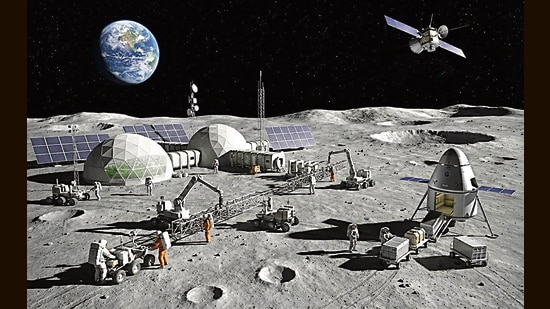
Researchers, including from US’s National Aeronautics and Space Administration (NASA) and the Indian Space Research Organisation (ISRO), have been working to use simulated lunar regolith or moon dust to make “space bricks” and “bio cement” that would combine bacteria and urea from human urine to produce calcium carbonate.
These could potentially be used to build habitation and other infrastructure on the moon.
Companies are also working on lunar and asteroid mining to make rocket fuel from potential energy sources like the ice on the moon, says Philip Metzger, a planetary scientist and director of the Stephen W Hawking Center for Microgravity Research and Education at the University of Central Florida. Lunar soil can be used to make metals for building large structures, such as data centres and solar panels.
“Since rare earth mining devastates forests, most visibly seen in open pit mining in Africa, we may now be able to turn to asteroids, potentially rich in lithium and rare earth minerals,” says Aloke Kumar, associate professor of Mechanical Engineering at the Indian Institute of Science (IISc), Bengaluru.
Helium is another resource that could be brought back from the moon, a gas crucial for medical diagnostics and radiation detection. It could be vital for cryogenically cooling quantum computers in the future, whose systems generate significant heat.
“I think ISM will be important for Earth’s environment,” says Metzger. “In an age of resource-intensive artificial intelligence data centres, for instance, companies like Blue Origin and even Google have proposed placing facilities in orbit instead.”
SpaceX also plans to build factories on the Moon to build data centres using lunar resources. Experts such as Metzger estimate that this could, however, take over 20 years.
Meanwhile, a few obvious questions emerge. Such as, how many engineers does it take to assemble a data centre in space? The problem boils down to cost. Shipping, staffing, maintenance, and sheer distance of operation.
“The biggest deterrent to in-space manufacturing remains, simply, money,” Metzger says.
However, there are exceptions, such as finding water ice on the Moon, which may produce a large payback much sooner. It’s why agencies such as ISRO, NASA and the Japan Aerospace Exploration Agency play a key role as they collaborate on the Chandrayaan-5 mission.
The environmental impact, meanwhile, remains a significant unknown.
Moving manufacturing into space could mean building supply chains that incorporate transportation by very large cargo-carrying launchers, which generate pollutants and emit greenhouse gases. Operating in near-Earth orbits would lead to increased congestion and potentially create more debris.
“The carbon footprint of a launch right now is hundreds of tonnes of CO2 not to forget the other kind of emissions that get deposited in vulnerable layers of the atmosphere,” says Varun Bhalerao, an astrophysics professor at IIT-Bombay.
There is also the additional problem of resource usage, compelling the European Space Agency to reexamine space missions.
When we launch and dispose hardware without reusing, we waste equipment, fuel and raw materials. “Manufacturing emissions must be monitored and mitigated, and further research is needed to understand the impact of launches and re-entries on the atmosphere and oceans,” says Tiago Soares, head of ESA’s Clean Space and Circular Economy Office.
One approach is ESA’s Life Cycle Assessment methodology, an environmental audit for missions that evaluates trade-offs at every stage, from mining raw materials to monitoring space pollution, including the release of toxic gases during satellite re-entry.
“As we enter an era of industrialisation and mass production in the sector, it is urgent that policy and regulation anticipate the change rather than reacting to it,” Soares says.


