
Revathi B, an engineering student in Bengaluru, hopes to turn 19 this April — if she lives to see it.

Diagnosed with the most severe form of Gaucher disease, a rare genetic disorder that often claims lives in early childhood, every year she has survived has felt miraculous — and punishing.
Since she was five, Revathi has depended on enzyme replacement therapy. Her condition prevents her body from breaking down certain lipids, leading to the dangerous buildup of fatty substances in vital organs, including the brain.
The imported injection she requires — Cerezyme — must be taken every fortnight and costs nearly Rs 40 lakh a year.
For almost 14 years, her family managed through donations and government aid from both the state and the Centre. But for the past year, the life-saving treatment has stopped.
“I am pulling through every day – it’s becoming more and more challenging as all my organs are getting damaged, and I don’t feel okay – I am fatigued, foggy, have extreme pain in all my joints and bone every second of the day and every bruise can become a medical emergency,” she told India Today.
In 2021, under the National Policy for Rare Diseases (NPRD), the Union government announced a one-time assistance of Rs 20 lakh for certain categories of rare disease patients, including those with Gaucher disease.
A year later, this ceiling was raised to Rs50 lakh. Before the national rollout, Karnataka — the only state to do so — had been supporting some rare disease patients facing prohibitive treatment costs as the therapies are mostly imported and patented.
Yet the national policy has created fresh friction. The Rs 50 lakh cap rarely covers lifelong therapies, and states that once extended support now argue that responsibility lies with the Centre.
The result: tens of families have turned to the courts, pleading for a framework that meaningfully addresses their needs.
A rare disease — sometimes called an orphan disease — affects fewer than one in 1,000 people, according to World Health Organization (WHO) estimates. But collectively, rare diseases impact an estimated 6–8 percent of any country’s population at a given time.
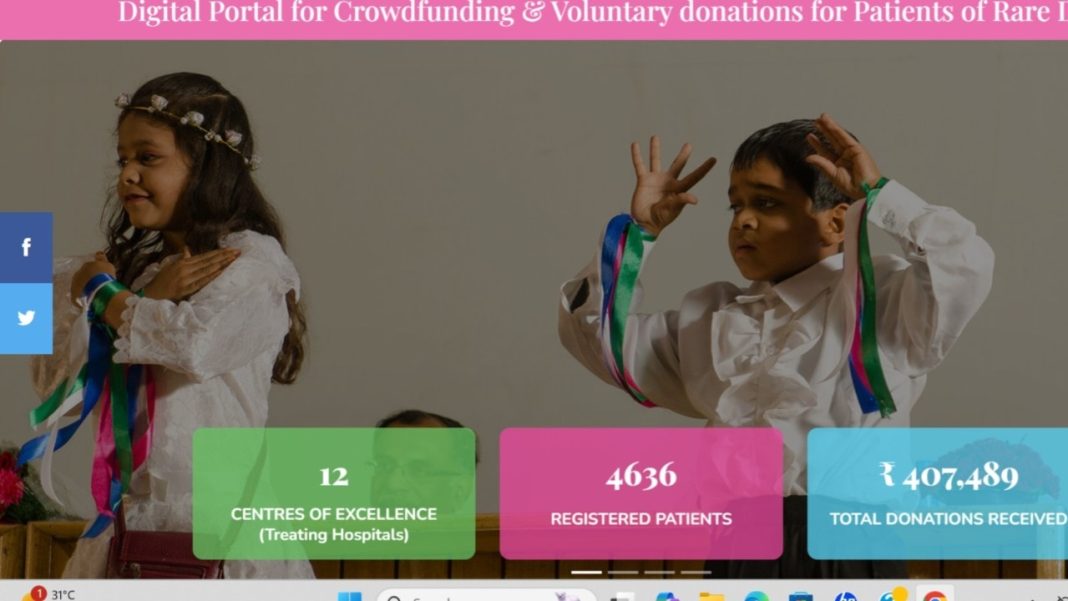
In India, that translates to more than eight crore people. Yet only around 15,000 patients are registered on the Union Health Ministry’s crowdfunding portal.
Commonly reported conditions include primary immunodeficiency disorders; lysosomal storage disorders such as Gaucher disease, mucopolysaccharidoses, Pompe disease and Fabry disease; small molecule inborn errors of metabolism such as Maple Syrup Urine Disease and organic acidemias; cystic fibrosis; osteogenesis imperfecta; certain muscular dystrophies; and spinal muscular atrophy.
TOO LITTLE: TOO MUCH RED TAPE
Under the NPRD, rare diseases are categorised into three groups. Group 1 includes disorders amenable to one-time curative treatment.
Group 2 covers conditions requiring long-term or lifelong therapy at relatively lower costs, with documented benefits and regular monitoring.
Group 3 comprises diseases where definitive treatments exist but are extremely expensive, require lifelong administration, and demand careful patient selection.
In Parliament this month, the government stated that approximately Rs 264 crore had been allocated to Centres of Excellence (CoEs) between 2021–22 and March 2025. Around Rs 618.4 crore has been budgeted for 2025–26.
With the treatment ceiling capped at Rs 50 lakh per patient, even if each beneficiary received the maximum amount, only about 650 patients may have been covered so far — a fraction of the 15,000 seeking support through crowdfunding, and negligible compared to the estimated burden nationwide.
Funds are routed through 15 COES— tertiary hospitals specialising in rare diseases across the country.
Prasanna Shirol of the Rare Disease Organisation of India (ORDI) says CoEs are disbursing funds, but typically prioritise younger children or patients who require comparatively less expensive drugs.
“Also while Centres says its state’s responsibility to fund treatment beyond Rs 50 lakh limit- states are now passing the buck saying treatment should be provided under the NPRD.” he said.
Dr Shefali Gulati, a paediatric neurologist at AIIMS, New Delhi, says the issue often becomes an ethical dilemma — whether to initiate a treatment that may cost Rs 4–5 crore annually.
“It’s mostly the case in the case of diseases in group 3,” she said.
Also, a confirmed diagnosis from designated tertiary government hospitals is mandatory, and the condition must appear on the limited approved list of just 52 diseases.
“Upfront costs for diagnostic tests burden families financially, while prolonged approval processes—often spanning months—exacerbate patient suffering in the interim,” Dr Gulati said.
Lack of awareness, problems in providing sustained assistance and cumbersome administrative processes as other barriers, she added.
PUSH FOR DESI SOLUTIONS— BUT SLOW PROGRESS
As part of the NPRD, the government began collaborating with public agencies and pharmaceutical companies in 2022 to develop indigenous drugs for 13 priority rare diseases, along with sickle cell anaemia.
In 2023, four Made-in-India drugs for some of these priority conditions were launched, significantly lowering costs for certain patients.
One such breakthrough was for Tyrosinemia Type 1, a disorder marked by jaundice, liver failure and a high risk of liver cancer. Untreated children often do not survive beyond the age of 10. The imported drug, Nitisinone, costs between Rs 2.2 crore and Rs 6.5 crore annually, depending on body weight.
Generic versions introduced by Laurus Labs and Zenara Pharma have reduced the annual cost to about Rs 2.5 lakh.
In another landmark development, the Delhi High Court allowed Hyderabad-based Natco Pharma to manufacture a generic version of Risdiplam, used to treat spinal muscular atrophy (SMA), a neuromuscular disorder caused by deficiency of a key protein, leading to progressive muscle weakness and wasting.
Following the October ruling, Natco began selling the generic under the brand name Natsmart at Rs 15,900 per bottle — nearly 97 percent cheaper than Roche’s imported Evrysdi, which had cost as much as 6.2 lakh per bottle in India.
“These developments have been crucial – but not sufficient considering the huge burden of the diseases in the country and the massive in care,” said Shirol.
Dr Ashraf Mannan, vice-president at Variant Science, Strand Life Science, says that despite the staggering potential burden of rare diseases in India, policy, research and clinical practice remain limited. The landscape continues to face deep challenges in awareness, diagnosis, financing and access to care, despite recent policy steps.
Public health specialist Dr Sabine Kapasi says meaningful change will come only when rare diseases are treated as a sustained public health priority — one that demands continuity, coordination and compassion.


