
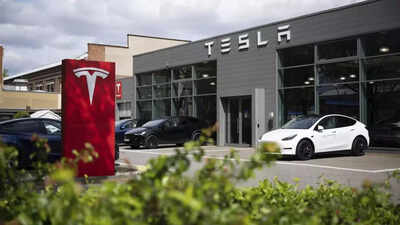
Tesla has filed a lawsuit against California’s Department of Motor Vehicles (DMV). In this lawsuit, the
Elon Musk-led electric vehicle maker is challenging a regulatory ruling that found the automaker engaged in false advertising regarding its self-driving technology. The legal dispute marks the latest escalation in tensions between Elon Musk’s company and state regulators over how its driver assistance systems have been marketed to consumers.
According to a CNBC report, the lawsuit follows a decision issued two months ago by California’s Office of Administrative Hearings, which found that Tesla violated the law by misleadingly promoting its vehicles’ automated driving capabilities.
The ruling allowed the DMV to temporarily suspend Tesla’s licenses to manufacture or sell vehicles in the state, although regulators ultimately stopped short of imposing that penalty.
Instead, the DMV directed Tesla to revise its marketing language. Earlier this month, the agency said the company had made the required changes, meaning no license suspension would be necessary. However, Tesla is seeking further action in court, arguing that the regulator’s findings continue to damage its reputation and business.
Why Tesla thinks California DMV’s claims about its Autopilot ads are wrong
In a complaint dated February 13, Tesla’s attorneys alleged that the DMV
labelled the company a over its earlier use of the terms and The automaker maintains that its branding accurately reflects the fact that its driver-assistance features still require human supervision.
Tesla now markets the system under the name
and offers it through a subscription model rather than the one-time purchase structure previously used.
Earlier versions of the technology were sold across Autopilot, Enhanced Autopilot, and Full Self-Driving tiers, with some customers granted
or early access to features that were still under development.
In filings submitted to California’s Office of Administrative Hearings, attorneys representing the state’s DMV argued that Tesla’s marketing of
and created the impression that the vehicles were capable of autonomous operation. Tesla’s legal team countered that regulators had not demonstrated that consumers were misled about whether the vehicles could safely operate without human supervision.
The company’s attorneys argued that when those brand names were used,
The outcome of the case carries broader implications for Tesla, which is increasingly positioning automated driving technology and future robotaxi services as central to its long-term strategy.
Tesla CEO Elon Musk has for years told investors and customers that the company’s vehicles would eventually receive over-the-air software updates enabling them to function as robotaxi-ready cars. While that transition has not yet occurred, Tesla’s driver assistance systems have continued to evolve.
Following a decline in electric vehicle sales last year, Tesla’s future growth is increasingly tied to its ability to develop driverless systems that can operate vehicles without constant human intervention behind the wheel.
Tesla is also working on its Robotaxi project and is testing its self-driving cars in Austin, Texas. Around the same time, the company announced that it had started the production of Cybercab at its Texas facility.
The Cybercab is a two-seater car without a steering wheel or pedals.
Tesla has previously showcased its driving capabilities, suggesting it could operate with minimal to no driver input. In 2018, Tesla’s CEO, Elon Musk, appeared on CBS’s 60 Minutes program with Lesley Stahl. During the program, Musk demonstrated his Model 3 car with Autopilot engaged while Stahl was seated in the passenger seat. Musk removed his hands from the steering wheel and told Stahl that he was not doing anything, but the car continued to move.
However, Tesla’s owner manuals state that drivers must remain attentive and should not use Full Self-Driving (Supervised) features without monitoring the road.
In a separate class-action lawsuit progressing through California courts, customers who purchased Full Self-Driving packages expecting future upgrades enabling robotaxi functionality are seeking refunds.
Tesla has also been found partly liable in a fatal crash involving Autopilot. Testimony during the trial indicated that the driver had dropped his phone and attempted to retrieve it, believing the vehicle’s Enhanced Autopilot system would brake if an obstacle were to appear ahead. The case resulted in a $243 million verdict against Tesla, awarded to the family of the deceased victim and an injured survivor of the crash.


