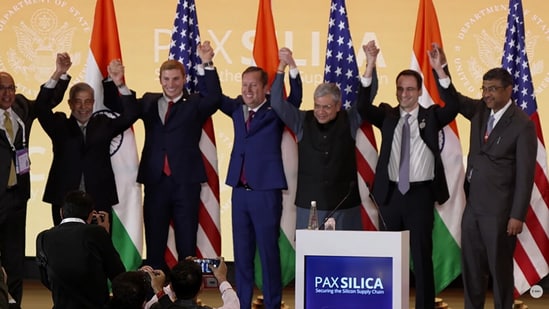
If the 20th century was defined by oil and steel, the 21st is forged in silicon. On Friday, India formally joined the Pax Silica—a US-led geopolitical and economic alliance designed to secure the global supply chain for AI, semiconductors, and critical minerals — sectors where China enjoys a near monopoly.
Brokered by the US State Department, the alliance is an initiative to decouple from China. For India, joining the Pax Silica represents a strategic pivot—a chance to lock in billions in tech investments and cement its role as the primary alternative to China.
The architecture of Pax Silica
Launched in December 2025, Pax Silica is a nod to Pax Americana—a G7 of sorts for the AI age. The foundational premise is that today, economic security is now inseparable from compute power. Unlike previous, narrower chip pacts, Pax Silica takes an end-to-end approach. It coordinates policy across the entire technology stack—from the mining and refining of rare earth elements to fabrication of chips and their use in AI foundation models and data centres.
The grouping includes Australia, Israel, Japan, the Netherlands, Singapore, South Korea, the United States and the United Kingdom, with Taiwan observing. Recent additions like the UAE and Qatar bring cheap energy to the table. And India, the demographic dividend of being the world’s populous country. And of course data generated by 1.45 billion citizens.

The China Problem
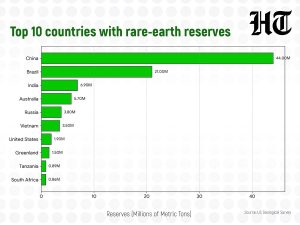
While the bloc’s official language emphasises positive-sum partnerships, the subtext is entirely focused on China. Beijing currently controls more than 60% of global rare earth processing and dominates legacy chip manufacturing.
Pax Silica embodies Washington’s “moving gap” doctrine to maintain a permanent technological lead over China in AI and semiconductors.
By coordinating export controls, subsidy, and capital flows among allied nations, Pax Silica attempts to weaponise interdependence. It effectively draws a “silicon curtain” across the global economy, restricting China’s access to the critical tools required to train AI models while subsidising capacity building in allied states.
India’s entry into Pax Silica
India’s formal inclusion this week—coinciding with the India AI Impact Summit in New Delhi—comes after two months of being left out in the cold.
When Pax Silica was unveiled in late 2025, India was notably absent. While India boasts a massive engineering talent pool and a rapidly growing AI market, it lacks the fab chops of a Taiwan or a South Korea.
But, things change.
The India-US trade deal—an initial framework for which was signed earlier this month—has resulted in a thaw in relations.
For Pax Silica to succeed it needs India’s raw potential, domestic market size, and growing mineral ambitions—as proposed in Union Budget 2026. US Ambassador to India Sergio Gor’s accelerated invitation to New Delhi underscores a pragmatic realisation: India is indispensable to any viable “China Plus One” strategy.
Free Market Friction
To be sure, the membership won’t be without friction.
Entering Pax Silica opens the door for India Inc.—like Tata Group, which is rapidly expanding its semiconductor footprint—to deepen joint ventures with global chip giants like Micron and Applied Materials. It also provides New Delhi with a seat at the table in shaping global digital governance.
Yet, India’s domestic industrial policy could clash with the bloc’s ethos. New Delhi relies heavily on protectionist measures, massive domestic subsidy, and import regulations to shield its nascent tech sector. Integrating these policies with Pax Silica’s free-market orientation and coordinated anti-dumping measures will require delicate diplomatic footwork.
Ultimately, India’s accession to Pax Silica is a watershed moment. It signals that New Delhi is willing to trade a degree of strategic ambiguity for a permanent seat in the elite coalition defining the future of global technology. In the high-stakes contest for AI supremacy, the battle lines are now clearly drawn.