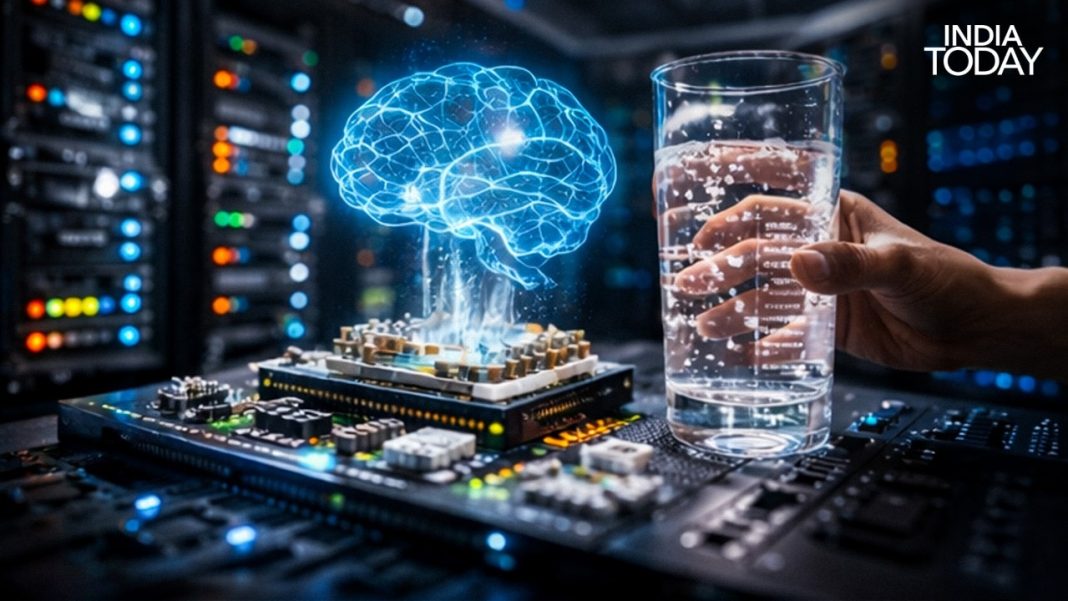
Google data centre’s 6-billion-gallon thirst, and why recycled water won’t work

If you have ever wondered why your digital life feels so seamless, the answer lies in massive warehouses filled with humming servers. AI is very thirsty, and in a single year, Google data centres consumed a staggering 6.1 billion gallons of fresh water, according to the Google 2024 Environmental Report.

In the report, the tech giant admitted to the scale of this resource drain. “In 2023, our data centers consumed 6.1 billion gallons of water—17% more water than the previous year, mirroring similar growth in electricity use,” the report said.

This is not just a drop in the ocean; it is enough water to irrigate approximately 41 golf courses annually in the southwestern United States.

As we transition into an era dominated by AI search, it is getting increasingly difficult to quench these machines’ thirst. Behind every prompt is a physical cost that is quickly becoming impossible to ignore.

HOW DOES AI COOLING WORK?

Computers generate intense heat. When you ask an AI to write a poem or generate an image, thousands of processors work simultaneously, creating immense thermal energy.

To prevent these multi-million-pound machines from melting, data centres use cooling towers. These systems work through evaporative cooling, where water is pumped over hot surfaces to absorb heat.
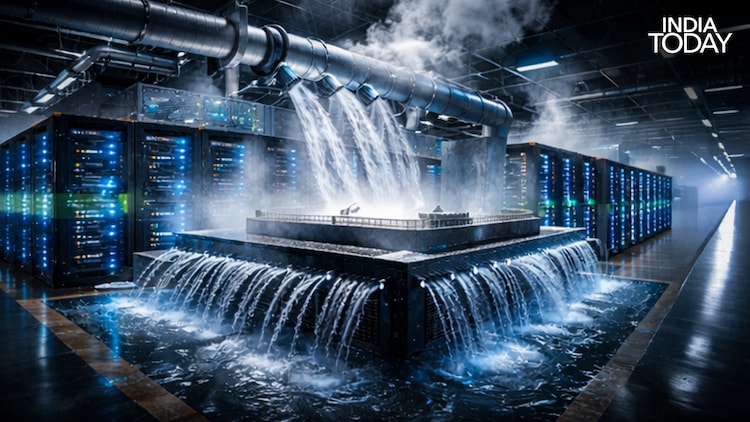
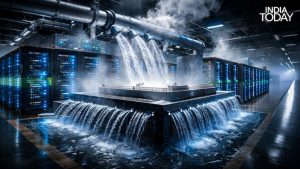
Data centres are consuming billions of gallons of fresh water to keep AI servers cool. (Photo: Generative AI/India Today/Radifah Kabir)

Cooling towers at a tech facility releasing steam into the atmosphere during the evaporation process. (Photo: Generative AI/India Today/Radifah Kabir)

The catch is that roughly 80 per cent of this water literally vanishes into the atmosphere as steam.

Because you cannot recycle steam, it is effectively lost from the local water cycle. This is why a facility can pull in millions of gallons daily but return almost none of it to the local pipes.

WHY IS FRESH WATER NECESSARY FOR DATA CENTRES?

One might wonder why tech giants do not simply use recycled or grey water. The answer is rooted in basic chemistry.

Water naturally contains minerals like calcium and magnesium. Every cycle through a cooling loop causes evaporation, which makes these minerals more concentrated.

Eventually, they form a hard crust called limescale. This scale is incredibly destructive, acting like a thick blanket that traps heat, clogging pumps and eating through expensive heat exchangers.
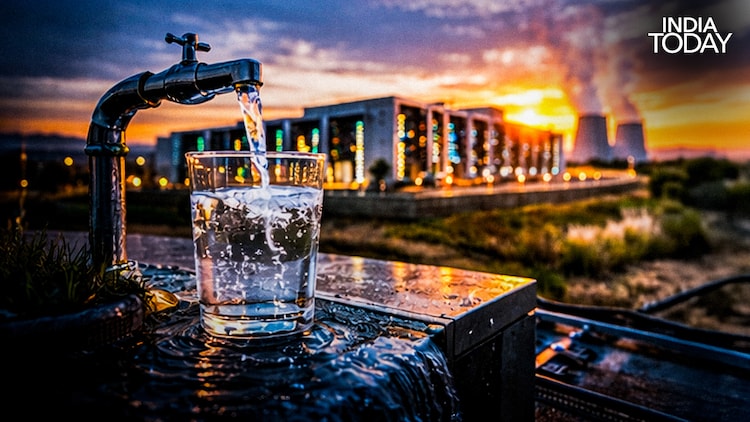
Minerals in recycled water may damage heat exchangers in AI data centres. (Photo: Generative AI/Radifah Kabir/India Today)

Minerals in recycled water may damage heat exchangers in AI data centres. (Photo: Generative AI/Radifah Kabir/India Today)

Recycled water starts with a much higher mineral count, making it even more corrosive from the first second. To use it safely, companies would need to build massive on-site treatment plants.

Currently, less than one per cent of water in the United States is recycled, and most cities lack the infrastructure to deliver it to industrial sites. Consequently, it is cheaper for data centres to simply drink from the municipal tap.

WHAT IS THE ENVIRONMENTAL IMPACT OF AI GROWTH?

The trajectory of this consumption is a major concern for climate scientists. A report by Morgan Stanley suggests that water consumption by AI data centres could increase 11 times by 2028.

Many of these facilities are being built in regions already struggling with water scarcity.

While companies often mention water stewardship projects to replenish what they take, these projects are rarely in the same local watershed where the water is consumed.
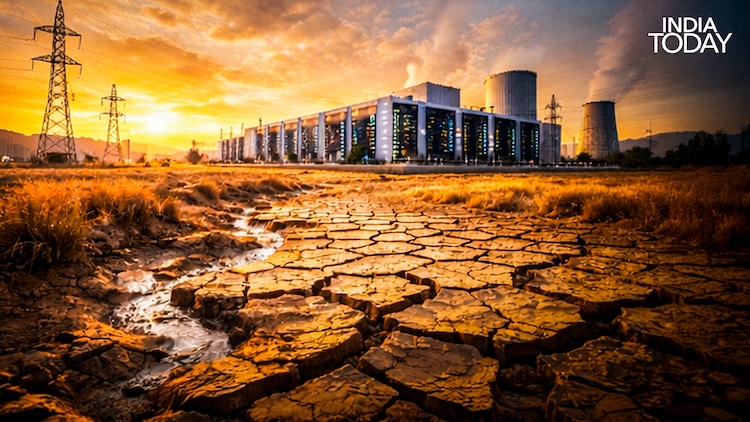
The rising demand of fresh water to keep AI servers cool poses a significant threat to local water supplies in drought-prone regions. (Photo: Generative AI/Radifah Kabir/India Today)

The rising demand for fresh water to keep AI servers cool poses a significant threat to local water supplies in drought-prone regions. (Photo: Generative AI/Radifah Kabir/India Today)

It is a system of global offsets that does little to help a small town which is sharing its water main with a facility that consumes as much water as 50,000 people.

As AI becomes more integrated into our lives, the pressure on our most precious natural resource will only intensify.

Latest

India to set up 7 space labs in universities to train next-gen rocket scientists

India is setting up seven space laboratories across universities and colleges to give students hands-on training in satellite systems, rocketry, and mission des

Delhi to sizzle at 45°C on Monday, Northeast braces for thundersqualls and hail

India braces for a sharply split weather day on Monday, April 27, with heatwave conditions roasting Delhi, Punjab, Haryana, Rajasthan, Bihar and Gujarat at 43 t

Himalayan snow hits 23-year low, water crisis looms for 2 billion lives

A new report has found that snow cover across the Hindu Kush Himalaya plunged 27.8 per cent below average this winter, the lowest in more than two decades.

Isro has now mapped every Indian village from space: Why it matters to you

Isro has completed high-resolution Land Use and Land Cover mapping for all of India at a 1:10000 scale, marking National Panchayati Raj Day 2026.

Olive Ridley turtles gathering at secret Sri Lankan location after leaving India

Satellite tracking shows Olive Ridley turtles moving from India's east coast to the Sri Lanka Dome. The journey underlines how conserving nesting beaches alone

Topics

Need money to study, need education to earn: The vicious loop trapping students

Many students need to borrow money money before they can access quality education, yet need education first to earn money. This creates a cycle of education loa

Which place is known as the Wildlife Capital of the world?

Nairobi is called the wildlife capital of the world for a reason. It is the only city where a national park sits right next to the skyline, blending wild animal

AI era hiring: Rs 50,000 stipend, flexible roles, and real work from day 1

Newton School of Technology's latest placement cycle expanded from 10 roles to 11 as companies assessed candidates in real time. The shift highlighted growing d

Is NPS Swasthya enough for medical emergencies? Here’s the reality

With rising healthcare costs, many are turning to NPS Swasthya as a safety net. But is it enough when a real emergency strikes? The answer may not be as reassur

Cursor AI Agent wipes out startup database in 9 seconds, founder shares 30-hour chaos timeline

A startup founder said Cursor AI Agent erased the company database in nine seconds. The account traced 30 hours of disruption after the incident.

Explained: Why stock markets are rising even as crude oil remains above $100

Benchmark indices rallied in early trade on Monday despite crude oil remaining elevated above $100. The move reflected bargain buying and global AI-led optimism

Reopen the Strait of Hormuz and end the war, Iran offers new proposal to US

Iran has reportedly offered a two-stage plan to US via intermediary Pakistan, which offers prolonged period of ceasefire extension or a permanent end to the war

Sun Pharma’s biggest-ever bet: Why markets cheered the Organon mega deal

Sun Pharma just made the biggest bet in Indian pharma history. Markets loved it instantly. Here’s why investors backed the Organon deal despite the massive pr
spot_img

Related Articles

Popular Categories

spot_imgspot_img