
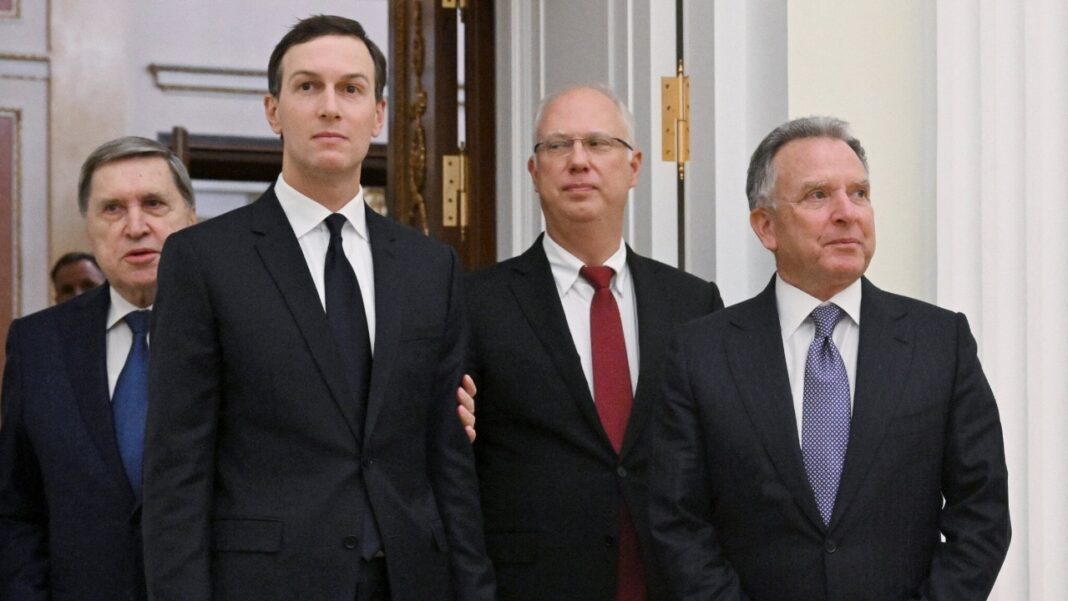
In a fresh diplomatic push that carries both urgency and risk, US President Donald Trump is dispatching his trusted envoy Steve Witkoff and son-in-law Jared Kushner to Pakistan for high-stakes talks with Iran, even as military tensions continue to simmer in the Gulf.
According to US officials, Witkoff and Kushner will travel to Islamabad this weekend to meet Iranian Foreign Minister Abbas Araghchi, in what could mark a crucial second round of ceasefire negotiations.
Confirming the development, White House press secretary Karoline Leavitt said in an interview with Fox News that the talks are aimed at pushing forward a possible deal.
“We’re hopeful that it will be a productive conversation and hopefully move the ball forward to a deal,” Leavitt said.
She added that Vice President JD Vance will not travel but will remain closely involved in the process. “He will be in the US on standby to fly to Pakistan if necessary,” she said, noting that Secretary of State Marco Rubio and the national security team are also engaged.
Leavitt also indicated tentative progress. “We’ve certainly seen some progress from the Iranian side in the last couple of days,” she said, without providing further details.
However, there is no confirmation from Tehran over a possible second round of talks in Islamabad. Iran has made the removal of the naval blockade in the Strait of Hormuz a key precondition to restarting negotiations with Washington.
Pakistan has quietly positioned itself as a mediator, attempting to bring Washington and Tehran back to the table after talks stalled on April 21 over the blockade.
The renewed diplomatic effort comes days after Trump agreed to extend a ceasefire with Iran indefinitely, following Islamabad’s request for more time.
Iran has also signalled a shift in emphasis. Foreign ministry spokesperson Esmaeil Baghaei said the focus of talks should move beyond nuclear issues.
“The main issue is ending the war in a way that secures our interests and demands,” he said, linking further negotiations to the lifting of what Iran calls an “act of aggression” — the blockade.
With both sides holding firm on key demands, the path to a breakthrough remains uncertain. Even as diplomatic channels reopen, the coming days could prove decisive in determining whether talks ease tensions or push the conflict toward a more volatile phase.


