
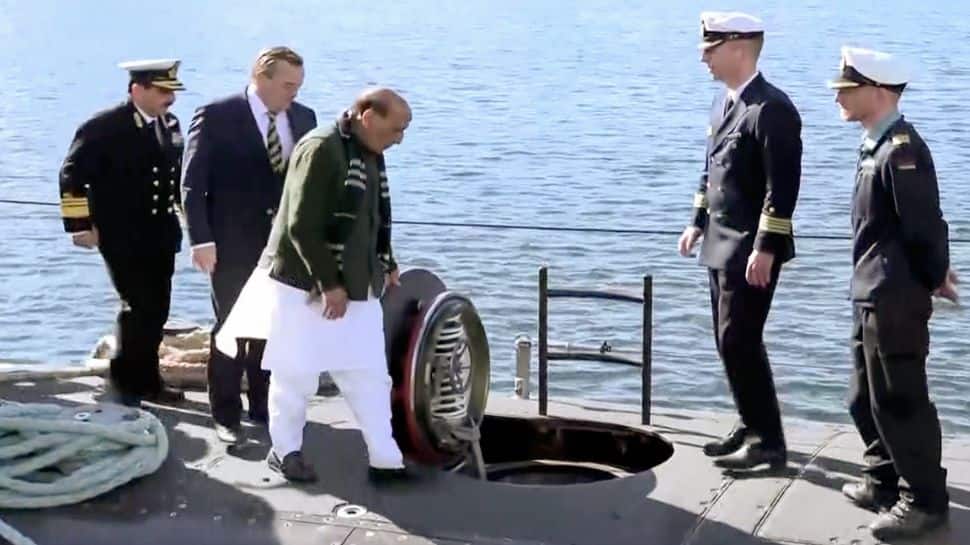
New Delhi: India’s top defence leadership is presently spread across major international defence hubs, checking military systems in real environments. Air Chief Marshal AP Singh is in the United States, Chief of Defence Staff General Anil Chauhan is in the United Kingdom and Defence Minister Rajnath Singh is in Germany, where talks are mainly on defence production and strategic cooperation.
These visits show that India will not buy any weapon system or fighter jet based only on presentations or claims. Each system will be tested and checked against the country’s requirements before any deal is finalised.
Fighter jet testing in the United States
Air Chief Marshal Singh recently visited the Nellis Air Force Base in Nevada and flew the Boeing F-15EX Eagle II fighter jet.
This visit is important because the Indian Air Force (IAF) is looking to replace its ageing MiG and Jaguar fleets and is planning to acquire around 114 Multi-Role Fighter Aircraft (MRFA).
The United States is pitching the F-15EX for this deal, while France’s Rafale is a strong competitor. The aircraft is built to carry a heavy payload of 13,381 kilograms, making it a powerful strike platform.
India is also in talks to acquire 31 MQ-9B SkyGuardian drones from Washington. Talks have also covered data sharing and surveillance systems.
In parallel, the United States has said that future negotiations could include the F-35 fifth-generation stealth fighter. This opens a long-term possibility for India.
India’s position, however, is clear. It is not only looking for aircraft but also for local manufacturing and technology transfer. The air chief’s test flight was aimed at assessing real combat capability before any decision.
Cyber, engine tech and joint production in UK
CDS Chauhan is in the United Kingdom, where he is meeting senior defence officials and visiting the Royal College of Defence Studies.
This is the first time a CDS from India has made such a visit to the United Kingdom.
Talks there covered advanced defence technology, including jet engines and naval propulsion systems. Companies such as Rolls-Royce are offering expertise in engine systems and electric propulsion, which are important for India’s future aircraft carriers and fighter projects.
Cyber warfare, artificial intelligence and space-based defence systems are also part of the negotiation as future wars are expected to depend heavily on technology.
India is also pushing for co-production models, where defence equipment is manufactured jointly rather than being imported fully built.
Submarine deal in Germany
Defence Minister Rajnath Singh is on an official visit to Germany from April 21 to 23, 2026. This is the first visit by an Indian defence minister to Germany in seven years.
A major part of the visit is Project 75I, under which India plans to acquire six advanced diesel-electric attack submarines. The deal is estimated to be worth around Rs 90,000 crore.
These submarines are expected to feature air-independent propulsion systems, allowing them to stay underwater for longer durations without surfacing for oxygen.
Germany’s ThyssenKrupp Marine Systems is working with India’s Mazagon Dock Shipbuilders Limited on this project.
India has made it clear that the submarines must be built in India with at least 45-60% indigenous components, under ‘Make in India’ initiative.
Why India is changing its defence approach
India’s military planning is driven by the need to prepare for two active fronts, one along the northern border and another in the western region.
The Air Force is operating with fewer fighter squadrons than required, while older aircraft like the MiG-21 are being phased out. This has increased the urgency for modern fighter jets.
At sea, the growing presence of Chinese submarines in the Indian Ocean has pushed India to strengthen its underwater capabilities with advanced stealth submarines and surveillance systems.
There is also a growing need for modern assault rifles, light tanks suitable for mountain warfare, swarm drone systems and precision-guided missiles.
India’s present defence push shows a change in approach. Weapons are no longer being chosen on paper alone. They are being tested, evaluated and matched with real operational needs before any final decision is made.
The outcome of these international defence visits could influence India’s military capability for decades ahead.


