
These days, artificial intelligence is a buzzword in the tech world. Everybody is talking about how the technology, which works by predicting the next word in its response using training data, can transform this world. But imagine—what if our actual brain, the way we act, respond, and all the things that define who we are, could be uploaded onto a chip?
That question, once confined to science fiction, is now being explored through advances in AI-simulated brains.
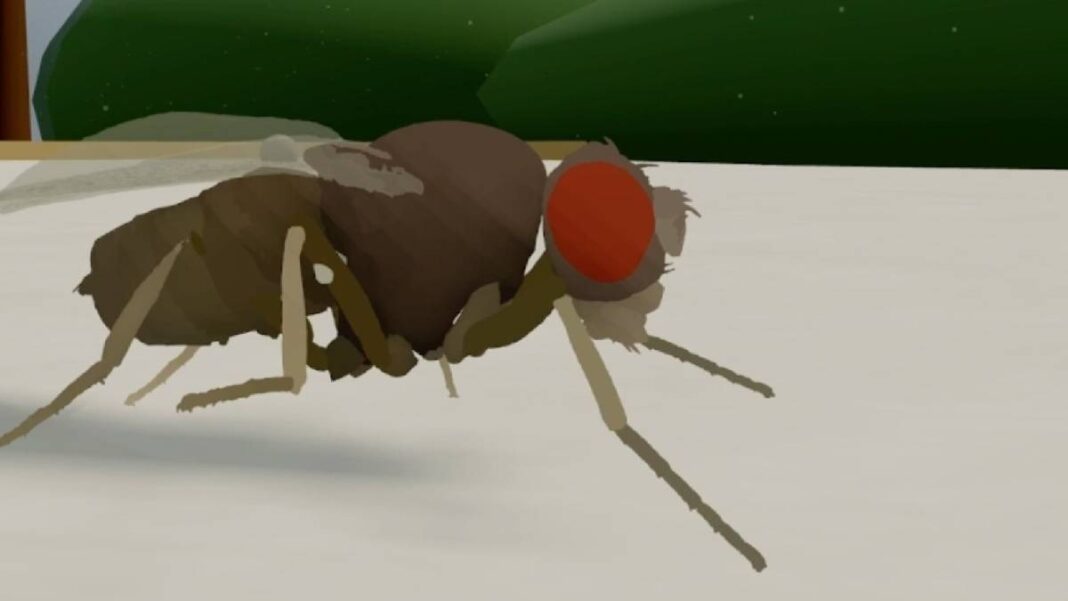
AI researchers have been trying to recreate and replicate how the brain actually works at a biological level, and for the same reason, they use the phrase “neural networks” for machine learning models. However, a company called Eon Systems has recently claimed to have achieved a simulation of an entire brain that produces multiple behaviours. The company has done this simulation for a fruit fly.
A virtual fly that acts real
The company shared a video on X showing a virtual fly moving around in a simulation-like environment. It briefly stopped to clean its antennae, and then soon reached some virtual banana slices, which it quickly ate. The video has gained wide attention because of the technology that powered the fly’s behaviour.
Its behaviour was powered by an AI algorithm that triggered the virtual neurons of the fruit fly in a way similar to what is found in an actual fruit fly brain, with an accuracy of 95 percent, as per the company.
To achieve this, the company tracked how a fruit fly’s brain actually works using an electron microscope and paired that data with an AI algorithm to control the neurons in the virtual fly’s brain in a way similar to that of a real fruit fly.
An early step toward mind uploading
Eon believes this is an early experiment in mind uploading, showing how the brain will respond to situations in a virtual environment.
The company’s co-founder, Wissner-Gross, suggests there are still some bugs, but it is a matter of time before it becomes technically possible to accurately simulate the brain of a fly or any other animal. Eon ultimately aims to simulate the human brain.
So, if Eon achieves a perfect simulation of the human brain, can it be called conscious?
Eon believes this is possible. The idea is that if every signal in your brain can be perfectly copied in digital form, then that digital version would also have your memories, feelings, and personal experiences that make you who you are.
What this could mean for AI
If this becomes a reality and the company achieves the simulation of the human brain, the technology might change the direction of artificial intelligence, which is currently based on training data and has no consciousness of its own.
However, experts have their apprehensions about this technology. A Gizmodo report quotes Karl Friston, a neuroscientist at University College London, as saying it is a mistake to assume that just because you simulate a conscious brain, the simulation will also have real experiences or feelings.
Similarly, neuroscientist Anil Seth explains it with an example: if you watch a computer simulation of a rainstorm, it does not mean the computer is actually wet inside.


