Apple M5 Pro vs M5 Max: Apple recently announced the latest 14- and 16-inch MacBook Pro with the all-new M5 Pro and M5 Max chips. Both chips power the same laptop lineup and may look quite similar at first glance. They belong to the same generation, use the same architecture, and even share the same 18-core CPU setup. But once you look deeper, some clear differences start to appear.
What both chips have in common
Both are built on Apple’s new Fusion Architecture. This design connects two third-generation 3-nanometer (3nm) dies into a single system-on-chip. It allows Apple to push performance further than the regular Apple M5 used in devices like the MacBook Air and the MacBook Pro 14‑inch.
The CPU setup is exactly the same on both chips. Each one has an 18-core CPU. Out of these, six are “super cores” designed for high performance. The remaining 12 are performance cores that handle multitasking while keeping power use in check.
According to Apple, this setup delivers up to 2.5 times better multithreaded performance compared to older chips like the Apple M1 Pro and Apple M1 Max. Both chips also use the same 16-core Neural Engine. This unit helps accelerate machine learning tasks.
Where the M5 Max gets stronger
The biggest difference appears in graphics performance. The M5 Pro comes with a 20-core GPU. The M5 Max doubles that number with a 40-core GPU. Each GPU core also includes a Neural Accelerator, which helps with AI and graphics-heavy workloads. This extra GPU power makes a big difference in tasks like 3D rendering, video effects, AI model training, and running large language models locally.
Memory is another area where the M5 Max pulls ahead. The M5 Pro supports up to 64GB of unified memory with 307GB/s memory bandwidth. The M5 Max doubles those numbers to 128GB and 614GB/s bandwidth. Higher bandwidth means the CPU, GPU, and Neural Engine can access data faster at the same time. This can improve performance in demanding creative or AI workloads.
Both chips include Apple’s third-generation ray-tracing engine. The M5 Pro delivers up to 35 percent better ray-tracing performance than the Apple M4 Pro. Meanwhile, the M5 Max shows about a 30 percent improvement over the Apple M4 Max. Overall graphics performance is roughly 20 percent higher compared to the previous generation chips.
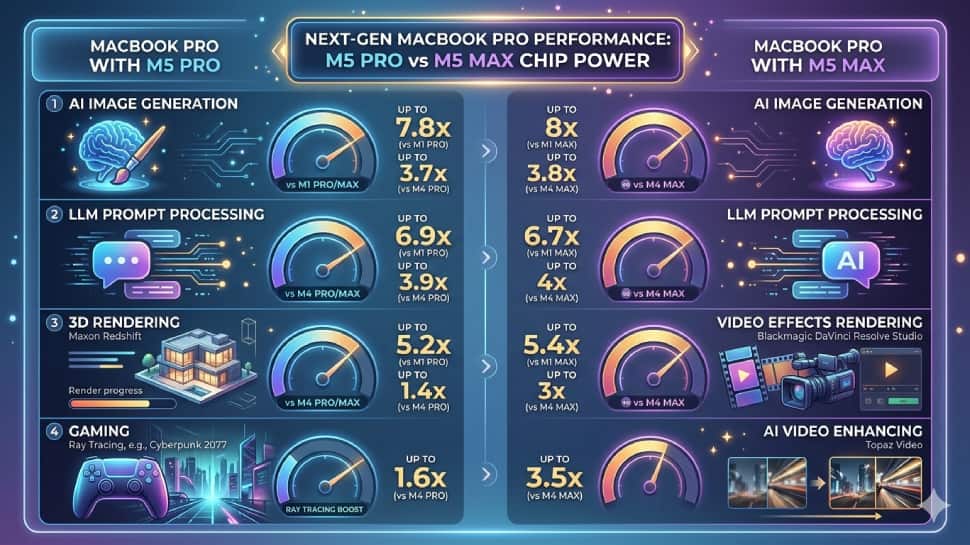
Apple says the M5 Pro already offers huge performance gains. For example, it can deliver up to 7.8 times faster AI image generation compared to a MacBook Pro powered by the Apple M1 Pro. It can also provide up to 6.9 times faster large language model prompt processing.
The M5 Max pushes performance even further. It offers up to eight times faster AI image generation compared to systems using the Apple M1 Max. It also brings major improvements in video effects rendering and AI video enhancement.
(Image source: AI)
Final takeaway
For many users, the M5 Pro and M5 Max are quite close in everyday performance. They share the same CPU design, AI capabilities, and Neural Engine. The M5 Max mainly stands out in GPU power, memory capacity, and memory bandwidth.
If your work heavily relies on graphics, AI models, or very large datasets, the M5 Max is the better choice. But for most professionals, the M5 Pro still offers plenty of performance without compromises.