
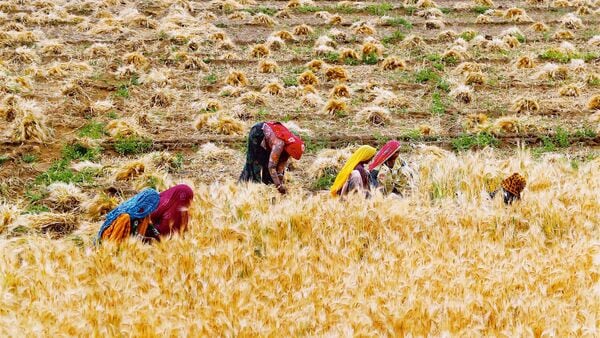
New Delhi: India’s farm sector is poised for a strong year, with foodgrain production projected to reach record levels in 2025–26, according to the second advance estimates released by the Union ministry of agriculture and farmers’ welfare on Tuesday.
Kharif foodgrain output is estimated at 174.14 million tonnes (mt) and rabi foodgrain production at 174.5 mt, excluding summer crops. This marks an increase of about 4.6 mt (2.8%) in kharif and 5.3 mt (3.2%) in rabi compared with last year’s production of 169.5 mt and 169.2 mt, respectively.
Among major crops, wheat production is estimated at a record 120.2 mt, about 2.26 mt more than last year’s output. Also, kharif rice output is projected at 123.9 mt, up from 122.7 mt in 2024–25, while Rabi rice output is estimated at 16.7 mt.
According to the estimates, production of coarse cereals is also expected to have grown strongly. Kharif maize output is estimated at a record 30.2 million tonnes, while Rabi maize is projected at 15.9 mt, also a record. Overall, kharif nutri/coarse cereals production is estimated at 42.5 mt and rabi production at 21.3 mt.
Among pulses, tur is estimated at 3.45 mt, gram at 11.8 mt and lentil at 1.7 mt. The ministry also projected kharif oilseeds production at 26.5 mt and rabi oilseeds at 14.5 mt. Soybean output is estimated at 12.7 mt while rapeseed and mustard production is expected to reach a record 13.3 mt.
Among commercial crops, sugarcane production is estimated at a record 500.2 mt while cotton output is projected at 29.1 million bales (170 kg each) and jute production at 8.1 million bales (180 kg each).
Rising foodgrain output indicates strong agricultural performance and improved food security, but it also requires careful management of procurement, storage and market prices to ensure farmers continue to receive remunerative returns.
“The projected rise in both kharif and rabi foodgrain output suggests that India is likely to maintain comfortable grain stocks in the coming year. The focus now should be on strengthening market linkages, storage and value chains so that higher production translates into better income for farmers,” said Pravesh Sharma, agri-policy expert and former managing director of the Small Farmers’ Agribusiness Consortium (SFAC).
Also, the increased production is expected curb inflation.
India’s retail inflation was recorded at 2.75% in January, while food inflation was 2.13%, marking a debut for a new series with the 2024 base year. The numbers can’t be compared with the previous month’s figures due to the much-awaited reset of the consumer price index basket.
The higher production could support stable food supplies.
“The projected increase in both kharif and rabi foodgrain output in the second advance estimates signals a healthy outlook for the farm sector. If realised, the higher production could support stable food supplies and moderate price pressures in the domestic market,” Binod Anand, a member of the government’s committee on minimum support price, or MSP, which guarantees procurement of a farmer’s produce at a fixed price, said.
Agriculture minister Shivraj Singh Chouhan, while releasing the estimates, said the steady growth in agricultural output reflects continued policy support for the sector.
The ministry said in a statement that the estimates are based on crop area data reported by states, validated through remote sensing inputs, the ministry’s Weekly Crop Weather Watch Group, and other agencies. Yield estimates are derived from Crop Cutting Experiments (CCEs), historical trends and other relevant factors.
While kharif estimates are largely based on CCE data, some crops such as tur, sugarcane and castor are still undergoing experiments. The rabi production figures are currently based on average yields and may be revised in subsequent estimates once updated CCE data becomes available.
The third advance estimates, which will incorporate the summer crop season, will be released later in the year.


