
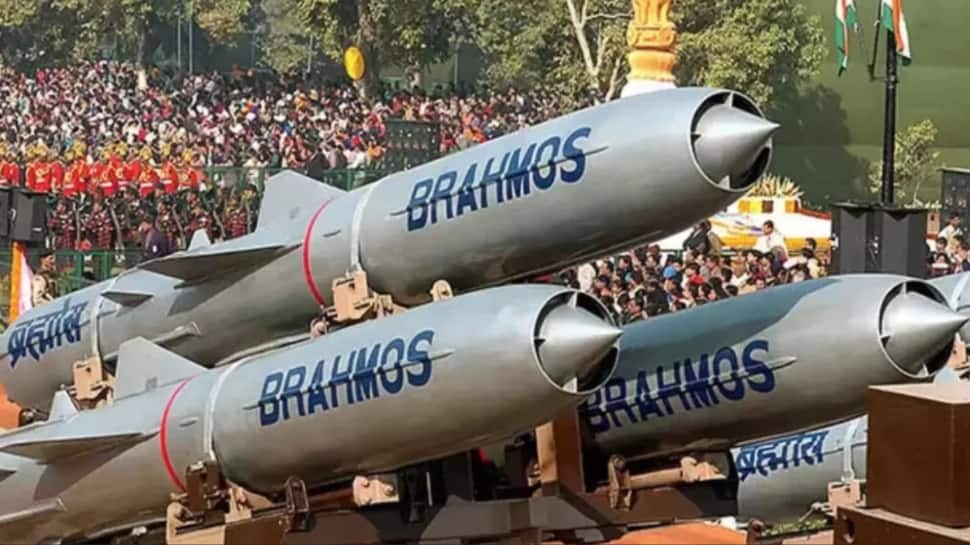
India’s supersonic BrahMos missile is steadily gaining ground in the global arms market, with Southeast Asian nations showing growing interest in the system. Indonesia has now confirmed it has entered into an agreement with India to acquire the missile, marking another step in New Delhi’s push to expand defence exports and strengthen security ties in the Indo-Pacific.
Indonesia’s defence ministry spokesperson Rico Ricardo Sirait confirmed the development to Reuters on Monday, saying the agreement forms part of the country’s broader effort to modernise its military capabilities.
The purchase comes after the Philippines became the first foreign buyer of BrahMos missiles in 2022, signing a deal worth $375 million to strengthen its coastal defence. The system has since become an important part of Manila’s strategy to counter rising tensions in the South China Sea, where it faces an increasingly assertive China.
Indonesia joins BrahMos buyers’ club
Sirait said Jakarta’s decision to procure the missile system is aimed at improving Indonesia’s defence capabilities, particularly in the maritime domain. The agreement is “part of the modernisation of military hardware and defence capabilities, especially in the maritime sector,” he said.
Although he declined to disclose the total value of the deal, BrahMos Aerospace, the company jointly owned by India and Russia, said in 2023 that it was in advanced discussions with Indonesia on a contract estimated between $200 million and $350 million.
Neither the company nor India’s defence ministry immediately commented on the latest confirmation.
Philippines praises the system
The BrahMos missile has already drawn praise from the Philippine military, which has begun deploying the system after purchasing three batteries. Two of those batteries have been delivered to the Philippine Marine Corps since 2025, strengthening the country’s coastal defence.
Speaking in New Delhi while attending the Raisina Dialogue 2026, General Romeo S. Brawner Jr, Chief of Staff of the Armed Forces of the Philippines, said Manila is satisfied with its purchase.
“…The Philippines was the first country to buy the BrahMos missile systems. Now Indonesia has bought the same system. I can say that we’re happy with our purchase, and hopefully we can do more business with India,” Brawner said.
The Philippines has been locked in tensions with China in the South China Sea, where Beijing’s coast guard vessels have used water cannons and dangerous manoeuvres, including ramming incidents, against Philippine ships.
Brawner said India has also been playing a growing role in regional security cooperation.
“..So last year I was here, I spoke with General Anil Chauhan, and I asked him to send ships to the Philippines so that we could sail together, doing freedom of navigation operations. And after four months, he sent four ships to the Philippines. This is a very important aspect of security in the region because we see non-traditional partners coming together and just pushing forward a rules-based international order,” he said.
More defence deals in the pipeline
Beyond the missile system, the Philippines is also exploring additional defence purchases from India.
According to sources, Manila is in discussions with New Delhi to acquire other indigenous platforms, including helicopters, fighter aircraft and submarines, as part of efforts to strengthen its maritime capabilities.
The two countries are also examining defence industrial cooperation, with India offering technical support to help develop a naval ecosystem in the archipelagic Southeast Asian nation.
How much does the BrahMos missile cost?
The BrahMos is among India’s most advanced and expensive missile systems. The average cost of a single missile is estimated at ₹25 crore to ₹35 crore, depending on the variant and configuration.
The missile has three main versions and can be launched from land, sea and air platforms, giving armed forces significant operational flexibility.
Jointly developed by India and Russia, the programme required about $250 million in research and development funding. The missile is produced by BrahMos Aerospace, a joint venture between the two countries.
Why the BrahMos is considered so powerful
The BrahMos is widely regarded as one of the fastest operational cruise missiles in the world. It can reach speeds of Mach 2.8, nearly three times the speed of sound, equivalent to about 3,900 kilometres per hour.
The missile also has radar-evasion capabilities and can fly at low altitudes, making it difficult for enemy air defence systems to detect and intercept. Its strike range typically falls between 300 and 400 kilometres, allowing it to hit targets far from the launch point while maintaining high precision.
Growing production in India
To support rising domestic and export demand, India has expanded production facilities for the missile. A new BrahMos manufacturing unit in Lucknow, built at a cost of around ₹300 crore, can produce 80 to 100 missiles each year. The system is also manufactured at several other locations across the country.
As more nations seek advanced yet relatively affordable missile systems, the BrahMos is increasingly emerging as a flagship export for India’s defence industry, and the recent Indonesian agreement signals that demand for the supersonic missile may continue to grow.


