
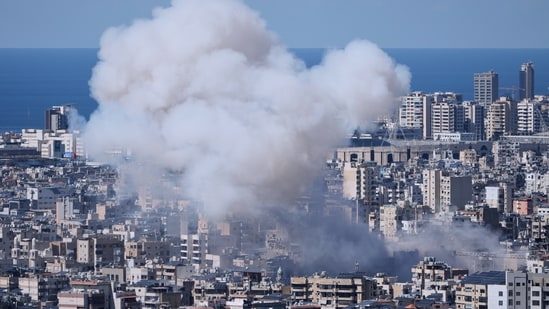
In a development adds another grave dimension to the conflict sparked by US-Israel strikes on Iran, UN-affiliated monitoring agency Human Rights Watch (HRW) has accused the Israeli military of unlawfully using white phosphorus incendiary shells over residential areas in the Lebanon town of Yohmor, where its forces claim to be attacking Iran-allied group Hezbollah.
Follow: Updates on the US-Iran conflict
The HRW report released on Monday, March 9, said these strikes took place on March 3. It said it geolocated and verified seven separate images showing airburst white phosphorus munitions being deployed over the village.
These included photographs posted to Facebook by the Civil Defense Team of the Islamic Health Committee in Yohmor, which is affiliated with Hezbollah.
“The photographs show workers extinguishing fires on residential rooftops and in a car and smoke emerging from the balconies of a home, which the Civil Defense Team attributed to white phosphorus. The geolocated sites were inside a radius of less than 160 meters,” the HRW report noted.
“The Israeli military’s unlawful use of white phosphorus over residential areas is extremely alarming and will have dire consequences for civilians,” said Ramzi Kaiss, Lebanon researcher at Human Rights Watch, as per news agency AFP.
“The incendiary effects of white phosphorus can cause death or cruel injuries that result in lifelong suffering,” Kaiss noted.
This adds another grave dimension to the US and Israel’s conflict with Iran, which has widened to the larger Middle East/West Asia region as both sides attack each other in allied countries too. These include attacks by Israel inside Lebanon, and Iranian strikes on US bases in the UAE, Qatar, Saudi Arabia and other Gulf countries.
For the Israel Defense Forces (IDF), this is not the first time they’ve been accused of violating or skirting international law. Iran and its allies have called the latest war altogether illegal, even as the Americans and Israelis call it “pre-emptive action” and “not war” as such.
The IDF was earlier accused of widespread use of white phosphorus between October 2023 and May 2024 across border villages in southern Lebanon. That was when Israel was on a military rampage in its occupied Palestinian territory of Gaza, after a Hamas militant attack killed around 1,200 people in Israel. That military pummeling of Gaza killed over 70,000 people in two years, as per rights organisations’ estimates so far.
What is white phosphorus, how it burns flesh?
White phosphorus is a waxy, yellowish chemical substance that ignites spontaneously when it comes into contact with oxygen.
Militaries primarily use it to create thick, white smokescreens to mask troop movements or to mark targets for airstrikes.
However, when used as a weapon, its effects are devastating.
Known also as ‘Willy Pete’ — a name given by US troops during the Vietnam war in the 1960s — it burns at around 800°C.
When an artillery shell containing white phosphorus bursts in the air, it releases 116 “felt wedges” soaked in the chemical. These fragments drift to the ground, continuing to burn as long as they have access to air. According to the World Health Organization (WHO), the substance burns at temperatures exceeding 800°C. That’s hot enough to melt metal, and melt or even incinerate human flesh as happens during cremation.
Unlike a typical fire, a phosphorus burn is both thermal and chemical; because the substance is fat-soluble, it can burn through skin and muscle down to the bone, WHO explains.
Medical experts have noted that these wounds can reignite even after treatment if a fragment is exposed to air during the changing of bandages. Inhalation of the smoke can cause severe respiratory damage, and if the chemical is absorbed into the bloodstream, it can lead to multi-organ failure, specifically affecting the liver and kidneys.
International law and a ‘smokescreen’ loophole
The use of white phosphorus is governed by the Convention on Conventional Weapons (CCW), an international treaty that prohibits the use of air-delivered incendiary weapons against “concentrations of civilians”.
However, rights groups and legal experts cite a significant loophole. Because white phosphorus is primarily designed for smoke-screening and not as a weapon to burn people, many militaries, including Israel’s, argue it falls outside the definition of an “incendiary weapon”.
Israel is not a signatory to this treaty.
United Nations experts assert that use of airburst white phosphorus in populated areas violates a fundamental principle of war, which requires armies to distinguish between military targets and civilians.
In its past statements, the Israeli military has insisted that its use of the substance is “consistent with international law”, and it’s used strictly for creating smokescreens.
Toxic legacy, continued use as weapon
The impact is long-term too, as residents in southern Lebanon describe a “toxic legacy” left on their lands since 2023 at least.
Abdullah al-Ghrayyeb, a local official in a previously hit village, has been quoted as saying by Amnesty International: “A very bad odour and massive cloud covered the town so that we were not able to see… people frantically fled. When some returned, their houses were still burning.”
Research has shown phosphorus residues contaminate the soil for years. In southern Lebanon, this has destroyed olive groves and citrus orchards, which are the backbone of the local economy.
The US military used white phosphorus extensively during the Vietnam War, and the use near civilian populations drew significant humanitarian criticism, alongside other controversial weapons like napalm. The UN convention against its weaponised use came in only in 1980.
Yet, the use continues. The US confirmed in 2005 that its forces used white phosphorus as an incendiary weapon in Iraq in 2004.
Human Rights Watch also verified videos showing Israel firing white phosphorus over the Gaza City port in October 2023. It noted that the chemical’s use in one of the world’s most densely populated areas violated international humanitarian law.
Russia has also been accused of using white phosphorus indiscriminately against civilians and combatants in both Ukraine and Syria.


