

Key Takeaways
- Ethiopia’s Hayli Gubbi volcano erupted after 12,000 years, sending ash and SO2 across continents.
- The volcanic plume traveled over 3,700 km, affecting Indian states and disrupting flights.
- Satellite data shows the cloud has now moved over China after clearing Indian skies.
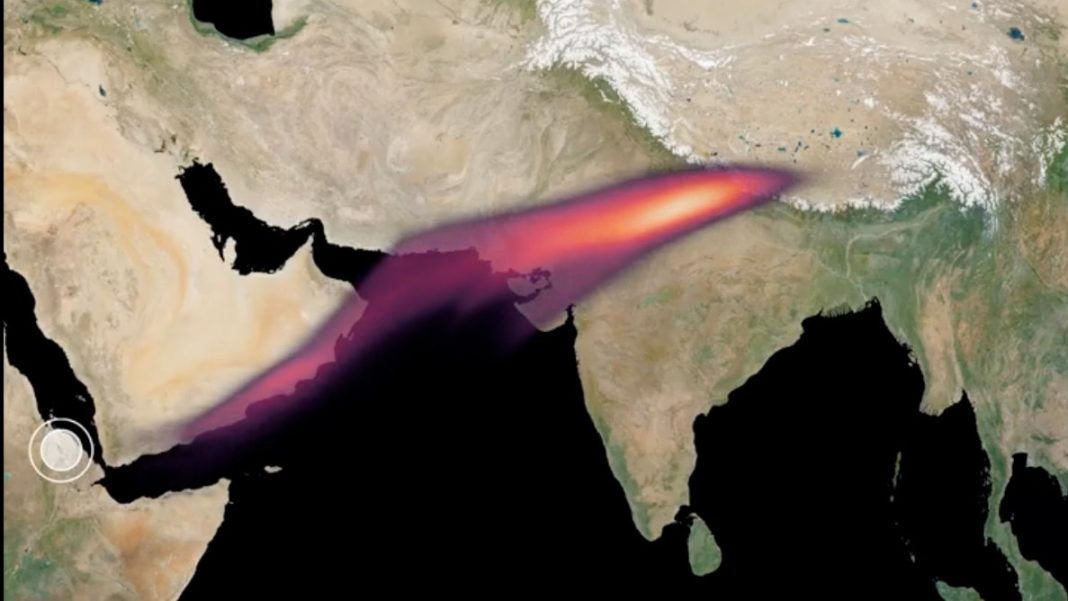
A stunning new animation from the EU Space Programme reveals how a massive volcanic plume from Ethiopia’s Hayli Gubbi volcano traveled thousands of kilometers, crossing India and the Himalayas before reaching China.
The visualization, based on Copernicus Atmosphere Monitoring Service data, tracks the sulfur dioxide cloud that began on November 23, 2025. The dormant volcano in Ethiopia’s Afar region erupted explosively after nearly 12,000 years of inactivity.
Volcanic Plume’s Journey Across Continents
Hayli Gubbi’s eruption injected ash clouds up to 45,000 feet into the atmosphere, sending sulfur-rich gases directly into the stratosphere. High-altitude winds then carried the plume across the Red Sea, Arabian Peninsula, and Arabian Sea before reaching Indian airspace.
The volcanic cloud affected multiple Indian states including Gujarat, Rajasthan, Delhi-NCR, Punjab, Haryana, and Maharashtra. The animation shows the SO2 plume stretching over 3,700 kilometers long, moving at speeds of 100-120 kmph.
Flight Disruptions and Air Quality Impact
Several airlines, including Air India, canceled flights due to engine risks from fine ash particles. Volcanic ash and SO2 can form sulfate aerosols that pose significant threats to aircraft engines and affect air quality.
Despite the massive scale of the plume, experts reported minimal ground-level air quality impact across most of India. However, elevated SO2 levels were detected in Nepal’s hills and Terai regions.
Current Status and Monitoring
IMD Director General M Mohapatra confirmed that Indian skies cleared by the evening of November 25, with the volcanic cloud having moved over China. Satellite tracking through Copernicus Sentinel-5P and the Toulouse Volcanic Ash Advisory Centre enabled real-time monitoring of the event.
While no injuries were reported from the eruption, the event disrupted livelihoods in Ethiopia’s Afar region and highlighted ongoing vulnerabilities in global aviation to volcanic activity.