

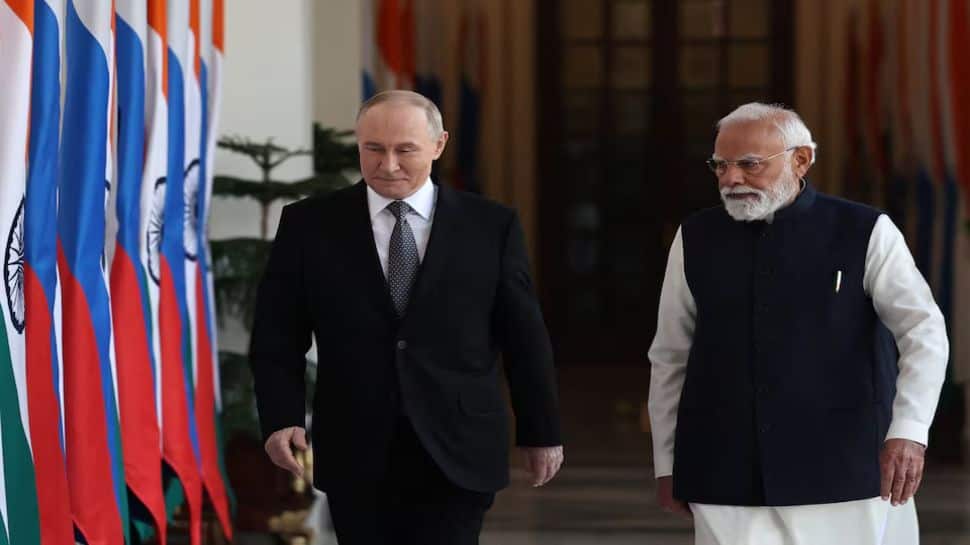
New Delhi: India and Russia are preparing for a new trade deal. Commerce between the two countries will no longer depend only on oil. Both sides are now discussing a bigger business agreement. The first official update in this regard came from Moscow where Russia’s Deputy Prime Minister Alexey Overchuk revealed a proposed preferential trade deal between India and the Eurasian Economic Union.
This pact is expected to create new business opportunities for Indian MSMEs and give them better access to markets across the Eurasian region.
The development comes at a time when India’s trade outreach is growing across regions. Engagements with Western economies have gathered pace in recent months, with several talks moving into advanced stages.
In the same window, pressure returned from Washington over India’s continued energy imports from Russia. New Delhi held its ground and reiterated that all external partnerships would be guided by national interest. The talks with Russia on the proposed deal shows that India is still sticking to this stand in its trade and strategic decisions.
Speaking at a business gathering in Moscow, the Russian deputy prime minister indicated that the first round of negotiations on the preferential trade agreement had concluded on firm ground. Expressing confidence about the progress, he said that both sides are ready to finalise the deal within a practical time frame.
The proposed deal goes beyond a simple agreement between two countries. Russian companies would get access to India’s large consumer market. At the same time, Indian exporters would gain a broader entry into the Eurasian region.
Together, the total market connected to this deal would reach nearly 2.2 billion people. A market of this size is important at a time when tariffs are rising, supply chains are expanding and global trade power is changing.
Negotiations are taking place to set-up a free trade zone structure involving the Eurasian Economic Union, whose members include Russia, Armenia, Belarus, Kazakhstan and Kyrgyzstan. The first round of talks with this group has already been completed. It has laid the foundation for more detailed discussions on tariffs and market access.
Trade expansion targets are ambitious. The leadership in New Delhi and Moscow has set a goal of pushing bilateral trade to $100 billion by 2030. The growth is already visible. Trade between the two countries reached $68.7 billion in 2024-25. Most of it came from energy trade, with other sectors also beginning to contribute.
Both countries are planning future cooperation in pharmaceuticals, agriculture, industrial machinery, chemicals and technology. Energy and defence will continue to be important, with growing focus on expanding trade into more sectors and higher-value exports.
Financial arrangements between the two countries are also changing. Both sides are working to expand trade settlements in their national currencies. Greater policy focus is being placed on rupee-ruble payment channels in response to Western sanctions and banking restrictions.
At the same time, alternative logistics networks are being strengthened through the International North-South Transport Corridor, a route aimed at cutting transit time and lowering freight costs between South Asia and the Eurasian region.