

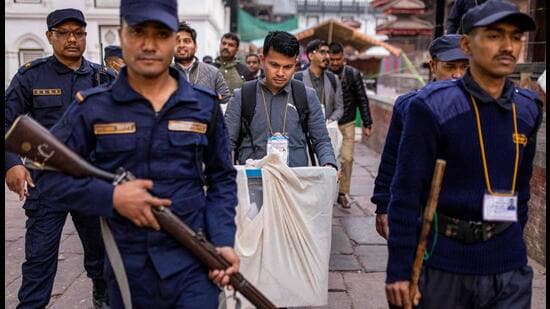
Raxaul, East Champaran: Heightened vigil, sealed border points, thin footfalls in marketplaces, sparse vehicular movement and a visible slump in cross-border trade during Holi greeted Raxaul town in Bihar’s East Champaran district as the border closure from March 3 culminated in the general elections in neighbouring Nepal on Thursday.
In Nepal’s interior regions, long queues spiralled outside polling booths from early morning, reflecting steady voter turnout amid tight security arrangements for the general election. Voters were seen queuing outside their respective polling stations in Parsa, Bara, Rautahat, and Nawalparasi, which spread along East Champaran and West Champaran of Bihar. “The voters showed full enthusiasm in exercising their franchise,” said Vijay Sarawagi, ex-mayor of Birganj.
Hindustan Times spoke to the voters over phones after the conclusion and observed a sense of relief and satisfaction among. “More than anything else, the seven days of leave on account of Holi and election certainly help voters from far flung area in India and Nepal reach their respective villagrs to exercise their franchise,” said Saroj Chaurasia, 38, a resident of Sedhwa village in Parsa district.
HT spoke to some voters over phone after the conclusion of polling and observed a sense of relief and satisfaction among them. “More than anything else, the seven days of leave on account of Holi and election certainly helped voters from far flung area in India and Nepal reach their respective villages to exercise their franchise,” said Saroj Chaurasia, 38, a resident of Sedhwa village in Parsa district.
Barring few incidents of skirmishes and altercation between political workers of parties in Rautahat and Bara districts, the elections by and large passed off peacefully. Officials in Nepal and India described the election as peaceful along the border areas.
Nepal has witnessed the installation of 14 governments since it adopted federal democracy in 2008 but none of them has completed a full term.
However, with the Rastriya Swatantra Party (RSP) led by rapper-turned-politician and former Kathmandu mayor Balendra Shah seeking to expand its support base, the election has turned into a multi-cornered battle involving major national players.
The other established heavyweights include the Communist Party of Nepal (Unified Marxist–Leninist) headed by former prime minister K P Sharma Oli, the Nepali Congress represented by leader Gagan Thapa, and the Communist Party of Nepal (Maoist Centre) led by former prime minister Pushpa Kamal Dahal. With no clear frontrunner in the two districts, the race remains open and intensely competitive.
Shah’s RSP, which gained attention during the “Gen-Z” protest movement, is attempting to position itself as a force for change.
Officials in Nepal and Indian described the election as peaceful along the border areas.
Back in Raxaul, traders and businessmen heaved a sigh of relief at the thought of resuming cross-border movement. “Unlike other Holis and festivals, our business remained muted and subdued as footfall from Nepal came to a halt due to the border closure on March 3 itself,” said Akash Kumar Gupta, a Raxaul-based shop owner at Birganj Kirana Pasal.
Located about 205km northwest of state capital Patna, the otherwise bustling border town Raxaul wore a subdued look, with thin footfalls in commercial area though shops remained open.
Back in Raxaul, traders and businessmen heaved a sigh of relief at the thought of resuming cross-border movement. “Unlike other Holis and festivals, our business remained muted and subdued as footfall from Nepal came to a halt due to the border closure on March 3 itself,” said Akash Kumar Gupta, a Raxaul-based shop owner at Birganj Kirana Pasal.
Located about 205km northwest of state capital Patna, the otherwise bustling border town Raxaul wore a subdued look, with thin footfalls in commercial area though shops remained open.
Located about 205 km northwest of state capital Patna, the otherwise bustling border town Raxaul wore a subdued look, with thin footfalls in commercial area though shops remained open. Streets that usually witness heavy movement of goods-laden trucks, passenger vehicles and pedestrians crossing over to Nepal remained unusually quiet. Vehicular movement was sparse and security personnel from the Sashastra Seema Bal (SSB), state police and other agencies kept a strict watch at all entry and exit points along the Indo-Nepal border.
“Things are in place… We conducted joint patrolling along the border in coordination with the SSB last (Wednesday) night. About 40 vulnerable points marked by lanes and bylanes leading to Nepal were found and the SSB jawans are manning these points. Any cross-border movement is strictly prohibited. However, security personnel have been directed to handle emergency cases such as health issues, etc.,” said Manish Anand, sub-divisional police officer (SDPO), Raxaul.
According to officials, East and West Champaran share nearly 200km of porous border with Nepal, with several vulnerable stretches between Jhandu Tola and Pantoka. The 21st Battalion of the SSB is securing the stretch from Jhandu Tola to Shaktinala (pillar 61), identifying areas such as Thari village, Susta, Dhani Rena and Jhandu Ghat as risk zones.
The 44th, 47th and 71st battalions are manning the border from Amtola to Jamuniya and have secured over three dozen vulnerable points. Security personnel have been deployed across both districts to prevent any untoward incident.


