

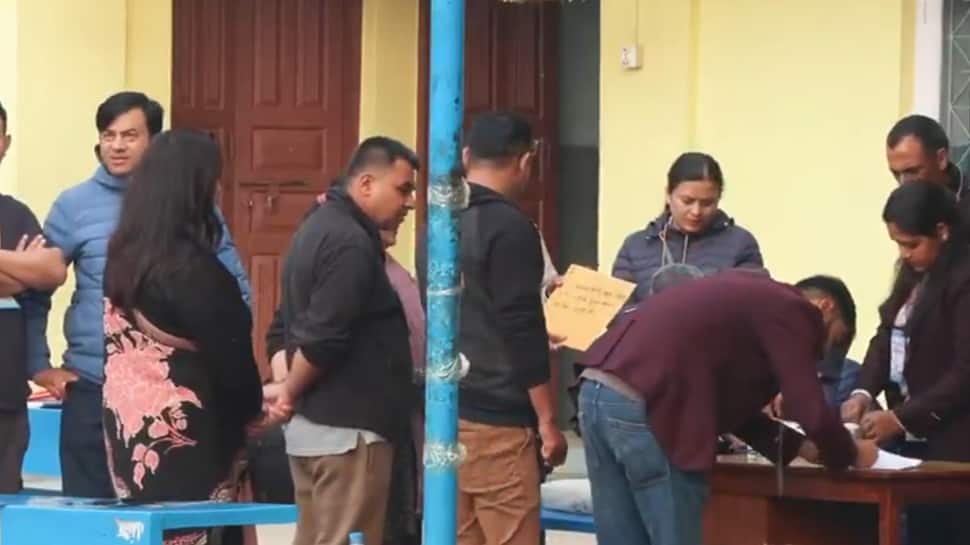
Nepal Election 2026: Seven months after a Gen-Z uprising ousted the incumbent government, Nepalese citizens are set to elect their new leader today, i.e., March 5, 2026, as the nation votes in parliamentary elections, marking the first national polling since the September protests.
The Himalayan nation was facing uncertainty, with political leaders facing protests, but the interim government headed by Sushila Karki managed to restore political stability while taking Nepal towards a time-bound polls. To ensure security during the polls, around 335,000 security personnel has been deployed, including nearly 1,50,000 special election police.
Nepal Election Issues
The first and foremost issue raised by the youth voters was rampant corruption and unemployment. The Nepalese voters are set to elect a new government seeking reform, economic opportunities, employment, honesty and accountability after months of unrest.
Nepal Election 2026: Date and Time
Nepal’s parliamentary polls or general elections are being held for the lower house of the Parliament, just like India’s Lok Sabha. It’s called the House of Representatives. The voting is taking place today, i.e. March 5, 2026. The voting will take place from 7am to 5pm local time. Notably, Nepal is 15 minutes ahead of India.
Nepal Election 2026: EVMs or Ballot Papers?
As per reports, the voting in Nepal will take place using ballot papers as the country is still adopting the Electronic Voting Machine system, which is not fully operational.
Nepal Election 2026: Eligible Voters, Candidates
Since the elections are being held after gen-z protests, the focus is on youth voters. Around 1.9 crore voters are elible to cast their franchise. This includes around 8,00,000 first-time voters. Of the total voters, 96 lakhs are male voters while 92 lakhs are female voters.
A total of 3,406 candidates are in the fray under the first-past-the-post (FPTP) system, while 3,135 candidates are contesting under the proportional representation system, as per the Election Commission of Nepal. Voters will elect 275 members to the House of Representatives. Of the total seats, 165 lawmakers will be chosen through the first-past-the-post system, while the remaining 110 will be filled under the proportional representation model.
Nepal Election 2026: Result Date, Vote Counting Deadline
Nepal’s poll body has said that it hopes to announce results for 165 FPTP seats within 24 hours of the voting. However, the biggest challenge will be collecting and securing ballot papers from across the country, which has a vast, uneven terrain. The collection of ballots usually takes a day.
According to Acting Chief Election Commissioner Ram Prasad Bhandari, the counting of votes for the 110 proportional representation seats may take an additional two to three days time. Notably, during the 2022 general elections, the Nepalese Election Commission took more than two-three weeks to publish the full results.
Nepal Election 2026: Major Parties, Key Candidates
Nepal follows a multi-party system. This time, around 65 political parties are contesting the polls across seven provinces of Koshi, Madhesh, Bagmati, Gandaki, Lumbini, Karnali, and Sudurpaschim. The key political parties in the fray are Rastriya Swatantra Party (RSP), Congress, Communist Party of Nepal (Unified Marxist–Leninist) CPNUML, Nepal Communist Party, Rastriya Prajatantra Party (RPP), The People’s Socialist Party, Nepal (PSP-N) or Janata Samajbadi Party, Janamat, and Ujyalo Nepal Party (UNP).
The key candidates are former PM KP Sharma Oli, Gagan Thapa, leader of Nepali Congress and Balen Shah, a former rapper and mayor of Kathmandu.
Nepal Election 2026: Key Challenges and Outcomes
The Nepal Election 2026 will replace the interim government headed by Sushila Karki and establish a fully elected legislature. The poll pits the youth leaders against traditional party leaders after Gen-Z protests. It will decide how much say the youth voters get in Parliament, as 160 youth leaders are contesting the polls. The new government will be responsible for the country’s economic upliftment, employment creation, anti-corruption efforts, and foreign policy decisions, especially at a time when China is trying to influence the region.
Acting Chief Election Commissioner Ram Prasad Bhandari called upon citizens to participate in the democratic exercise without fear. “Since elections are the foundation of a representative system of governance and provide legitimacy and assurance to the people’s right to be governed through representatives of their choice, I sincerely urge all voters to attend their respective polling centres and cast their votes confidently on Thursday,” Bhandari said.