

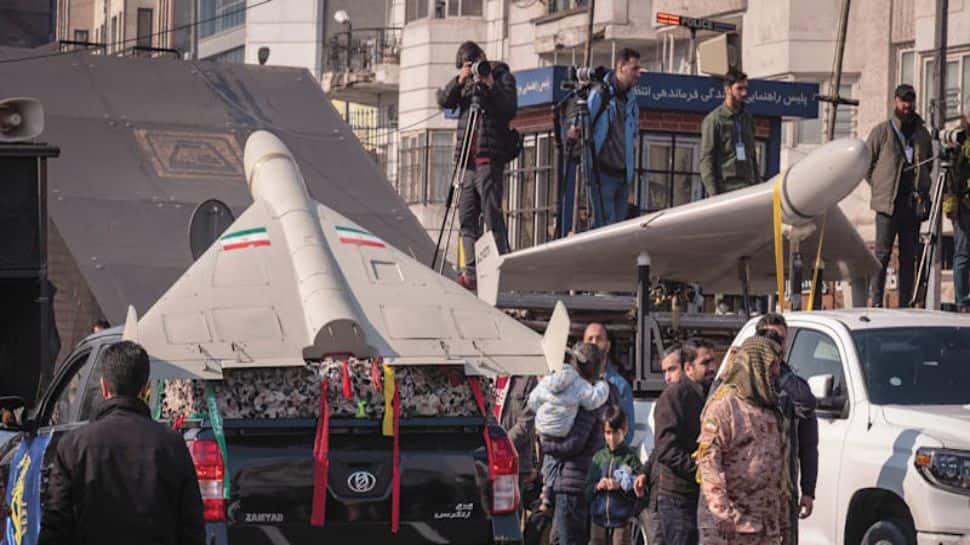
New Delhi: The Shahed-136 is a low-cost suicide drone with a range of 2,000-2,500 kilometres, a speed of 185 km/h and a payload of 30-50 kilograms. Iran has deployed it and also supplied it to Russia, Houthis and Hezbollah. Its affordability allows swarm attacks that exhaust air defences. Strikes in Ukraine, Gulf countries and American bases have spread concern across 14 nations.
The Shahed-136 has emerged as Iran’s most formidable and inexpensive weapon. It is classified as a suicide drone because it detonates on impact once it reaches its target. Iran first started using the drone in 2021, but the world took notice in 2022 when Russia began using it heavily in the Ukraine war and showed how powerful it could be.
Iran is using it against its target in Gulf countries and Israel in the ongoing war. The strikes have prompted heightened alerts in Israel, the United States, Saudi Arabia, the UAE, Kuwait and Bahrain. These drones usually fly at night and beats normal air defences. Iran says the drone is cheap and can be used in large numbers for attacks.
Technical features of Shahed-136
The drone measures approximately 3.5 metres in length, has a wingspan of around 2.5 metres and weighs about 200 kilograms. Its delta-wing design provides stability in flight. It is powered by a pusher-propeller piston engine, modelled on or copied from the MD-550 engine, which allows it to achieve a maximum speed of 185 km/h.
The Shahed-136 has a range of 2,000 to 2,500 kilometres, allowing it to reach distant targets. Its warhead contains 30-50 kilograms of high-explosive fragmentation material that are capable of causing large scale damage. The drone is guided by GPS and INS systems that are set in advance to reach specific targets.
Launch operations are conducted from trucks, and multiple drones can be deployed simultaneously to carry out swarm attacks. Its low production cost allows Iran and Russia to manufacture thousands of units for rapid deployment.
Why the drone is so effective
The drone’s primary advantage lies in its affordability and long range. Estimates suggest that a single unit costs between $20,000 and $50,000, while traditional missile systems can cost millions. This allows adversaries to saturate air defences with relatively inexpensive drones, forcing them to use costly interceptors.
In the Ukraine war, Russia deployed the Shahed-136 under the name Geran-2, launching thousands of drones against critical infrastructure, electricity grids and cities. Iran has supplied the drone to groups such as the Houthis and Hezbollah while deploying it directly in response to American and Israeli strikes.
Flying close to the ground makes the drone hard for radar to spot, which makes it more effective against military sites and important targets.
Countries affected by Shahed-136
The drone has impacted multiple countries across different theatres of war. Russia used it extensively against Ukraine, while Iran has deployed it against US bases in Iraq and Syria. The Houthis have used it against Saudi Arabia and the UAE.
Iran is using it to target US assets in Gulf countries. In total, Iran-linked groups and Russian deployment have affected 10 to 14 countries, including Ukraine, Israel, the United States, Saudi Arabia, the UAE, Kuwait, Bahrain, Jordan and Iraq.
The sudden and large number of these attacks has made people afraid, especially at night. The United States too copied its technology and improved it to counter Iran. But Tehran’s advantage is that it can make them cheaply and in large numbers.
The future role of Shahed-136
The Shahed-136 has changed drone warfare by showing that cheaper drones can be very dangerous without needing expensive missiles. Russia and Iran are improving it, with Moscow making thousands in factories and Tehran working on new versions with jet engines and better guidance.
These drones can attack in swarms, with hundreds hitting at the same time to overwhelm air defences. Countries are trying to fight them with electronic systems and small intercept drones, but the Shahed-136 is still a big problem. It shows that smart and low-cost drones can be more disruptive than costly weapons and have frightened people in many countries.