

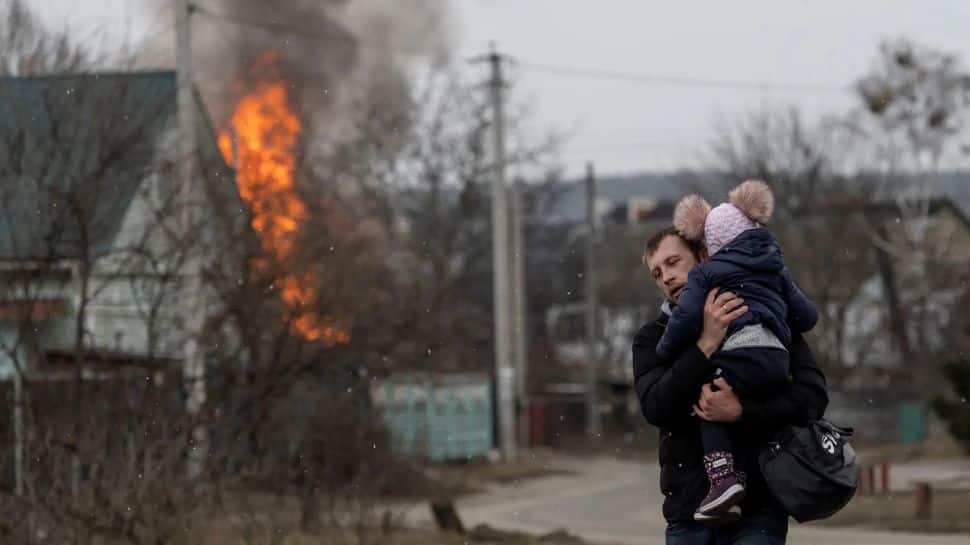
Moscow: Four years after Russian troops crossed into Ukraine expecting a quick victory, the war has turned into a long and grinding conflict that has changed the country’s politics, economy and society.
The campaign once envisioned by the Kremlin did not go as planned. Ukraine’s government held firm, and President Volodymyr Zelenskyy continued to be in Kyiv despite the early pressure of the invasion. The conflict slowly turned into a long war, with small gains on the battlefield and growing losses on both sides.
Despite the drawn-out war and growing international pressure, Russian President Vladimir Putin continues to hold firm control at home.
A country reorganised around war
Analysts say Russia is now functioning largely like a country at war. Defence spending has sharply risen since 2022, taking up a big part of government spending and the national economy. Experts say Kremlin has moved factories and resources toward weapons production, military recruitment and supply systems. This has helped the war effort continue despite sanctions.
Factories producing ammunition, drones and armoured equipment run at full pace. Employment linked to defence industries has helped stabilise regional economies. The system does not deliver prosperity, but it keeps economic activity moving.
Russia’s economy is under pressure, including slower growth and rising budget problems linked to falling oil revenues and sanctions. Even so, it is functional because of reserves, government spending and redirected trade networks that help reduce external shocks.
For many Russians, daily life in major cities still feels familiar. Shops are open, public transport runs normally and entertainment venues operate much as before. Rising prices are noticeable, but they have not triggered unrest.
The power of narrative
A central pillar of Putin’s resilience lies in messaging. State television and official platforms continue to present the war as a defensive struggle against hostile Western powers. Government messaging presents Russia as facing an existential challenge from external enemies, who are seeking to weaken or divide the country.
Schools, cultural programmes and national media repeat similar messages. Official broadcasts highlight battlefield successes and emphasise patience and unity. Civilian suffering inside Ukraine receives little exposure on domestic television, influencing how the conflict is perceived by viewers at home.
Independent views have become harder to find. Many foreign social media platforms are restricted, while government-backed local apps are promoted to keep online communication within nationally regulated systems.
Support mixed with distance
Surveys and interviews conducted by researchers suggest a complex social mood. Many express support for the state’s goals or accept the official explanation of the conflict. Enthusiasm for personally joining the military is limited, even as calls for victory continue in public discourse.
The war has gradually blended into everyday life. After four years, mobilisation announcements, sanctions news and battlefield updates no longer dominate daily conversations in the same way they once did.
Analysts say this normalisation helps sustain political stability. A conflict perceived as distant becomes easier for the society to absorb.
Sanctions pressure without political collapse
Western governments have imposed extensive economic restrictions targeting Russia’s finance, energy and technology sectors since 2022. These sanctions have limited investment and access to advanced technology while freezing large reserves abroad.
Economic losses have been substantial, but sanctions alone have not forced a policy reversal. Military production has increased in the country and new trade partners have helped exports continue through alternative routes.
Think tanks assessing the war say that Russia still has the ability to keep fighting at least until 2026, even as economic growth slows and pressure on manpower increases.
Slow gains on the battlefield
On the front lines, progress comes gradually rather than dramatically. Russian forces continue to push forward in limited sectors, capturing small areas over long periods. Military analysts describe the campaign as a war of attrition in which incremental advances carry political value.
These steady gains support the Kremlin’s message that persistence will eventually bring results.
Negotiations without resolution
Peace talks have been held from time to time as global politics changed, including new diplomatic efforts after political changes in Washington. But the negotiations have not produced any major progress.
Moscow continues to press demands that Kyiv does not accept, leaving the war at a standstill. Drone attacks in Russia and continued sanctions have added pressure, but they have not made the Kremlin change its position.
Why Putin still looks secure
Four years into the war, Putin’s political strength rests on several interconnected factors, which include a functioning wartime economy, strict control over information flows, gradual military progress and the absence of a unified domestic opposition capable of mobilising mass dissent.
Public fatigue exists, but it has not translated into organised resistance. The state continues to project stability, and many citizens adapt to the new normal created by conflict.
The war that began as a rapid operation has turned into a defining era for modern Russia. Its outcome is uncertain. Inside the country, however, the system built around it continues to hold and that endurance explains how Putin is in power even as the conflict enters its fifth year.


