
Key Takeaways
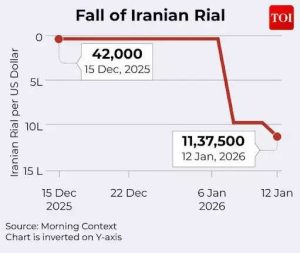
- Iran faces its largest economic protests in years, triggered by the rial’s collapse to 1.4 million per US dollar.
- Unrest spans all 31 provinces, uniting lower-income and middle-class Iranians against economic survival threats.
- The regime faces a critical test of legitimacy, balancing repression with a collapsing economy and external pressure.
Iran is convulsed by nationwide unrest sparked by a currency collapse, marking the most significant economic challenge to the Islamic Republic since the 2022 protests. The Iranian rial’s plunge to roughly 1.4 million per US dollar shattered markets, triggered strikes in Tehran’s Grand Bazaar, and ignited protests across all provinces.
US-based Human Rights Activists News Agency estimates at least 600 deaths and over 10,000 arrests. Unlike previous uprisings focused on social freedoms, this revolt directly targets the state’s ability to ensure economic survival, pulling in a broad coalition of Iranians.
Why This Economic Crisis Matters
The unrest strikes at the regime’s most sensitive nerve: its promise of basic economic stability. Analysts note this convergence of lower-income and middle-class protesters has long worried Tehran. Bazaar strikes carry historic weight, echoing the merchant-led economic noncooperation that helped topple the Shah in 1979.
Regionally, Iran is more exposed than ever. Its proxy network is degraded, and Israel damaged its missile and nuclear infrastructure in the June 2025 war. The state is poorer, weaker abroad, and faces a broader domestic coalition.
The Trigger: A Corruption Pipeline Collapses
The immediate catalyst was a policy fight over Iran’s preferential exchange rate, set at 285,000 rials per dollar—a system widely seen as a corruption pipeline for regime insiders. When parliament rejected a budget proposal to address it, confidence collapsed.
The rial’s freefall made pricing impossible and froze commerce, especially in import-heavy sectors. A currency tracker showed $1 equal to nearly 1,137,500 rials by January 12. This isn’t just a graph; it’s a snapshot of daily governance failure, where salaries become fiction and the middle class is pushed into survival mode.
Life Under Economic Collapse
For many, the crisis is about bare survival. Water rationing hits parts of Tehran for hours, while districts face rolling blackouts. Food insecurity spreads to once-stable households, with reports of desperate acts in supermarkets.
Inflation, long above 40%, has hollowed out wages. Economists estimate purchasing power has fallen to a third or less of its level a decade ago. The protests’ geographic spread—from cities to drought-battered provinces—reflects this shared precarity.
What They Are Saying
We are struggling. We cannot import goods because of US sanctions and because only the Guards or those linked to them control the economy. They only think about their own benefits.
A Tehran trader to Reuters
The regime’s response mixes surface sympathy with underlying repression. Judiciary chief Gholamhossein Mohseni Ejei vowed “no leniency” for “rioters.” Foreign minister Abbas Araghchi claimed the situation was “under total control,” blaming Israel and the US.
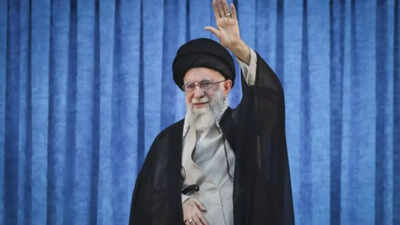
Supreme Leader Ali Khamenei warned the Islamic Republic “will not back down.” Externally, former US President Donald Trump warned of severe consequences if Tehran violently suppresses protests, adding tariff threats for nations doing business with Iran.
Any country doing business with the Islamic Republic of Iran will pay a Tariff of 25% on any and all business being done with the United States of America.
Donald Trump
Regime Resilience and Opposition Fragmentation
Despite appearances, the regime isn’t cornered yet. The appointment of hard-liner Ahmad Vahidi to a senior IRGC role signals readiness to escalate. The Guards have declared a “yellow” emergency, tightening control.
Crucially, senior bazaaris and regime-linked oligarchs remain on the sidelines, insulated from daily currency swings and embedded in patronage networks. The opposition remains fragmented, with bitter splits between monarchists backing Reza Pahlavi and rival camps wary of a single “savior.” As one analyst noted: “Anger is abundant. Coordination is scarce.”
What Comes Next for Iran?
History suggests three possible paths, none guaranteed:
- Economic Shock Absorber: Tehran could restore preferential rates at a higher level, reopen corruption channels, and rely on targeted arrests.
- Escalation and Repression: If protests expand into sustained strikes in critical sectors, the regime may opt for overwhelming force.
- Slow Unraveling: A prolonged stalemate of grinding poverty, intermittent unrest, and tighter security could hollow out the system without dramatic collapse.
For real change, several shifts must occur simultaneously: elite defections, protesters holding territory, disciplined nationwide noncooperation, and a credible “day after” vision. Iran’s proverb looms: “Same donkey, different saddle.” Many seek a clean break, not a cosmetic swap.
The Islamic Republic is arguably weaker than ever. But as decades show, weakness doesn’t automatically mean collapse—especially when fear of chaos still rivals hope for change.