

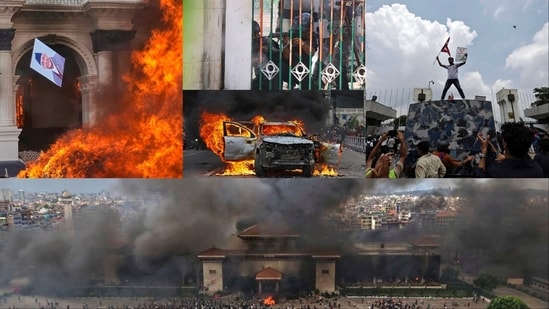
From a ban on social media triggering violent Gen Z-led protests that toppled KP Oli’s government to a social media platform helping the youth elect an interim leader until the general election, Nepal witnessed dramatic scenes unravel in its political circuit in 2025. They were a series of events that seemingly turned into a saga anchored by the power of social media. As nearly 19 million eligible voters cast their ballots on Thursday to finally pick their next Prime Minister and government, let’s take a look at the journey that brought the country to this day.
Six months after the anti-corruption protests, which left at least 77 people dead, the 275-member Nepal Parliament went to polls and recorded a 60 per cent voter turnout, according to initial estimates shared by Chief Election Commissioner Ram Prasad Bhandari.
While the toppling of Oli’s regime paved the way for a new, hopeful government, it also made a mark on the world by displaying the revolutionary power of social media. The then-prime minister ordered a ban on social media platforms, and those platforms led to his ouster.
Ban on social media triggers protests
Hami Nepal, a humanitarian and activist group, called for the first ‘Gen Z’ protest on September 8, four days after the Nepalese government imposed the social media ban. The group presented its Discord server as a hub for organisation and communication for the Gen Z movement.
Citizens spread the word via social media, and thousands of youths gathered at Maitighar Mandala in central Kathmandu on September 8. However, the peaceful protest quickly spiralled into chaos, with demonstrators marching toward government buildings and clashing with security forces.
The violent protests prompted police forces to open fire, leaving at least 20 dead and several injured. Amid intensifying tensions, a curfew was imposed across Kathmandu.
Injured protestors were rushed to hospitals, with Hami Nepal’s main face, Sudan Gurung, taking to social media to address the chaos and present the demonstrators’ side. Prime Minister KP Oli called for an urgent meeting of his Cabinet and the National Security Council. Soon after the meeting, home minister Ramesh Lekhak resigned from his post.
As the death toll from the violence continued to increase, the anger among the Gen Z movement also intensified. On September 9, protests widened and spread across Nepal. Demonstrators stormed government buildings and set them ablaze. Residences of several ministers and key political leaders were also attacked, with those of ex-PM Pushpa Kamal Dahal and current head of state KP Oli’s homes being set on fire by protestors.
Nepal’s 2025 Gen Z protests: Timeline at a glance
Gen Z protests oust Nepal PM KP Oli
An angry mob even assaulted five-time PM Sher Bahadur Deuba and his wife, with visuals surfacing, showing the two bleeding after being beaten up by protestors. Meanwhile, another group of violent agitators set former PM Jhala Nath Khanal’s house on fire, with his wife, Rajyalaxmi Chitrakar, trapped inside the residence. Chitrakar reportedly sustained serious burn injuries and eventually succumbed to her wounds at a hospital.
Though the protests were triggered by the social media ban, they were further fuelled by frustration at the government, as unemployment in Nepal stood at around 10 per cent, and the gross domestic product (GDP) per capita was just $1,447 (just over 2 lakh in Nepalese rupees at the time), according to the World Bank.
Eventually, KP Oli was forced to resign as prime minister on the same day.
The Gen Z movement managed to oust the PM, but the agitation continued. Federal buildings, including the Nepalese Parliament, the Singha Durbar and the Supreme Court, went up in flames as protestors raged over the rampant corruption in the nation.
HT Editorial | Electing a post-uprising government in Nepal
The increasing violence prompted Nepal Army chief Ashok Raj Sigdel to break his silence. He issued a video statement, appealing to the protestors to exercise restraint and “prioritise the motherland”. He called for an end to the violence, asking the youth to ensure the prevention of further loss and requesting their assistance in preserving peace in Nepal.
Later that night, army personnel were deployed across the nation to enforce curfew and restore order.
On September 10, the protests finally came to an end. As the dust of agitation settled, the damage to Nepal and its infrastructure became clear. Young people, including students, volunteers and activists, picked up brooms and shovels and mobilised to clean up their country. They picked up garbage, cleared shattered glass from the streets, scraped charred wood, and hauled away burnt furniture from the roads.
Amid some restored calm in the nation, Army chief Sigdel spoke with President Ram Chandra Poudel and invited the Gen Z group for talks.
From discussions to elections: All via Discord server
Soon after, Hami Nepal announced on social media that the administration, or at least what was left of it, and the President, Ram Chandra Poudel, had invited the Gen Zs for negotiations.
The country’s united youth spent hours discussing their demands on the Hami Nepal Discord server. The group came up with four key demands: Dissolution of the Parliament, an interim leader of the Gen Z movement’s choice, fresh general elections within six months, and an extensive probe into the killings of protestors.
Following this, the rarest of the rare happened. The Gen Z movement decided to pick Nepal’s interim leader on Discord via an online poll. In this, the country’s former chief justice, Sushila Karki, gained the maximum votes and emerged as the youths’ choice.
As Karki’s popularity among Gen Z surfaced, rapper-turned-politician Balendra Shah, famously known as Balen, voiced support for the former chief justice. Soon after, Hami Nepal’s Sudan Gurung took to social media and stated that the Gen Z movement wanted Balen to be its next Prime Minister after the general elections. He said they wanted Balen not for six months, but for five whole years — the entire term of the PM’s office.
Amid all these developments, social media was abuzz with speculation about President Poudel’s seeming disappearance, according to the Himal. The rumours were later dismissed as Poudel issued a statement, saying he was working on a solution to restore peace and democracy in Nepal.
Gen Z’s choice, Sushila Karki, was then called in by the President for discussions, which stretched late into the night and spilt over to the morning of September 12. To ensure that Gen Z’s demands were met and a decision was reached on an interim prime minister, Sudan Gurung kept vigil at Shital Niwas, the President’s office.
Subsequently, Sushila Karki’s interim leadership was finalised. She was sworn in as the interim prime minister at the President’s office. The Gen Z movement rejoiced on social media after their victory, saying, “We did it.”
The nationwide curfew was finally lifted on September 13, as Nepal began a slow and steady return to normalcy.
In the following days, the demands of the Gen Z movement were fulfilled one by one, including the dissolution of the Parliament and the announcement of the general election’s schedule. The Election Commission of Nepal stated voting for the 275-member House of Representatives will take place on March 5, 2026.
CEC Ram Prasad Bhandari stated that the results under the direct voting system will be announced within 24 hours of the collection of all ballot boxes, while those under the proportional voting system could take one or two days, news agency PTI reported.
The Gen Z movement in Nepal has continued on social media to this day, even as the country went to polls and is set to soon get its next government.
Why social media redefined Nepal’s political landscape
The 2025 Gen Z protest was not an ordinary one. From organisation to sensitisation about ongoing developments, almost everything was entirely done via encrypted messaging platforms and social media servers like Discord.
According to a 2023 study published in the International Journal of Research and Analytical Reviews, social media has emerged as a powerful tool for political mobilisation, providing a platform for individuals and groups to voice support for “political change and organise themselves”.
“Young people and marginalised communities, who have particularly been excluded from mainstream political discourse, have been particularly mobilised by social media,” the study states.
While noting that some governments may take extreme measures to negate the negative impact of social media on political discourse, including imposing bans, the study states that such censorship “can also have negative implications for free speech and democratic governance”.
Highlighting the positive impacts of social media, the study notes that these platforms foster tolerance of different opinions and help increase understanding, contributing to an informed and involved society.
It states, “With the ability to share information and engage in political discussions on social media platforms, citizens are better equipped to participate in political decision-making, hold elected officials accountable, and advocate for policies that reflect their interests and values.” This directly reflects the way the Gen Z uprising in Nepal redefined the country’s political landscape with the help of social media.
Though it notes the brighter side of social media, the study also underlines that the negative impact, such as the spread of misinformation and propaganda, cannot be overlooked in a bid to increase engagement in the political discourse.
Social media has its positives and negatives, and poses significant challenges, such as the spread of fake news, manipulation of public opinion, lack of regulation and privacy violations, among others.
Regulation, accountability and transparency in the use of social media in global politics are among the measures that can largely address and resolve these challenges, the study states.
Social media holds the power to significantly influence global politics, even though it is a complex and multifaceted phenomenon. It offers a sea of opportunities that can have a notable impact on the political discourse.
(with inputs from agencies)