

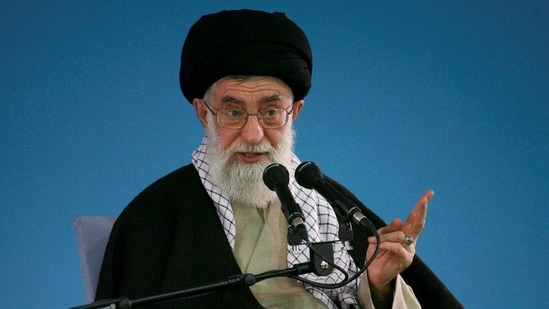
Iran’s Supreme Leader Ayatollah Ali Khamenei, the cleric who consolidated theocratic power for more than three decades and steered the Islamic Republic into confrontation with Israel and the United States, has died at 86, Iranian state media reported early Sunday.
State television and the official IRNA news agency announced his death without elaborating on the cause.
Hours earlier, US President Donald Trump said Khamenei had been killed in a joint American-Israeli operation targeting Iran.
Israeli and US forces launched major strikes Saturday against military and nuclear-linked sites across the country.
Khamenei’s death comes at a moment of extraordinary escalation, after months of mounting tensions and days of direct exchanges between Iran, Israel and the United States.
From Khomeini’s successor to the Islamic Republic’s longest-serving ruler
Khamenei took power in 1989 following the death of Ayatollah Ruhollah Khomeini, the architect of the 1979 Islamic Revolution that overthrew Shah Mohammad Reza Pahlavi and installed clerical rule. Where Khomeini was a charismatic ideologue, Khamenei – then a relatively low-ranking cleric – was seen as a quieter, more bureaucratic figure tasked with turning revolutionary zeal into a durable state.
He ended up ruling longer than Khomeini. Over 35 years, Khamenei expanded the clerical establishment and transformed the Islamic Revolutionary Guard Corps (IRGC) into the backbone of his authority. The Guard evolved into Iran’s most elite military force, controller of its ballistic missile arsenal and a vast business empire spanning energy, construction, telecommunications and finance.
Through a network of appointed bodies that could veto or override elected institutions, Khamenei became the ultimate arbiter of political life. Hard-liners described him as second only to God in authority.
Crackdowns at home, confrontation abroad
Khamenei’s rule was marked by persistent internal unrest and deepening external conflict.
Waves of protests, from the reform movement of the late 1990s to the disputed 2009 election of Mahmoud Ahmadinejad, challenged clerical rule. Security forces repeatedly responded with force. Economic grievances fueled further unrest in 2017 and 2019, when a crackdown over fuel price protests killed hundreds, according to activists.
The most explosive demonstrations followed the 2022 death of Mahsa Amini, detained for allegedly violating Iran’s mandatory headscarf rules. Protests against social restrictions broadened into calls for systemic change. More than 500 people were killed and tens of thousands arrested, rights groups said.
In late 2025, new economic protests swelled into what appeared to be the largest challenge yet to the Islamic Republic, with hundreds of thousands chanting slogans directly targeting Khamenei. Security forces launched a sweeping crackdown.
Abroad, Khamenei built what became known as the “Axis of Resistance” — a network of allied militant groups and political movements designed to project Iranian influence. Iran backed Hezbollah in Lebanon, supported militias in Iraq and Syria, and aided Yemen’s Houthi rebels. The strategy allowed Tehran to exert regional influence without direct conventional warfare.
But the regional wars ignited after Hamas’ Oct. 7, 2023, attack on Israel shook that architecture. Israel targeted Iranian-backed groups across the region, and in 2024 the two countries attacked each other directly for the first time. In 2025, Israeli and US strikes targeted Iran’s nuclear program and senior military officials.
Nuclear ambitions and standoff with Washington
Khamenei remained deeply suspicious of Washington, frequently referring to the United States as the “Great Satan.” Under his leadership, Iran advanced its nuclear program while denying any intention to build a bomb. He issued a religious ruling declaring nuclear weapons un-Islamic, yet insisted on Iran’s right to enrich uranium.
The 2015 nuclear deal curbed enrichment in exchange for sanctions relief. But Trump withdrew the US from the agreement in 2018 during his first term, reimposing sanctions. Iran subsequently exceeded the deal’s limits, enriching uranium to near-weapons-grade levels.
Diplomatic efforts to restore the agreement faltered. Tensions escalated sharply after Trump returned to office in 2025. In June of that year, Israel and the US bombed Iranian nuclear facilities. Indirect talks resumed, but no breakthrough followed.
On Saturday, US and Israeli forces launched what American officials described as a large-scale operation against Iranian military and nuclear-linked targets. Trump later said Khamenei had been killed in the strikes. Iranian state media confirmed his death hours later.
Succession questions loom
Khamenei’s death raises immediate uncertainty about the future of the Islamic Republic.
Under Iran’s constitution, the 88-member Assembly of Experts selects the Supreme Leader. No clear successor has been publicly confirmed. Much may depend on the Revolutionary Guard, which has shown a readiness to use overwhelming force to preserve the system.