

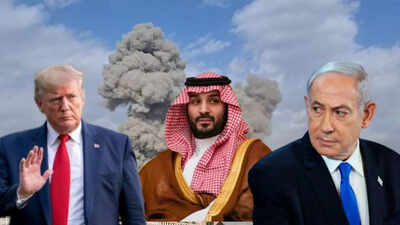
For nearly a decade, US President and MAGA supremo Donald Trump fashioned his political identity around a simple, potent pledge: end America’s “endless wars. ” He derided the foreign policy establishment as reckless interventionists and insisted he alone could resist the military-industrial complex. “I am the most militaristic person there is, but I don’t want to use it,” he often said, branding himself a “peace president. ”
Yet as 2026 unfolds, Trump’s second term tells a sharply different story — one marked by muscular interventions in Venezuela and now Iran, open threats against Greenland, Mexico, and Canada, and a worldview that fuses red-blooded nationalism with high-stakes brinkmanship.
The most dramatic rupture with Trump’s earlier peacenik posture came in January, when US forces launched a lightning operation in Venezuela that culminated in the capture of its President Nicolás Maduro and his wife, Cilia Flores. The raid — described by the White House as a “counternarcotics mission” — effectively decapitated the government in Caracas. But that was “small beer” compared to the action in Iran, where he has eviscerated the country’s top leader.
Trump framed the action in Venezuela as law enforcement. “We are taking out narco-terrorists who threaten American communities,” he said, adding that the United States would oversee a “stable transition.” Critics, including many Democrats on Capitol Hill, called it regime change by another name.
Behind the counternarcotics rationale lay broader geopolitical calculations. Maduro’s government had deepened ties with Moscow and Beijing, offering both a strategic foothold in the Western Hemisphere. The operation, dubbed by critics as part of a “Donroe Doctrine” — an amped-up reinterpretation of the Monroe Doctrine — signaled that Trump sees the Americas as a sphere where US dominance will be enforced, if necessary, by force.
This assertiveness has extended northward. Trump revived his long-standing ambition to “acquire” Greenland from Denmark, at one point suggesting military options if negotiations stalled. “We are going to do something on Greenland whether they like it or not,” he said in January, before softening the rhetoric at Davos amid NATO backlash. The episode rattled European allies and underscored a foreign policy that treats territory less as sovereign ground than as strategic real estate.
Nowhere is the contradiction between Trump’s rhetoric and actions more glaring than in Iran. In June 2025, after “Operation Midnight Hammer,” Trump declared that US strikes had “completely and totally obliterated” Tehran’s nuclear capabilities. “They will never have a nuclear weapon,” he said triumphantly, presenting the mission as a decisive end to the threat.
But eight months later, he authorized “Operation Epic Fury,” a sweeping joint assault with Israel targeting nuclear and missile facilities and senior regime figures. In a televised address, Trump offered a starkly different assessment. “The regime has continued to develop its nuclear program and plans to develop missiles to reach US soil,” he said. “We will ensure that Iran does not obtain a nuclear weapon… this regime will soon learn that no one should challenge the might of the US Armed Forces.”
The juxtaposition is jarring: a president who claimed to have eradicated the threat now invoking its “imminent” resurgence as justification for further war. US intelligence assessments last year suggested Iran was not actively pursuing a weapon, raising questions about the immediacy of the danger. Administration officials argue Tehran attempted to rebuild capabilities after the 2025 strikes, necessitating renewed force. For Trump, the distinction may be less about technical intelligence judgments than about projecting strength. In his framework, peace is achieved not through negotiated equilibrium but through overwhelming dominance.
Layered atop these actions is Trump’s long-running preoccupation with the Nobel Peace Prize. He has repeatedly argued that diplomatic efforts such as the Abraham Accords merited recognition and has publicly lamented that “Norway foolishly chose not to give me the prize.” He has repeatedly claimed he had “ended eight wars” and saved “tens of millions of lives,” suggesting that his critics ignore the stabilizing effects of his assertiveness. In messages to Norwegian officials, he hinted that perceived slights diminish his incentive to “think purely of Peace.”
The irony is unmistakable. Trump equates peace with submission — conflicts concluded through coercion or decisive force. By that logic, escalating crises to a breaking point and then imposing outcomes can be cast as peacemaking. The result is a presidency that is simultaneously isolationist and interventionist. Trump remains skeptical of multilateral institutions, has slashed foreign aid, and demands allies shoulder more burdens. Yet he has demonstrated a readiness to deploy American power unilaterally in pursuit of strategic leverage. Supporters see decisive leadership restoring deterrence. Detractors see erosion of alliances and a pattern of regime-change operations once denounced as folly.
The central paradox endures: a leader who rose to prominence condemning foreign entanglements now presides over an era of expanding military engagements. In Trump’s evolving doctrine, “America First” does not mean withdrawal from the world. It means reshaping it — forcefully if necessary — while insisting the ultimate aim is peace, and perhaps, a medal, which he may well pin on himself, to prove it.



