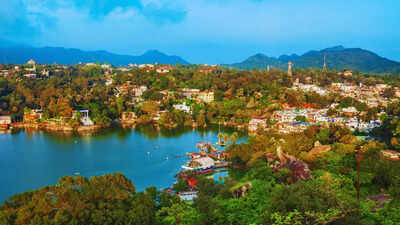
Rajasthan has announced new names for three historic destinations, a move the state government says is aimed at preserving cultural heritage. Chief Minister Bhajan Lal Sharma made the declaration in the Assembly during discussions on the Finance Bill, and later on his official account on X, confirming that Mount Abu, Kaman and Jahazpur will now be officially known as Abu Raj, Kamvan and Yagyapur, respectively. His post reads (translated), “Taking into account public sentiments, our government has decided to rename three major places in Rajasthan. Mount Abu will now be known as ‘Abu Raj’, Jahazpur as ‘Yajnapur’, and Kaman as ‘Kamvan. ”
For travellers, the change is more than administrative, it reshapes how some of Rajasthan’s culturally rich locations will appear on maps, signboards and tourism material in the coming months.

Mount Abu is now Abu Raj
Rajasthan’s only hill station, Mount Abu, will be renamed Abu Raj. Nestled in the ancient Aravalli range at an elevation of about 1,722 metres above sea level, the town has long been a summer retreat for visitors escaping the desert heat.
Despite the name change, the experience remains the same. The traveler will still enjoy the cool mountain air, the forest cover on the slopes, and the views from the top. At Abu Raj, the Dilwara Temples are famous for their craftsmanship in marble.
There is also the scenic spot of Nakki Lake, where boating is still a popular activity.
The hill station also holds a special place in mythology. It is said to be the place where Sage Vashistha is supposed to have been present. There are temples here too. With the new name, officials suggest the emphasis will be on highlighting indigenous and historical identity rather than its colonial-era nomenclature.
For tourists planning a visit, bookings, routes and attractions remain unchanged, though future travel brochures and railway announcements may begin reflecting “Abu Raj.”
Kaman becomes Kamvan
The town of Kaman, located in Bharatpur district, will now be known as Kamvan. Kaman is an important religious destination, particularly for devotees of Lord Krishna. The town is dotted with temples and kunds (sacred water tanks) linked to Braj heritage. Its closeness to Mathura and Vrindavan means that it is part of a larger tourism circuit centered around spirituality.
With its new name of Kamvan, which is steeped in local lore, it seems that the state is looking to tap into its existing connections with mythology. For tourists, it could be a renewed interest in temple tourism and heritage walks that are connected to Braj culture.
Jahazpur renamed Yagyapur
In Bhilwara district, Jahazpur will now be called Yagyapur. Jahazpur is also famous for its ancient fort and temple ruins, which showcase the historical past of the Rajputs and the medieval era. The fort in the town provides a panoramic view of the surrounding plains and is a must-visit destination for travelers who wish to explore the state of Rajasthan beyond the popular cities of Jaipur and Udaipur.
The new name, Yagyapur, is derived from the ancient Sanskrit words used in ritualistic worship and is a reflection of the town’s association with the subject. Tourism experts are of the view that the new name could revive the town’s popularity as a destination for travelers who are keen on exploring the subject.
What this means for tourism
Rajasthan is one of the most popular states in India in terms of tourism. While Jaipur, Udaipur and Jodhpur dominate most itineraries, places like Abu Raj (formerly Mount Abu), Kamvan and Yagyapur offer quieter, culturally immersive experiences.
Importantly, none of the destinations are changing in character. Abu Raj continues to be the state’s only hill station and a green escape within Rajasthan’s arid terrain. Kamvan retains its spiritual importance in the Braj circuit. Yagyapur remains a historic town with fort architecture and regional charm.
A heritage rebranding
The Rajasthan government has stated that the renaming exercise is intended to preserve and promote the state’s heritage. For travellers, it signals a shift toward emphasising indigenous history and cultural roots in destination branding. For now, Rajasthan’s landscapes stay timeless, even if the names on the map are evolving.