

Zoho Executives Warn of AI-Driven Job Cuts in Tech
Senior executives at Indian software giant Zoho warn that the tech industry has reached a “productivity tipping point,” where AI tools will lead to a significant reduction in jobs, even as they boost output.
Key Takeaways
- Zoho’s Chief Evangelist, Raju Vegesna, says AI is pushing tech towards a “productivity tipping point” that shrinks workforces.
- Co-founder Sridhar Vembu notes AI makes senior engineers far more productive, reducing the need for junior developers.
- An internal example showed one engineer completing a year-long project in just one month using AI.
- Both executives highlight a looming dilemma: fewer junior roles could hinder training the next generation of software architects.
The “Productivity Tipping Point”
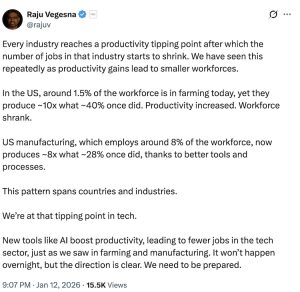
In a recent post on X, Zoho Chief Evangelist Raju Vegesna stated that tech companies are approaching a critical phase. “Every industry reaches a productivity tipping point after which the number of jobs in that industry starts to shrink,” he wrote.
He drew parallels with history: “In the US, around 1.5 per cent of the workforce is in farming today, yet they produce nearly ten times what about 40 per cent once did. Productivity increased. Workforce shrank. The same pattern played out in manufacturing. Now we’re seeing it in tech.”
Vegesna explained that AI tools are already boosting engineer output, meaning fewer people will be needed to deliver the same or better results. While the shift won’t be overnight, he believes it will eventually lead to fewer jobs overall.
AI Reshaping Software Development at Zoho
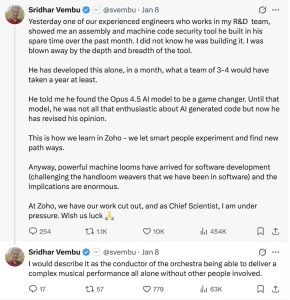
Co-founder Sridhar Vembu has echoed these concerns, focusing on AI’s disruptive potential in software development. “AI makes senior architects more productive and reduces the need for junior engineers,” Vembu wrote.
He described experienced engineers now acting like orchestra conductors, guiding AI tools to achieve outcomes that once required entire teams.
Vembu shared a striking internal example: one Zoho engineer built an advanced assembly and machine-code security tool in just one month. Traditionally, this project would have taken a team of three or four engineers close to a year.
“He told me he found the Opus 4.5 AI model to be a game changer. Until that model, he was not all that enthusiastic about AI generated code but now he has revised his opinion,” Vembu wrote.
A Looming Training Dilemma
While celebrating the productivity gains, Vembu flagged a significant future challenge. He questioned how the industry will train its next leaders if entry-level roles vanish.
“But if we don’t have junior engineers, we don’t get to train the next generation of architects — after all, how does someone become a software architect without being a junior engineer first?” he wrote.
Nevertheless, Vembu acknowledged the transformation is already underway. “Powerful machine looms have arrived for software development,” he wrote, “challenging the handloom weavers that we have been in software — and the implications are enormous.”