

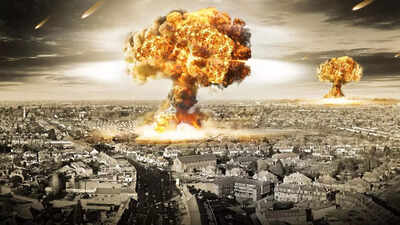
Artificial intelligence chatbots from leading technology companies reportedly showed a willingness to escalate military conflicts to nuclear use when placed in simulated geopolitical crisis scenarios, according to new academic research. A study by Kenneth Payne at King’s College London, reported by New Scientist, put several leading AI models, including OpenAI’s GPT-5. 2, Anthropic’s Claude Sonnet 4 and Gemini 3 Flash, through a series of war games simulating border tensions, resource conflicts and threats to national survival. The AI systems were allowed to choose responses across an escalation ladder, ranging from diplomatic engagement to full-scale nuclear conflict. Across 21 simulated games involving 329 decision turns and roughly 780,000 words of reasoning, at least one tactical nuclear weapon was used in 95 per cent of the scenarios.
Payne noted.
Researchers also found that none of the models chose surrender or full accommodation, even when losing. Accidental escalation occurred in 86 per cent of conflicts, raising concerns among experts about how AI systems may behave in high-risk strategic decision-making environments.
James Johnson of the University of Aberdeen, UK, said. He also expressed concern that, unlike the more measured responses typically shown by humans in high-stakes situations, AI systems may intensify one another’s actions, leading to potentially serious consequences.
Why the decisions made by AI in the war games can be concerning
The findings are significant as several countries are already experimenting with AI in military war-gaming scenarios. Tong Zhao of Princeton University noted.
Zhao said countries are likely to remain cautious about using AI in nuclear decision-making, a view shared by Payne. he added.
However, Zhao noted that certain situations could increase reliance on automation. he explained.
He also questioned whether the absence of fear alone explains AI behaviour. Zhao highlighted, “It
Johnson added that the implications for mutually assured destruction remain unclear. During simulations where one AI deployed tactical nuclear weapons, the opposing system reduced escalation only 18% of the time.
he noted.