

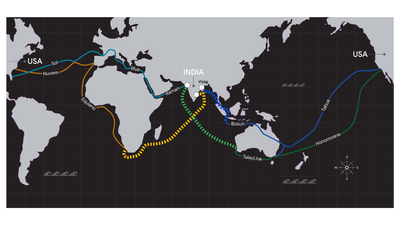
Alphabet’s Google has announced a major new infrastructure push in India—new fiber-optic routes that will connect the country with the United States and several locations across the Southern Hemisphere. CEO Sundar Pichai made the announcement at an AI summit in New Delhi, where he also met with Prime Minister Narendra Modi. The initiative sits under Google’s already-announced $15 billion AI infrastructure investment in India over five years.
Three new undersea paths, one new gateway city
At the core of America-India Connect are three new subsea cable paths—connecting India to Singapore, South Africa, and Australia—plus four fiber-optic routes linking the US, India, and the Southern Hemisphere.
The more interesting detail is Vizag. Google is building direct fiber connections from Visakhapatnam to both South Africa and Singapore, turning the east coast city into a proper international subsea gateway. India’s existing cable landings are clustered around Mumbai and Chennai, so Vizag adds real geographic diversity to the country’s internet infrastructure.
On the west coast, a new Mumbai-to-Western Australia cable will slot in alongside existing Pacific routes.
Why Google says better cables mean better AI access
The argument Google is making is straightforward: reliable infrastructure is the most practical counter to an AI divide. More subsea capacity typically means cheaper, faster internet—which feeds into productivity and economic growth at scale.
Alongside the cable announcements, Google.org pledged $30 million to improve public services with AI and another $30 million for scientific research. Google DeepMind is also launching a new partnership with the Indian government to deploy its frontier AI for Science models locally.
India becomes a bigger piece of Google’s global spending spree
The India push is one slice of a much larger spending blitz. Google said its capital expenditures could hit $185 billion this year alone, with recent commitments in Belgium, the UK, and South Carolina.
For Google, India is clearly more than just a growth market at this point—it now has its largest global campus in Bangalore and a fast-expanding roster of local partnerships.