Wealth creation can seem intimidating for many – where should you put your money for steady returns over short-term, medium and long term? In today’s world of heightened uncertainty, the question becomes even more pertinent. Are stocks the right way to go or are they too risky? Gold and silver have been rising at a record breaking speed – should your hard earned money be invested in them? And what about the age old wisdom of putting money in fixed deposits?
While experts believe that one investment strategy doesn’t work for everyone, and risk profile and time horizon play a crucial role, they are broadly in consensus on what a large part of your portfolio should look like. One lesson is clear: Don’t chase asset classes with recent highs, instead focus on long-term wealth creation.
Investing ₹1 lakh with a long-term horizon should focus on wealth creation, and historically equities have been the most effective asset class for long-term growth.
Depending on risk appetite and financial knowledge, investors may allocate some portion directly to stocks, though for most, mutual funds offer a more practical and diversified approach. A mix of active, sectoral or thematic, and low-cost index funds or ETFs can provide both growth potential and broad market exposure.
Since no single asset class outperforms in every cycle, diversification is essential to smooth returns and reduce volatility. A practical allocation could involve a majority in equities for growth, around ~20% in commodities like gold for diversification and inflation protection, and about ~10% in debt instruments for stability and liquidity. This balanced approach keeps the portfolio growth-oriented while providing resilience during market uncertainty.
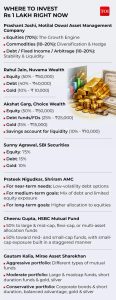
- Equities (70%): The Growth Engine
Equities are the foundation of long-term wealth creation due to their strong inflation-beating potential. A diversified mix of active funds (across market caps and strategies) along with index funds and selective sector exposure enables broad market participation. The Nifty 50 Total Return Index has delivered about ~12% CAGR over the past 25 years, highlighting equities’ long-term growth power. Investing through SIPs helps average costs, reduce timing risk, and benefit from different market cycles.
- Commodities (10–20%): Diversification & Hedge
The recent rally in commodities underscores their importance in a diversified portfolio, particularly assets like gold and silver. Over the long term, they can deliver solid returns while also acting as a hedge against inflation and market volatility. During periods when equities underperform, gold often serves as a safe-haven asset, helping stabilize portfolio performance.
- Debt / Fixed Income / Arbitrage (10–20%): Stability & Liquidity
Allocating 10–20% to debt instruments such as government bonds, FDs, PPF, or arbitrage funds provides stable and predictable returns. With bond yields around 6–7% and PPF offering ~7.1% tax-free interest, this portion helps reduce portfolio volatility and serves as a liquidity buffer during market stress or unexpected cash needs.
Invest in well-managed flexicap funds with a largecap bias. These funds offer stability and valuation comfort. Besides, fund managers can easily change their investments between large, mid, and small companies based on market trends.
This portion helps keep your portfolio stable and provides regular income, which is helpful when stock markets are volatile. Use a mix of bank fixed deposits for quick access to cash and high-quality non-convertible debentures (NCDs) for better interest rates than inflation.
acts as an anchor in the portfolio, providing protection against geopolitical risks, currency depreciation, and market volatility. Investors can gain exposure through gold ETFs, which track gold prices, offer liquidity, and are relatively tax-efficient compared to physical gold.
Disclaimer: Asset allocation will depend on age and a variety of other factors. The above is for illustration purposes only. Please consult a registered financial advisor or wealth manager before investing.
The market returns across large cap to small cap are in negative trajectory from last 3 months as Nifty 50 TRI delivered -2.3%, Nifty Midcap 150 – TRI at -2% and Nifty Smallcap 250 – TRI is at -5.7% as on 20th Feb 2026.
Despite a good earnings season, the India- US trade deal, the FTA between India and EU, a pro-growth Union Budget and benign inflation data, the market is still showing weakness. This time correction and price correction across the market may persist because of geopolitical issues as well as fear of rising crude oil prices.
If your investment tenure is more than 5 years and you have a high risk appetite, then you should allocate predominantly to equity with a large cap bias and build allocation to mid and small caps in a staggered manner.
Despite multiple rate cuts by RBI, yields are at elevated levels and the RBI would keep enough liquidity and focus on transmission of the rate cuts. Considering current yields and global crude oil uncertainty, one should have allocation to the short end of the yield curve. Accrual strategy (Corporate bond and short duration debt schemes) preferred.
Gold and silver prices remain volatile. Investors should continue to maintain around 10% of their portfolio as hedge against global uncertainties and continued US dollar weakening.
If I had ₹1 lakh to invest right now, I wouldn’t chase what’s trending. I’d focus on balance. Markets are never perfectly calm, so the idea is to participate in growth while managing risk sensibly.
I would allocate about half the amount — ₹50,000 — to equities through a combination of a large-cap and a quality multi-cap or focused fund, with a minimum time horizon of five to seven years. Equity remains the most reliable way to create real wealth over the long term, provided you stay patient through volatility. Around ₹25,000 would go into short-duration debt funds or a 1–2 year fixed deposit. This portion acts as a stabiliser and is suitable for a one- to three-year horizon.
I would allocate roughly ₹15,000 to gold, preferably via Sovereign Gold Bonds or a gold ETF, with a three- to five-year view. Gold isn’t about high returns; it’s about protection during uncertain phases. The remaining ₹10,000 would stay in a liquid fund or savings account as a buffer for immediate needs or opportunities.
In terms of execution, I’d deploy a majority upfront if comfortable, and stagger the rest over a few months. Most importantly, the investment should align with a clear goal and time frame. Discipline matters more than timing.
Within equity investors can allocate funds towards fundamentally sound businesses across sectors like Auto/Auto Ancillary (M&M, Bajaj Auto, Lumax Industries, Pricol, SJS Ent etc), Defence (BEL, Solar Industries), Metals/Mining (Nalco, Tata Steel, IMFA, GPIL), Fin.Serices (BoB, ICICI Bank, Shriram Finance, 360 WAM, NAM India, KFIN etc), Consumption/Diversified (Reliance,. CCL Products, Varun Beverages, Voltas, Titan, Bajaj Consumer, Swiggy etc), Telecom (Bharti, Indus Tower), Oil & Gas (HPCL), IT (HCL Tech) etc.
In the current uncertain global environment, exposure to debt will offer stability to the portfolio.
Exposure to gold offers a hedge against the unforeseen global events and trend of de- dollarisation.
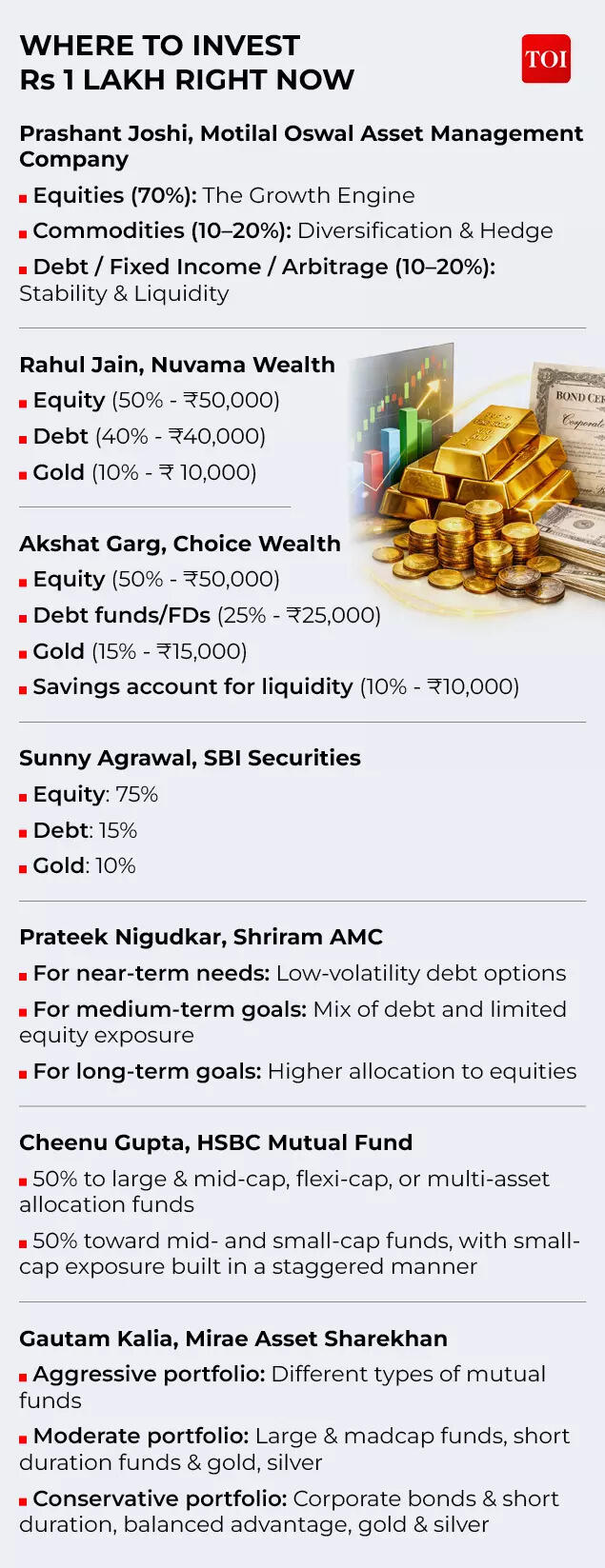
There is no one-size-fits-all way to invest ₹1 lakh. The appropriate asset mix depends not just on time horizon, but also on an investor’s risk appetite, liquidity needs, existing asset allocation, income stability, and financial goals. For near-term needs, the focus should be on liquidity and capital protection through low-volatility debt options. For medium-term goals, a mix of debt and limited equity exposure can help balance stability and return potential. For long-term goals, a higher allocation to equities may be considered to participate in growth, with some debt for stability. The key is aligning the asset mix to the investor’s time horizon and risk appetite, rather than trying to time markets or chase returns. Investors should assess suitability and consult a financial advisor before investing.
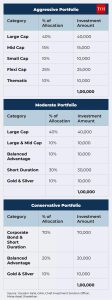
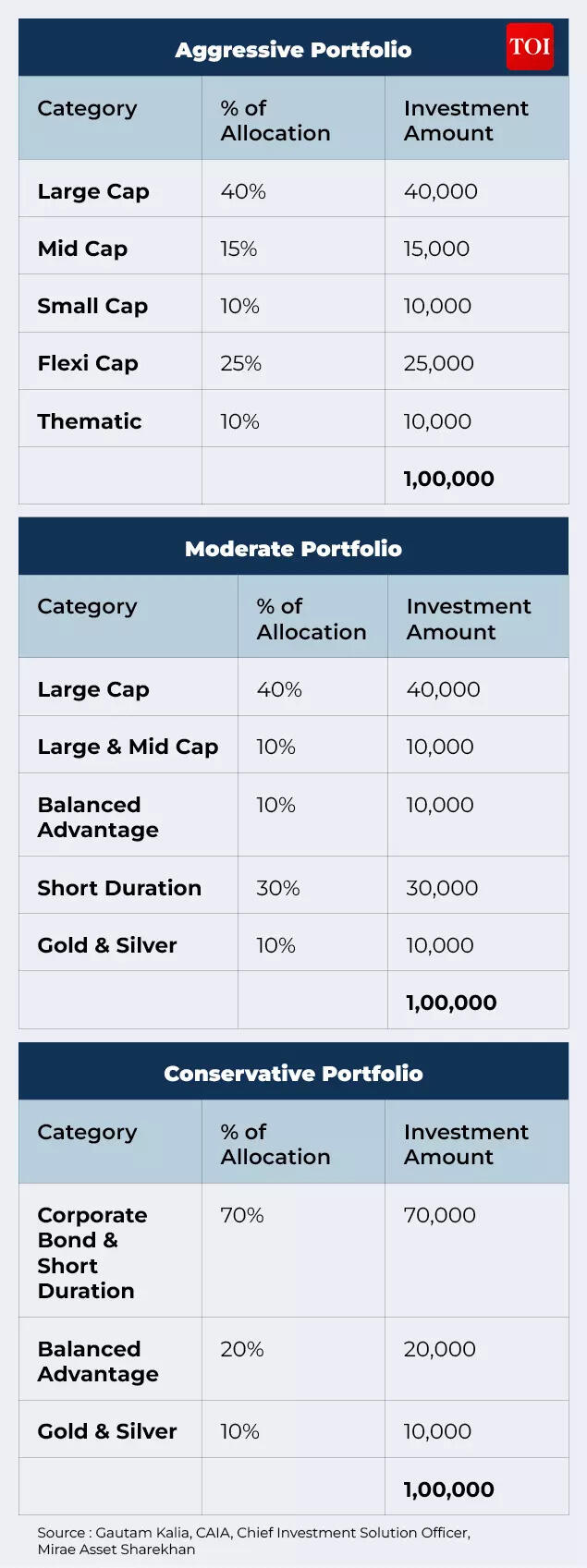
In 2026, amid shifting interest rates and elevated valuations, investors should prioritise disciplined asset allocation over short-term market reactions. Portfolio positioning should remain aligned with individual risk appetite, investment horizon and financial goals. Conservative investors typically structure portfolios with a greater emphasis on stability-oriented assets, keeping exposure to growth assets limited to manage volatility. Moderate investors usually follow a balanced approach, with diversification across growth and stability-oriented assets, segments and styles.
Aggressive investors, given their higher risk tolerance and longer investment horizons, generally maintain higher exposure to growth-oriented assets, while continuing to benefit from diversification and periodic portfolio reviews. Across all profiles, regular rebalancing is essential to keep portfolios aligned with long-term objectives.
As for mutual funds, investors need not rethink the product itself in 2026. Instead, the focus should return to fundamentals such as asset allocation, diversification and suitability.
Rather than favouring or avoiding specific fund categories based on market conditions, aligning mutual fund investments with risk appetite, time horizon and financial goals, combined with periodic review, can help navigate varying market environments more effectively.
We have already experienced nearly 18 months of time correction, and with Q3 FY26 earnings showing encouraging strength and FY27 earnings growth expected to improve meaningfully over FY25 and FY26, the earnings cycle seems to be turning.
With valuations having moderated and earnings visibility improving, this appears to be an opportune phase for investors to begin accumulating mid- and small-cap exposure. Mid-caps can be considered for selective lump-sum allocation given their improving fundamentals, while small caps, being more sensitive to liquidity and sentiment cycles, are better accumulated gradually through SIPs or STPs.
Additionally, given the evolving geopolitical landscape and global uncertainties, maintaining allocation to equities alongside precious metals like gold appears prudent for long-term portfolio resilience.
Therefore, for an investment of ₹1 lakh today, a balanced approach could involve allocating 50% to diversified options such as large & mid-cap, flexi-cap, or multi-asset allocation funds — the latter offering exposure to equity along with gold and other asset classes — and the remaining 50% toward mid- and small-cap funds, with small-cap exposure built in a staggered manner. A disciplined 3–5 year investment horizon will be key to realizing the potential of this allocation strategy.