

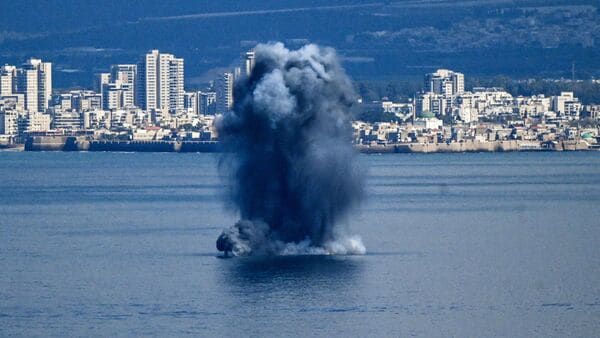
Indian stock market benchmark indices Nifty 50 and Sensex are expected to open in sharp sell-off mode on Monday after a dramatic escalation in West Asia rattled global sentiment. A coordinated military strike by the United States and Israel on Iran has significantly heightened geopolitical tensions and further weakened already fragile investor risk appetite.
According to media reports, the joint operation resulted in the death of Iran’s Supreme Leader Ayatollah Ali Khamenei, who had led the country for over three decades.
Iran has responded forcefully, reportedly launching missile strikes targeting Israel and several Gulf nations, including Saudi Arabia, Bahrain, Qatar, Kuwait and the United Arab Emirates — countries that host US military bases. The developments have intensified fears of a broader regional conflict, triggering risk-off sentiment across global markets.
As tensions rise in the Gulf, markets are once again bracing for volatility. But according to market veteran Devina Mehra, Founder & CMD. First Global, the instinctive reaction — panic selling — may be precisely the wrong move.
In a detailed post on X, Mehra addressed both the geopolitical and financial dimensions of the unfolding US–Iran confrontation. While she promised a deeper video analysis later, her central message was immediate and clear: history does not support emotional exits from markets during geopolitical flare-ups.
“Spoiler alert: There is no need for panic selling – that is what the history of Geo political conflicts tell us.”
That framing sets the tone. Markets often react sharply to geopolitical shocks, but data across decades shows that unless conflicts morph into prolonged global disruptions, the long-term trajectory of equities remains intact.
Geography, Regime Stability & Strategic Limits
Questioning, what the United States’ actual objective might be, Mehra note, “The geography of Iran (surrounded by mountains and deserts) is such that a land war is simply impossible. Remember the area of Iran is more than half that of India – it is not a small country.”
Mehra also highlighted the political reality inside Iran. Contingency planning at multiple levels is reportedly in place. Under such circumstances, expecting spontaneous internal overthrow is unrealistic.
She noted that calls for the Iranian public to rise up “make no sense” given the regime’s demonstrated willingness to suppress dissent.
“Ironically I understood that regime change of even a bad regime is not always good thanks to the Iranian revolution… Never ever say: Anything will be better than this.”
It is a caution against simplistic narratives. History shows that destabilising an existing regime does not guarantee a better outcome — and often produces unintended consequences.
The Real Market Risk: Insurance, Not Oil
Rather than framing the conflict in terms of oil supply disruptions alone, she shifts attention to insurance markets and regional risk premium.
“It is not about the physical security of the Straits of Hormuz, it is about whether anyone is willing to insure the risk of oil moving through those straits.”
Mehra further argued that by targeting civilian buildings and creating dramatic visual signals — such as drones near landmark structures — Iran may be amplifying psychological and financial risk rather than maximising military damage.
In other words, the strategy may be to raise the regional risk premium — making the Gulf more expensive, more uncertain and less investable — in hopes that neighbouring economies exert pressure on the United States.
For markets, this translates into volatility, higher crude prices and short-term fear spikes. But unless escalation widens dramatically, history suggests markets eventually stabilise.
Mehra’s overall message is sober rather than alarmist. Yes, there are real risks. Yes, families and businesses in the region face uncertainty. But investment decisions should be guided by data and history — not headlines.
Disclaimer: The views and recommendations made above are those of individual analysts or broking companies, and not of Mint. We advise investors to check with certified experts before making any investment decisions.