
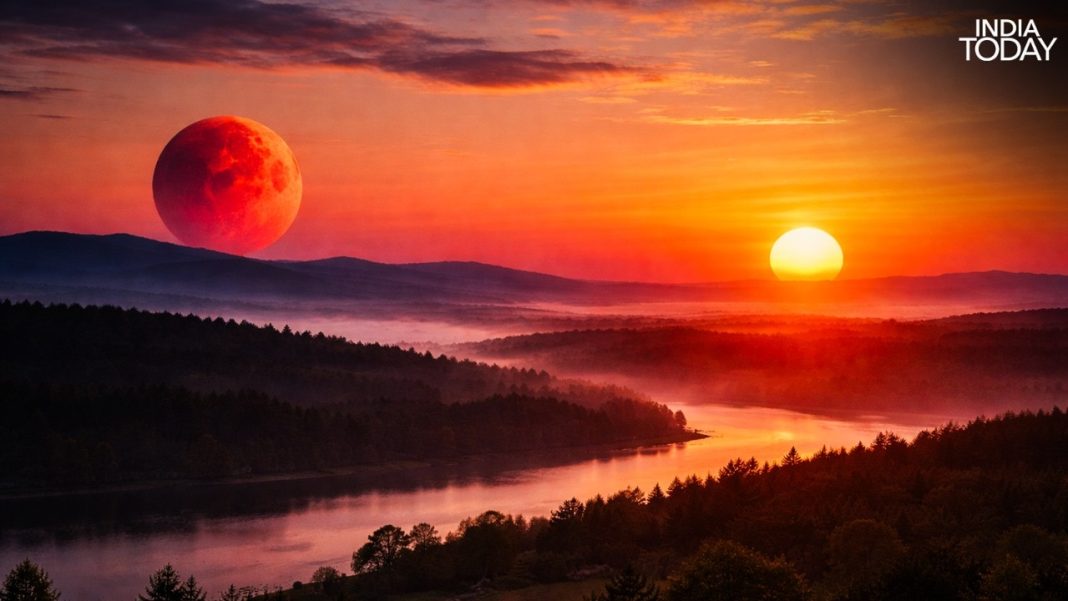
Imagine looking at the horizon to see a blood-red Moon sinking in the West while the Sun begins to glow in the East at the exact same time. This is the magic of a Selenelion, a rare cosmic alignment that is captivating skywatchers right now.
On March 3, 2026, the Earth is witnessing a total lunar eclipse with a twist that seems to break the rules of geometry. While the Sun and Moon are technically positioned 180 degrees apart during an eclipse, a rare optical trick allows both to be visible simultaneously.
WHAT IS A SELENELION ECLIPSE?
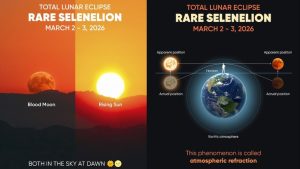
A Selenelion occurs when the Sun and the eclipsed Moon can be seen at the same time, appearing on opposite sides of the sky.
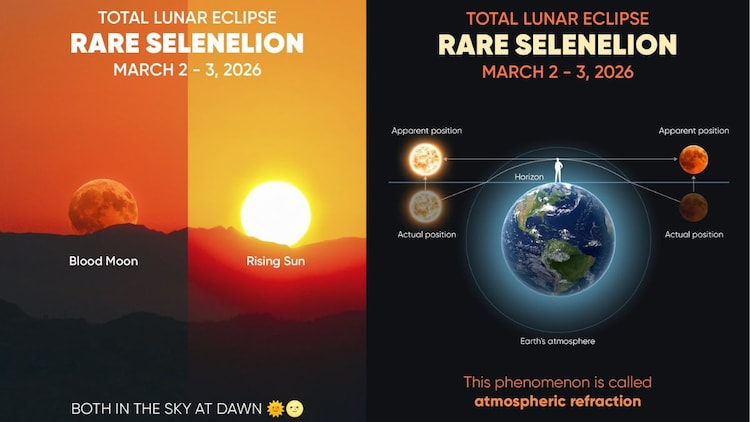
Under normal circumstances, this should be physically impossible. During a total lunar eclipse, the Earth, Sun, and Moon align in a perfectly straight line.
Because they are directly opposite each other, the moment the Sun rises, the Moon must set, and vice versa. However, for a brief window of roughly two to nine minutes during sunrise or sunset, both celestial bodies remain in view.
HOW CAN WE SEE THE SUN AND MOON TOGETHER?
The reason we can see this impossible sight is due to atmospheric refraction. Our atmosphere acts like a massive, natural lens that bends the light rays coming from space.
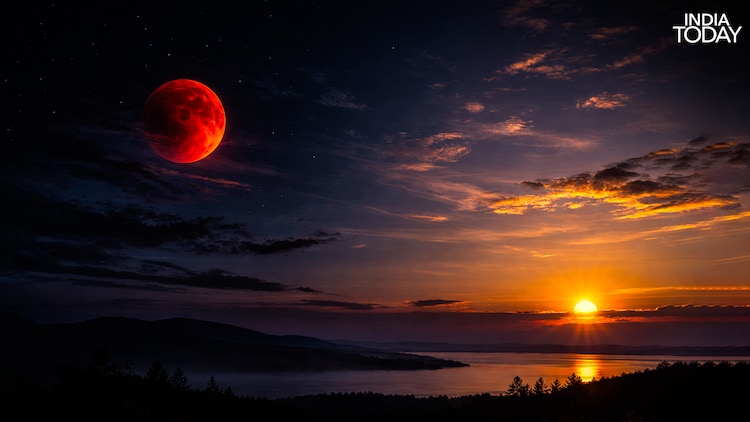
This bending of light visually lifts the images of both the Sun and the Moon above the horizon, even when they have technically already dipped below it.
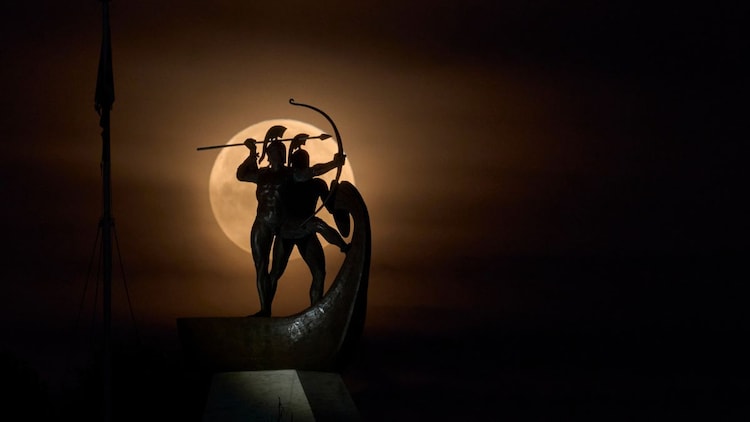
It is essentially a beautiful cosmic illusion. While the actual positions of the Sun and Moon are below the horizon line, the atmosphere allows us to see their images lingering in the sky.
This allows the blood-red Moon to remain visible for those few extra minutes as the Sun begins its morning ascent.
WHAT IS UNIQUE ABOUT THE 2026 ECLIPSE?
This particular eclipse is special because the timing of the Moon’s entry into the deepest part of the Earth’s shadow aligns perfectly with the transition between day and night for millions of people.
While the total eclipse is a global event, the Selenelion effect is a regional treasure. In the Eastern United States and parts of Canada, early risers are currently looking for that haunting copper-toned Moon in the West while dawn breaks in the East.
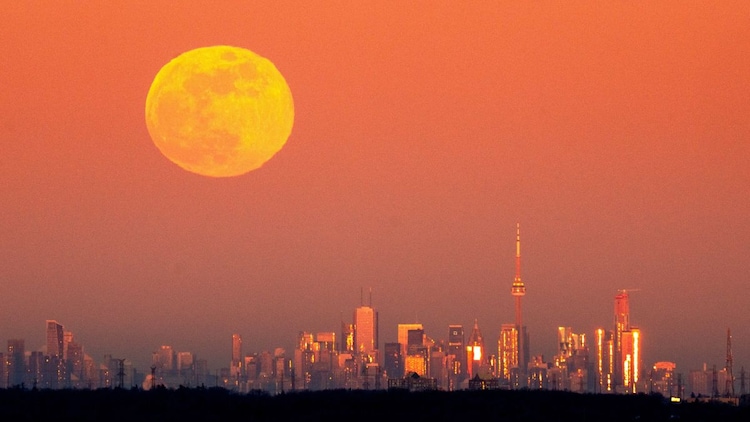
In India, the maximum phase of this eclipse occurs at 5:04 PM IST. Because the Moon is passing deep into the shadow of the Earth, it takes on a dark red or orange hue, a phenomenon often called a Blood Moon.
This happens because Earth’s atmosphere filters out blue light, allowing only the longer red wavelengths to reach the lunar surface and bounce back to our eyes.