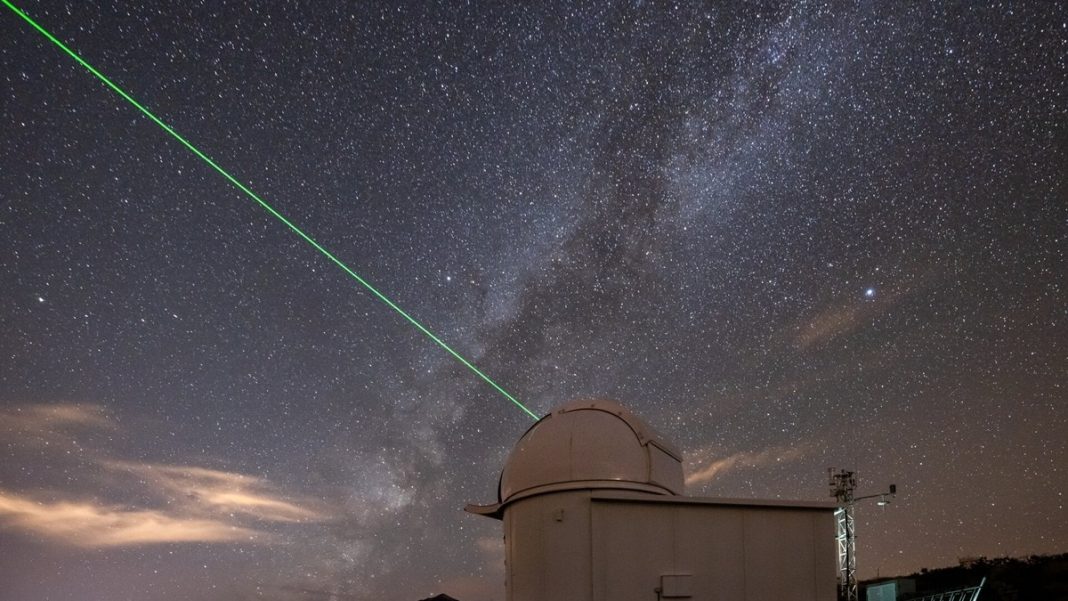
Why are we unable to find aliens? Something is blocking their signals

For decades, scientists hunting for signs of alien life have been scanning the skies for radio signals.

These signals are sharp, narrow spikes in frequency that have not yet been found.

But what if those signals exist, and we’re simply not catching them because space weather is blurring them out of recognition?

That’s the unsettling possibility raised by a new study from the Search for Extraterrestrial Intelligence (SETI) Institute, published in The Astrophysical Journal.

A monitor shows a radio signal of the Rosetta spacecraft in space. (Photo: Reuters)

A monitor shows a radio signal of the Rosetta spacecraft in space. (Photo: Reuters)

WHAT IS MAKING ALIENS SIGNALS HARD TO DETECT?

The culprit, researchers said, is what is called stellar plasma.

Stellar plasma is a turbulent, electrically charged gas that swirls around stars.

When a radio signal travels outward from a planet, it first has to pass through this plasma environment. That journey can blur the signal, spreading it across a wider range of frequencies and making it weak.

Traditional SETI searches are designed to find ultra-narrow, razor-sharp signals. But if a signal gets blurred before it even leaves its home star system, it simply won’t match what our detectors are looking for, and will get missed entirely.

“If a signal gets broadened by its own star’s environment, it can slip below our detection thresholds, even if it’s there, potentially helping explain some of the radio silence we’ve seen in technosignature searches,” said Dr Vishal Gajjar, astronomer at the SETI Institute and lead author of the paper.

An image of a swirling mass of plasma spinning above the Sun's surface. (Photo: Reuters)

An image of a swirling mass of plasma spinning above the Sun’s surface. (Photo: Reuters)

HOW DID SCIENTISTS FIND OUT?

The team used something surprisingly close to home. It relied on radio transmissions from our own spacecraft.

By measuring how solar plasma distorts signals from probes within our solar system, they built a framework to estimate how much blurring could happen around other stars.

“By quantifying how stellar activity can reshape narrowband signals, we can design searches that are better matched to what actually arrives at Earth, not just what might be transmitted,” said co-author Grayce C Brown.
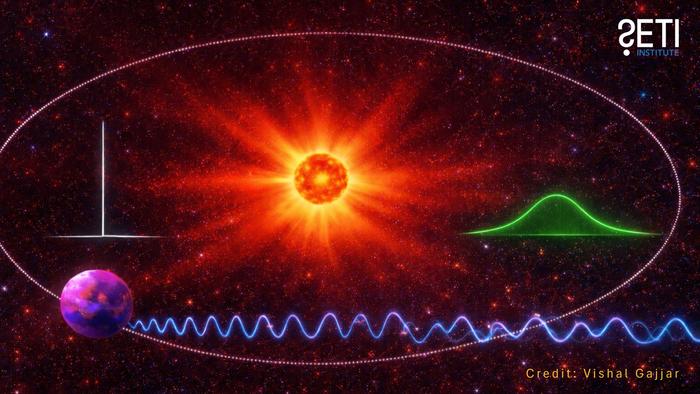
An illustration of a radio signal and its analysis. (Photo: SETI/Vishal Gajjar)

An illustration of a radio signal and its analysis. (Photo: SETI/Vishal Gajjar)

The findings are especially relevant for M-dwarf stars.

M-dwarf stars are the small, active, and frequently stormy stars that make up roughly 75 per cent of all stars in the Milky Way.

These stars are prime candidates in the alien-life search, but their intense space weather makes signal distortion far more likely.

The study pushes scientists to rethink how SETI searches are designed; building detectors sensitive to broader, fuzzier signals, not just perfect narrow ones.

In the hunt for alien life, it turns out, the universe’s own weather might have been throwing us off the scent all along.
Latest

Solar superstorm that struck Earth in 2024 led to computer mayhem on Mars

While Earth experienced dazzling auroras seen as far south as Mexico, Mars faced a very different and far more intense impact.

15-year heat record shattered: Why March is making you sweat like never before

IMD confirmed that the hot temperatures are creating conditions that more closely resemble late April or May than early March.

This bird flew 13,000 km without stopping for 11 days from Alaska to Australia

The birds rely on accurate navigation, conserving energy and sleeping while flying to survive long journeys.

Delhi to hit 36 degrees on Monday, Himachal Pradesh on heat wave alert

Delhi is set to touch 36 degrees Celsius on Monday as the IMD warns of heat waves across northwest India and incoming snow in Jammu and Kashmir.

An iceberg twice the size of London lasted 40 years at sea. Its time is up

A colossal Antarctic iceberg that broke off in 1986 and weighed nearly a trillion tonnes is finally disintegrating in the South Atlantic. Scientists say it will

Topics

Why Adin Ross plans legal action against TMZ after sister Madeline Ross death report leaves him shocked during emotional livestream

US Streamers News: Adin Ross is speaking out after a painful personal moment became public news. The popular Kick streamer recently said he plans to take legal

Marco Rubio or JD Vance? Donald Trump asks donors whom they prefer for president in 2028 — report

US News: In the early hours of Feb. 28, President Donald Trump and his administration joined Israel in launching a wave of strikes on Iran, and later that nigh.

Minnesota lawmakers condemn Hinduphobia and anti-Hindu bigotry in new law — Everything you need to know

US News: Minnesota lawmakers have introduced a resolution in the state legislature condemning Hinduphobia and anti‑Hindu bigotry and reaffirming the state’s

War against Iran ‘very much complete’ says Trump, makes bold claim: ‘They’ve got no Air Force, communications…’

In an interview with a US media outlet, Trump reportedly said that the war ‘could be over soon’. He also had a call with Russian President Vladimir Putin to

Trump rules out sending US troops to Iran N-site, slams defiant Mojtaba Khamenei

The clear indication comes as Iran faces upheaval following the death of Supreme Leader Ayatollah Ali Khamenei in US-Israeli airstrikes and the rapid appointmen

Putin shares proposals to end Iran war ‘quickly’ in call with Trump, says Kremlin

The Kremlin said the phone call was initiated by Trump. The two leaders also discussed the ongoing war in Ukraine, it added.

Can Pakistan stay neutral as the US-Iran war pulls it towards Saudi Arabia?

Pakistan spent months courting Donald Trump and signing defence pacts with Saudi Arabia. Now West Asia is on fire and Islamabad is discovering that playing ever

Trump leaves door open on controlling Iran oil, says ‘too soon’ to talk about it

The statement came as fallout from the ongoing armed conflict in the Middle East sent global crude prices soaring past USD 110 per barrel, with fears of prolon
spot_img

Related Articles

Popular Categories

spot_imgspot_img