

Key Takeaways
- Earth and a Mars-sized protoplanet called Theia collided 4.5 billion years ago, forming the Moon
- New evidence shows Earth and Moon have nearly identical chemical compositions
- Theia likely formed as Earth’s close neighbor between our planet and the Sun
Earth’s Moon was likely created when our planet collided with a massive neighbor called Theia approximately 4.5 billion years ago. Groundbreaking research from the Max Planck Institute reveals this ancient protoplanet was probably Earth’s cosmic next-door neighbor rather than a distant visitor.
The Cosmic Collision That Created Our Moon
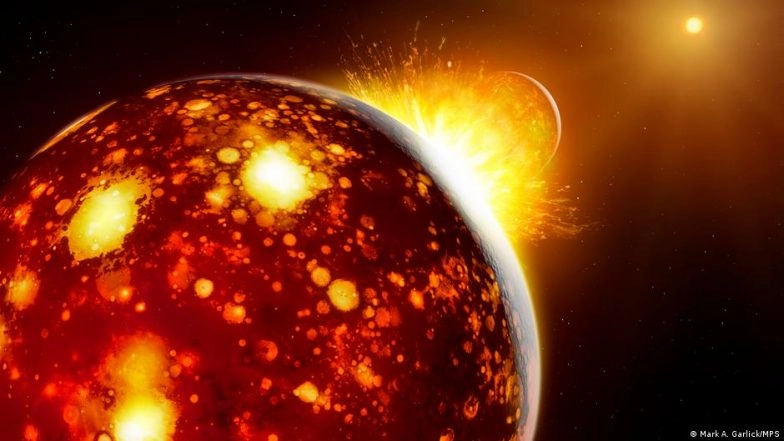
About 4.5 billion years ago, when Earth was still a molten ball of iron and other elements, a Mars-sized protoplanet named Theia smashed into our young world. The catastrophic impact completely destroyed Theia while sending massive amounts of debris into space – debris that eventually coalesced to form our Moon.
While scientists broadly agree on this collision theory, the origin of Theia has remained one of astronomy’s enduring mysteries. New research published in Science journal now provides compelling evidence about where this ancient world came from.
Chemical Fingerprints Reveal Theia’s Origins
Researchers at the Max Planck Institute for Solar System Research conducted detailed analysis of Earth, Moon, and nearby meteorite samples. They discovered that elemental isotopes – chemical variations of elements – are practically identical between Earth and the Moon.
“The similar iron isotopic composition of the moon and Earth was not that surprising, because this was shown before for other elements,” explained study lead Timo Hopp, a geoscientist at MPS.
The real breakthrough came when comparing these samples to near-Earth meteorites, which showed distinctly different iron isotopic compositions. This suggests Earth and the Moon formed from the same cosmic building blocks, while meteorites from nearby space regions came from different material reservoirs.
Theia: Earth’s Chemical Twin Next Door
The remarkable chemical similarity between Earth and Moon provides crucial clues about Theia’s origins. If Theia had formed far from Earth, it would have drawn from different cosmic materials, leaving a distinct chemical signature in Moon samples.
Instead, the near-identical compositions indicate Theia formed from the same isotopic building blocks as Earth – essentially making it Earth’s chemical twin that developed in our immediate cosmic neighborhood, somewhere between Earth and the Sun.
Ongoing Lunar Formation Mysteries
While this research provides significant insights, many questions about the Moon’s formation remain unanswered. Earlier in 2025, another German team suggested the Moon formed mainly from Earth material with little Theia contribution.
Hopp’s team assumes the giant impact “fully homogenized” material from early Earth and Theia, effectively mixing both worlds. However, the exact mechanism remains unclear.
“The actual mechanism and conditions of how this can be achieved are unknown, and need further investigation based on simulations and modeling,” Hopp acknowledged.
As scientists continue to refine their understanding through new analyses and simulations, the story of Earth’s earliest days and the creation of our Moon continues to evolve, revealing new insights about our cosmic origins.