

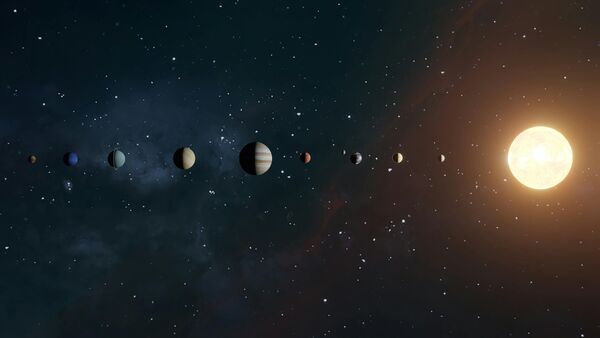
On 28 February, a rare sky event will allow six planets to be seen in the evening sky. This is often called a planetary parade, but many claims on social media are misleading.
According to NASA, Mercury, Venus, Jupiter, Saturn, Uranus and Neptune will appear shortly after sunset. However, only four planets can be seen with the naked eye if the sky is clear.
Uranus and Neptune are very faint and will need binoculars or a telescope to be visible. Mercury may also be difficult to spot because it stays close to the horizon.
“Four of those planets will be visible to the unaided eye, weather permitting, but only those with optical assistance will be able to view Uranus and Neptune (Mercury can sometimes be harder to spot, too),” NASA says.
Some online posts exaggerate the event by suggesting that all six planets will be easily visible everywhere. Some posts also claim that it is an extremely rare, once-in-a-lifetime phenomenon.
Such planetary groupings happen from time to time. However, they remain exciting for sky watchers.
Can we view all planets at once?
On 28 February, viewing all the planets at once will not be easy. Saturn, Neptune, Mercury and Venus will stay low near the horizon while Jupiter and Uranus will be higher. Among them, only Jupiter can be clearly seen without optical help.
Clear western skies, darkness and good weather will be essential for skywatchers and photographers. Tools like long-lens cameras, binoculars and planning apps can improve the chances of spotting multiple planets. Capturing all the planets in a single image is difficult because each has a different brightness.
For example, here are some misleading social media posts:
Despite exaggerated social media claims, the event remains interesting for astronomy lovers. Planetary alignments occur from time to time, and 2026 is expected to be a strong year for observing planets.
Mars will become visible before sunrise, starting from April. Venus will shine very brightly by late March, second only to the Sun and the Moon in brightness.
Planetary alignment on 28 February: Viral posts debunked
“Six planets aligning” does not mean a straight line. In astronomy, alignment usually means several planets appear in the same region of the sky from Earth’s point of view.
They are still millions of kilometres apart in space. So, this is a visual grouping, not a physical line-up.
Mercury, Venus, Jupiter and Saturn can often be seen with the naked eye when conditions are clear. Uranus and Neptune are usually too faint to see without binoculars or a telescope. So, the claim that all six are easily visible everywhere is partly exaggerated.
It is not the “most important sky event of the decade”. Planet groupings happen every few years. They are beautiful, but not particularly rare compared to events like total solar eclipses, bright comets, and major meteor showers.
If the sky is clear near sunset or sunrise, you might notice several bright points close together. They may be visible along the path where the Sun and planets move. That is the real spectacle.
This is a nice skywatching opportunity. But, many social-media claims are dramatic rather than scientifically precise.


