

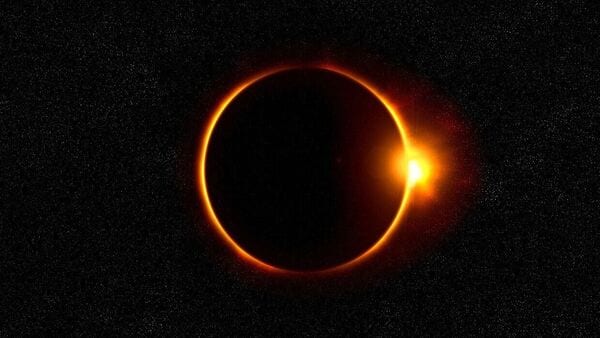
Solar Eclipse on Feb 17, 2026: Skywatchers around the world are gearing up for the first solar eclipse of 2026, scheduled for Tuesday, 17 February. The event will be an annular solar eclipse—a dramatic alignment in which the Moon passes in front of the Sun but does not block it entirely, leaving a bright ring of sunlight visible in the sky.
A solar eclipse occurs when the Sun, Moon and Earth line up in a straight configuration—known to scientists as a syzygy—causing the Moon to cast its shadow on Earth and temporarily block sunlight. In an annular eclipse, the Moon is near its farthest point from Earth. As a result, it appears slightly smaller than the Sun and creates the striking “Ring of Fire” effect.
Other forms of solar eclipses include total eclipses, where the Moon fully covers the Sun and daytime briefly turns dark, and partial eclipses, where only a portion of the Sun is obscured.
When will the February 17 eclipse happen?
The eclipse will begin at 09:56 UTC, with the maximum phase occurring at 12:12 UTC, according to astronomical timings.
Where will it be visible?
The annular eclipse will be fully visible only from extremely remote regions, largely confined to parts of Antarctica. However, several regions will witness a partial solar eclipse. These include parts of southern Africa—such as Cape Town and Durban—along with Zimbabwe and Tanzania. Partial views are also expected from the southern tips of Argentina and Chile, as well as island nations like Madagascar and Mauritius.
Will it be visible in India?
The eclipse will not be visible in India. Astronomers explain that the alignment will take place over the Southern Hemisphere at a time when the Sun is below the horizon in India.
Will it be visible in the US?
The annular solar eclipse will also not be visible in the United States.
When is the next major eclipse?
Those missing out on the February event won’t have to wait long. A total solar eclipse is scheduled for 12 August 2026 and will be visible from parts of Greenland, Iceland and northern Spain, with a partial eclipse seen across wider areas of Europe and Africa, Space.com reported.
Even sooner, on 3 March 2026, a total lunar eclipse will turn the Moon a deep red—often called a “Blood Moon”—and will be visible across North America, Australia, New Zealand, East Asia and much of the Pacific region.


