
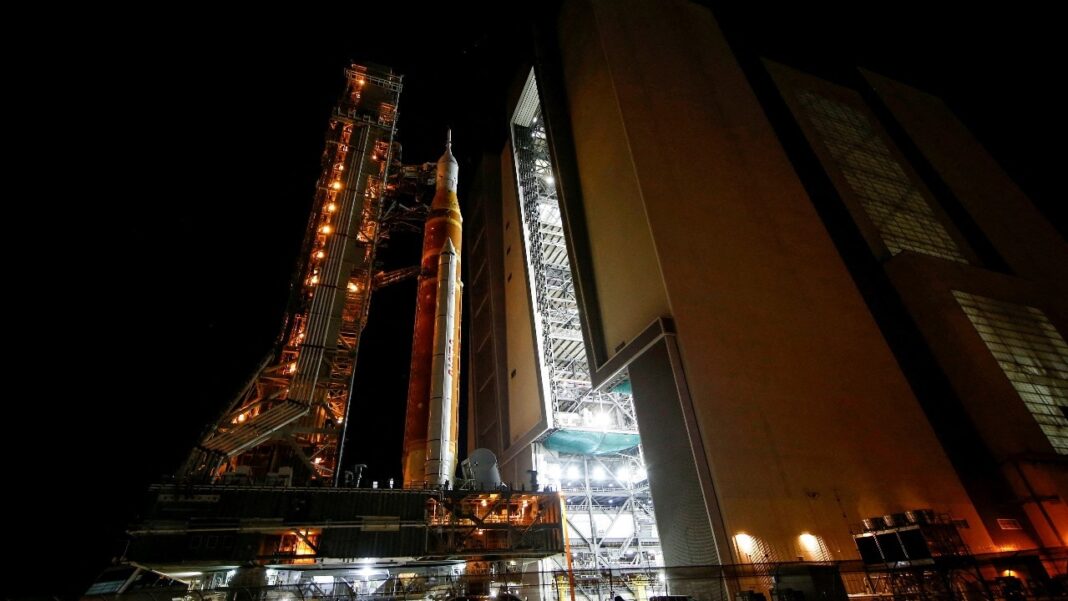
Nasa is set to launch its next Moon mission, Artemis II, on April 1 as the US space agency moves closer to sending astronauts back to lunar orbit for the first time since 1972. The mission will be the first crewed flight of Nasa’s Space Launch System (SLS) rocket and Orion spacecraft and will carry four astronauts on a journey around the Moon before returning to Earth.
The flight is designed as a major test of the spacecraft systems that will eventually enable astronauts to land on the lunar surface again under Nasa’s Artemis programme.
“This mission will prove Orion’s life support systems are ready to sustain crew on future missions and allow the crew to practice operations essential to the success of Artemis III and beyond,” Nasa said.
According to the space agency, preparations for the mission are currently underway at the Kennedy Space Centre, where engineers are completing final integration work on the SLS rocket and Orion spacecraft inside the Vehicle Assembly Building. Nasa said the rocket is expected to roll out to the launch pad on March 19 ahead of the targeted April launch window.
Once at the pad, teams will conduct additional testing, including another wet dress rehearsal, a full launch countdown simulation during which the rocket is fuelled with cryogenic propellants to ensure all systems operate as expected before liftoff.
TECHNICAL ISSUES DURING PREVIOUS DRILLS
The mission timeline has faced several delays after engineers detected technical problems during earlier drills. During one of the tests, teams discovered a helium flow issue in the rocket’s upper stage, which is used to pressurise the propellant tanks and maintain proper engine conditions.
After engineers failed to access the affected components easily at the launch pad, Nasa decided to roll the massive rocket back to the Vehicle Assembly Building for closer inspection and repairs. The issue was eventually traced to a faulty seal in the quick-disconnect system that connects ground helium supply lines to the rocket. Engineers repaired the system and ran validation tests to confirm the fix.
Earlier tests had also revealed a liquid hydrogen leak during a wet dress rehearsal, forcing Nasa to halt countdown operations and conduct additional troubleshooting before continuing launch preparations.
Despite the setbacks, Nasa officials stated such tests are designed to uncover problems before launch. Engineers are now working through final checks to ensure the rocket and spacecraft are ready for the historic mission.
Artemis II will be the first crewed mission of the Artemis programme, which aims to return astronauts to the Moon for the first time since the Apollo era ended in 1972. The mission will also pave the way for Artemis III, which is expected to attempt a lunar landing later this decade.
“In this Golden Age of exploration and innovation, the Artemis missions will allow astronauts to explore the Moon for scientific discovery, economic benefits, and help build momentum for the first crewed missions to Mars,” Nasa had said.


