22.1 C
Delhi
Saturday, January 17, 2026

NASA Confirms Earth Has Second Moon Until 2083

Key Takeaways

  • Earth has a temporary second moon called 2025 PN7, confirmed by NASA
  • The 19-meter wide asteroid will remain in Earth’s vicinity until 2083
  • It’s the smallest and least stable of six known quasi-moons with Earth-like orbits
  • Unlike our main moon, it’s not gravitationally bound and requires telescopes to view

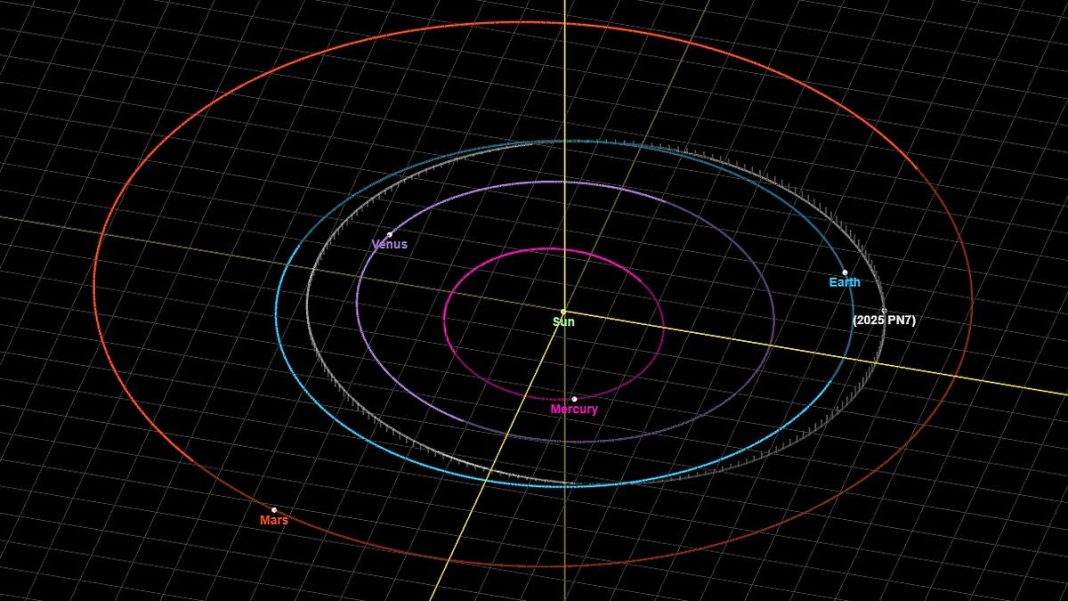
NASA has confirmed Earth temporarily hosts a second moon—a small asteroid called 2025 PN7 that will accompany our planet until 2083. Discovered by the Pan-STARRS observatory in Hawaii, this 19-meter wide space rock has been following a similar solar orbit since the 1960s.

What Are Quasi-Moons?

Quasi-moons are asteroids that orbit the Sun on paths similar to Earth’s, creating the appearance of orbiting our planet. Unlike our permanent moon, they aren’t gravitationally bound to Earth and will eventually drift away. 2025 PN7 is classified as the smallest and least stable among six known quasi-moons with Earth-like trajectories.

Carlos de la Fuente Marcos from Complutense University of Madrid noted these objects are “full of surprises” and explained that 2025 PN7 went undetected for so long because it’s “small, faint and visibility windows from Earth are rather unfavourable.”

Historical Context and Discovery

Scientists first identified quasi-satellites in 1991 with the discovery of ‘1991 VG’—initially suspected by some as an alien probe. Researchers now recognize these natural objects as part of a secondary asteroid belt within Earth’s orbital region around the Sun.

While 2025 PN7 has accompanied Earth since the 1960s, this is relatively brief compared to another famous quasi-moon, Kamo’oalewa, which maintains an Earth-related orbit for approximately 381 years.

Orbital Characteristics

2025 PN7 maintains varying distances from Earth, ranging between approximately 2.8 million miles (4.5 million km) and 37 million miles (59 million km). These objects belong to a special category called Arjunas, which move in synchronization with Earth’s solar orbit.

Future Discoveries and Research Importance

The newly operational Vera C. Rubin Observatory in Chile may uncover additional quasi-moons during its scans. Alongside quasi-moons, Earth occasionally hosts ‘minimoons’—objects that temporarily orbit our planet, though only four have been identified and none currently remain.

According to The Planetary Society, studying these celestial companions helps scientists understand asteroid origins and composition, potentially revealing whether they come from the main asteroid belt, lunar impacts, or breakup of larger objects. This research provides crucial insights into how asteroids might threaten Earth.

Latest

Indian Scientists Uncover Cell’s Life-or-Death Decision Mechanism

Breakthrough research reveals how cells choose survival or self-destruction under stress, opening new paths to treat cancer, heart attacks, and Alzheimer's.

ISRO Grounds PSLV After Second Consecutive Launch Failure

PSLV launches halted after January 2026 failure destroys 16 satellites. Investigation begins as ISRO's 2026 schedule faces major delays.

KID Capsule Survives ISRO PSLV Rocket Failure, Transmits Data

Spanish Orbital Paradigm's experimental KID capsule became the lone survivor of a failed ISRO launch, transmitting crucial re-entry data after the PSLV malfunctioned.

Flash Fog in Delhi: Science Behind the Sudden Zero-Visibility Event

Understand how a sudden 'flash fog' engulfed Delhi-NCR in minutes on Makar Sankranti 2026, its causes, dangers, and why meteorologists warn it may happen again.

Mysterious Dying Star Creates Colourful Cosmic Shockwave

Astronomers are puzzled by a white dwarf star ejecting gas and creating a vibrant, long-lasting shockwave in space, defying current scientific explanations.

Topics

Elon Musk Shares OpenAI President’s Files, Alleges Fraud Conspiracy

Elon Musk releases internal OpenAI documents, accusing leadership of a 'conspiracy to commit fraud' in an escalating legal and public feud.

Japan Investigates Elon Musk’s Grok AI, Warns Social Media Firms

Japan launches probe into Grok AI's data and content practices, issuing a compliance warning to all social media companies in a major regulatory move.

Trump Threatened Denmark with Tariffs Over Greenland Purchase Bid

Donald Trump reveals he considered tariffs and reduced protection to pressure Denmark into selling strategic Greenland, citing Russian and Chinese threats.

Putin Warns of ‘Catastrophic’ War in Calls with Israel, Iran Leaders

Russian President urges Netanyahu and Pezeshkian to de-escalate tensions, warning further conflict could lead to catastrophic violence across the Middle East.

RIL Q3 Profit Rises 11% to ₹19,641 Crore, Beats Estimates

Reliance Industries posts strong Q3 results with profit up 10.9%, EBITDA growth of 16.7%, and robust performance across all business segments.

Budget 2026: Education Sector Demands Focus on Skills and Jobs

Industry and academia seek higher funding for skill development, NEP implementation, and tax incentives in the upcoming Union Budget to boost employability.

Mumbai Voter Turnout Hits 32-Year High in Lok Sabha Elections

Mumbai recorded 55.38% voter turnout in 2024 Lok Sabha polls, its second-highest in 32 years. Analysis reveals what drove the surge and what it means for the city's civic engagement.

Indian Scientists Uncover Cell’s Life-or-Death Decision Mechanism

Breakthrough research reveals how cells choose survival or self-destruction under stress, opening new paths to treat cancer, heart attacks, and Alzheimer's.
spot_img

Related Articles

Popular Categories

spot_imgspot_img