
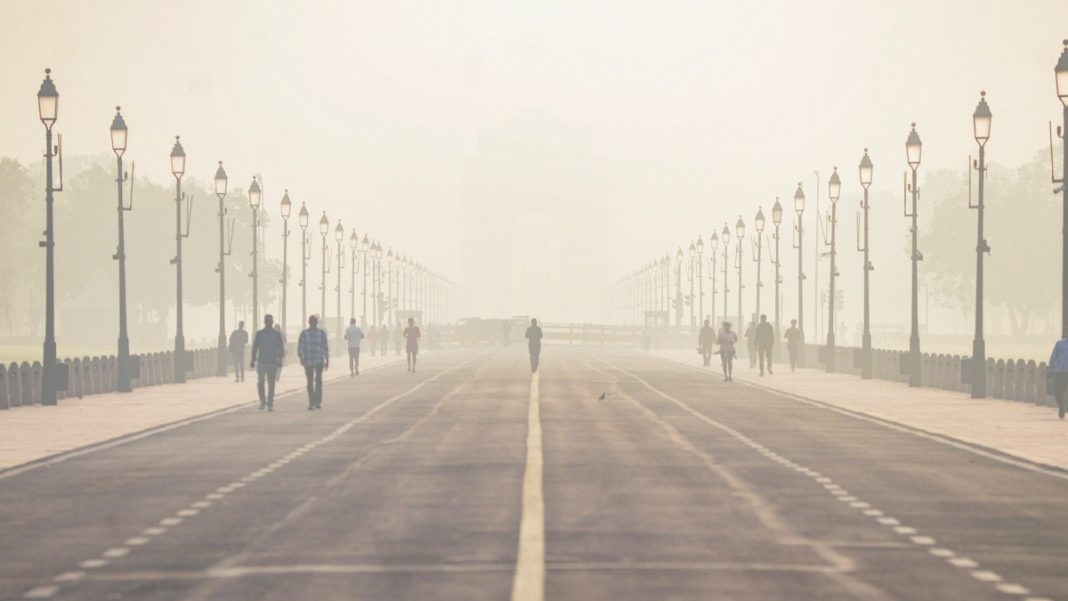
A thick haze that settled over Delhi and the National Capital Region (NCR) has sparked speculation on social media, with some users claiming it could be linked to refinery strikes and “petrol rain” reported in parts of Iran.
Weather experts, however, say the phenomenon over north India has a far more local and familiar explanation: dust carried by strong winds from nearby arid regions.
According to Mahesh Palawat, Vice President for Meteorology and Climate Change at Skymet Weather, the haze currently affecting Delhi-NCR is due to dust transported by strong westerly winds.
These winds are carrying large quantities of dust particles from Balochistan in Pakistan and the Thar Desert, both known sources of dust storms during dry and windy conditions.
“When winds intensify over these desert regions, loose sand and dust get lifted into the atmosphere and can travel hundreds of kilometres,” Palawat explained. “The current weather pattern has directed these dust-laden winds toward northwestern India, including Delhi-NCR.”
The suspended dust particles create a brownish or grey haze, reducing visibility and giving the sky a dull appearance. While such haze may resemble pollution smog, it is largely composed of natural mineral dust rather than industrial emissions.
In recent days, rumours circulating online have suggested that the haze could be linked to smoke or chemical fallout from refinery strikes in Iran, even claiming that “petrol rain” in the region was responsible for the unusual atmospheric conditions.
Meteorologists say these claims are scientifically incorrect.
“There is no meteorological pathway for smoke from refinery strikes in Iran to travel such long distances and directly create haze over Delhi,” Palawat said. “The atmosphere and prevailing wind directions do not support such a scenario.”
Weather models instead point to regional dust transport, a common occurrence in north India, especially during late winter and early summer when dry conditions prevail across desert landscapes in Pakistan and western India.
The good news, according to forecasters, is that the haze is temporary. Changes in wind patterns are expected to disperse the dust gradually.
“Once wind speeds shift and atmospheric mixing improves, the dust will settle or move away,” Palawat noted. “Conditions should begin to clear within the next two days.”


