India’s urban water crisis is here. What will it take to fix it?

Chennai went thirsty in 2019. Bengaluru grappled with water scarcity that affected thousands in 2024. Delhi fights over its share of the Yamuna every summer.

From Bengaluru to Delhi to Chennai and to other urban regions across India, water is increasingly becoming a dwindling resource. This crisis is unfolding, city by city, putting stress on households and businesses. But the question of possible solutions still remains.
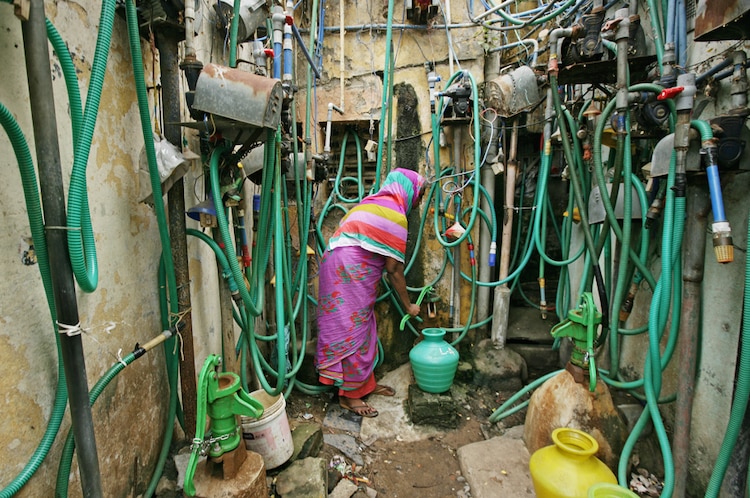
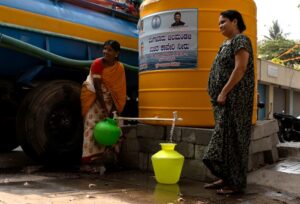
A woman uses a hand pump to fill up a container with drinking water in Chennai. (Photo: Reuters)

A woman uses a hand pump to fill up a container with drinking water in Chennai. (Photo: Reuters)

A new study, published in the journal Earth’s Future, might offer some hope.

Researchers at Stanford University have provided a blueprint for how fast-growing Indian cities can avoid catastrophe. The team behind the study formulated a plan by using Pune as a test case. They built a detailed model of how water supply, demand, and policy choices interact.

But the lessons they draw are meant for every Indian megacity in the making.

“We now have a framework that cities around the world can adapt as urban populations surge, cities expand, and climate pressures intensify,” said senior author Steven Gorelick.

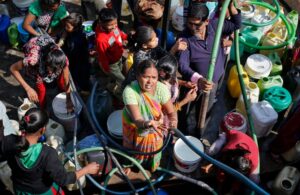
Residents surrounded by empty water containers. (Photo: Reuters)

Residents surrounded by empty water containers. (Photo: Reuters)

WHY IS INDIA FACING WATER SCARCITY?

By 2050, one-third to almost half of the global urban population is projected to face water scarcity, with a significant number living in India.

Five Indian cities, including Delhi, Kolkata, Chennai, Bengaluru, and Hyderabad, are already among the world’s 20 most water-stressed cities.

The reasons are familiar behind the dry state of the urban centres. The blame lies with decades of unregulated groundwater extraction, ageing pipelines, shrinking lakes, erratic monsoons, and rapid urban sprawl.

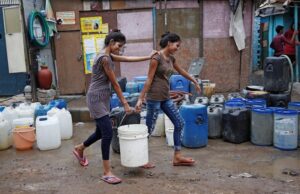
Girls carry a water container after filling it from a municipal tanker in New Delhi. (Photo: Reuters)

Girls carry a water container after filling it from a municipal tanker in New Delhi. (Photo: Reuters)

To not have water to drink or to bathe or wash clothes or water plants, are all a worrying prospect,

A NITI Aayog report had warned a few years back that by 2030, 40 percent of India’s population may not have access to drinking water.

The burden falls the hardest on those who can least afford it.

In cities like Bengaluru, residents in poorer neighbourhoods are entirely dependent on tanker water, which is very expensive.

The Stanford study puts a precise number on this inequality.

It notes that without intervention, low-income residents in fast-growing cities could spend nearly one-fifth of their income just to access water, and still receive less than half of what is needed for basic health and hygiene.

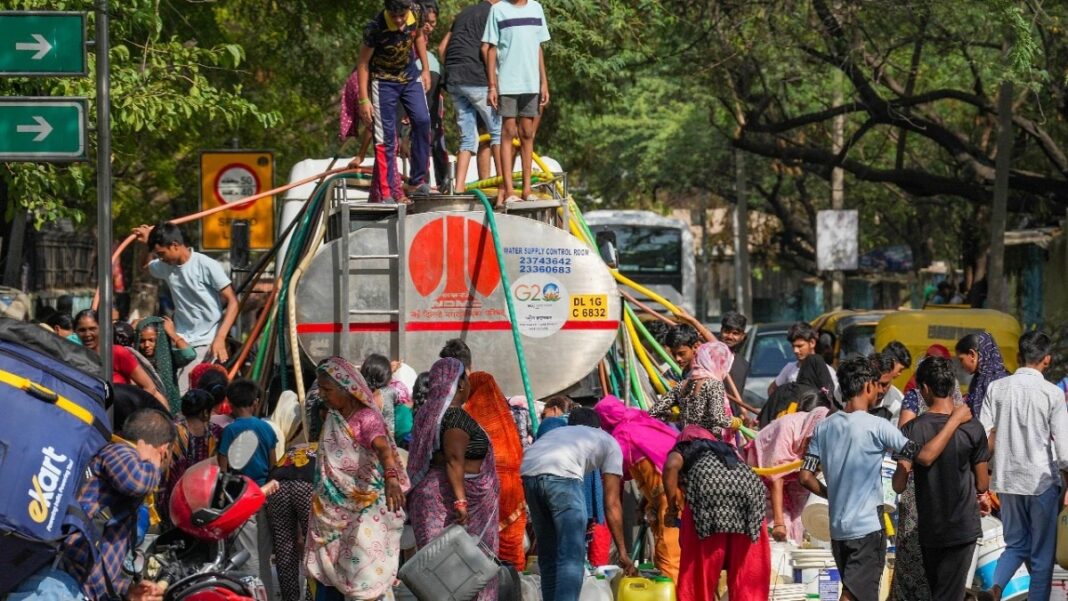
Residents fill their empty containers with water from a municipal tanker in New Delhi. (Photo: Reuters)

Residents fill their empty containers with water from a municipal tanker in New Delhi. (Photo: Reuters)

IS THERE A SOLUTION TO WATER SHORTAGE?

The researchers found that no single fix is enough.

Plugging leaks, cracking down on water theft, raising tariffs for heavy users, capping borewell extraction, all of these solutions help a little, but are not enough alone.

The real gains come from combining interventions.

The most powerful single policy, the study found, would be to allow farmers to legally sell their irrigation water to urban households through regulated tanker networks.

This alone could cut water costs for the urban poor from 18% to just 4% of income.

Residents fill their containers with drinking water from water tanks. (Photo: Reuters)

Residents fill their containers with drinking water from water tanks. (Photo: Reuters)

Crucially, the researchers found that fixing the crisis does not require a dramatic boost in supply. If proper policy interventions are adopted, all residents could gain access to at least 40 litres of water per day with only about a 1% increase in the total water supply.

“We discovered important synergies that identify unseen improvements in equality of water supply and access. This enables planners and policymakers to efficiently achieve their goals,” said lead author Ankun Wang, a PhD student at the Stanford Doerr School of Sustainability.

For India, where city after city is racing toward megacity status with creaking infrastructure and shrinking aquifers, the message is urgent. It says that solutions exist, and that the water is only just enough. But it warns that if policies are not created and enforced urgently, the country could be staring at a crisis that could affect millions.
Latest

Roaring volcanic eruptions are quietly triggering Asia’s monsoon rains

Scientists arrived at an unexpected finding after studying climate data spanning thousand of years.

Hawaii’s Kilauea erupts again, lava fountain rises over 1,000 feet

The volcano has seen other similar episodes, sometimes creating glowing lava lakes and fountains visible even from space. 

India seen glowing from space as Space Station passes over lit-up cities, Himalayas

In the background of India's glowing cities, you can also make out the faint silhouette of the Himalayas.

Why climate change will empty your tap before it floods your street

Climate on My Plate is India Today Science's new series on how the climate crisis is reshaping the everyday things you eat, drink, buy and own. This week, it is

Rain, snow and thunderstorms expected across several regions on Wednesday

The weather system may bring thunderstorms, lightning and gusty winds reaching 30-50 kmph across parts of Jammu and Kashmir on March 10 and 11.

Topics

OPINION | South India’s Tier-2 cities are quietly redefining healthcare

South India’s Tier-2 cities like Coimbatore, Madurai, Mangaluru and Hubballi are emerging healthcare hubs, leveraging private investment and infrastructure to

Pro-Iran hackers hit US medical device giant Stryker in shocking cyberattack after Israel strikes

US News: A suspected cyberattack linked to pro-Iranian hackers has shaken the global healthcare technology sector after targeting Stryker Corporation, one of t.

Oil tanker seized by US in relation to Venezuela set to transfer crude to smaller vessel 

USA-VENEZUELA/TANKER-SEIZURE:Oil tanker seized by US in relation to Venezuela set to transfer crude to smaller vessel 

JPMorgan Tees Up EA Debt Sale as Iran War Shakes Credit Markets

As JPMorgan Chase & Co. kicked off investor discussions this week over the $20 billion financing for Electronic Arts Inc., nervousness around a protracted war i

Nancy Guthrie update: Annie, Camron seen again at Catalina home; Savannah makes big decision

Nancy Guthrie’s daughter Annie and son Camron visited her Catalina home on day 41 of her disappearance. They reportedly left with Nancy’s Subaru.

Israel strikes central Beirut as Lebanon death toll tops 630

Israel strikes central Beirut as Lebanon death toll tops 630

‘Good cinema is going through deep struggle, we’re in difficult phase of filmmaking’, says Vishal Bhardwaj: It’s so sad

Vishal Bhardwaj said a revolutionary step is needed, adding that it is yet unknown whether it will happen through a film or a new medium.

Flipperachi, rapper behind Dhurandhar’s viral track FA9LA, cancels India performance amid Middle East tensions

Flipperachi, the Bahraini rapper who gained popularity in India after his track FA9LA featured in the spy thriller Dhurandhar, will no longer be perfo.
spot_img

Related Articles

Popular Categories

spot_imgspot_img