15.1 C
Delhi
Tuesday, February 24, 2026

How do birds survive long journeys across deserts and seas when migrating?

Every year, billions of small birds make one of nature’s most astonishing journeys, flying thousands of kilometres between Europe and sub-Saharan Africa and Asia, crossing scorching deserts and open seas with no place to stop, rest, or eat.

Now, a new international study published in the journal iScience has revealed a surprising secret behind how these tiny travellers survive.

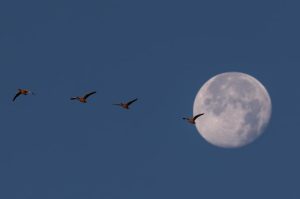
A flock of geese takes flight at sunrise, with the moon visible in the background. (Photo: Reuters)

A flock of geese takes flight at sunrise, with the moon visible in the background. (Photo: Reuters)

The study has found that birds successfully undertake extremely long journeys by changing altitude while flying. They change the level at which they fly depending on what lies beneath them, with their body shape and feather colour also playing an unexpectedly bigger role.

HOW DO BIRDS FLY?

Using miniature multi-sensor tracking devices, researchers tracked 17 species of small migratory birds as they crossed two major barriers on their journey: the Sahara Desert and large marine areas such as the Mediterranean Sea and the Bay of Biscay.

The findings were quite revealing.

When crossing the Sahara Desert, birds typically fly at much higher altitudes than over the sea, often reaching 2,500 to 4,000 metres above sea level, especially during daytime.
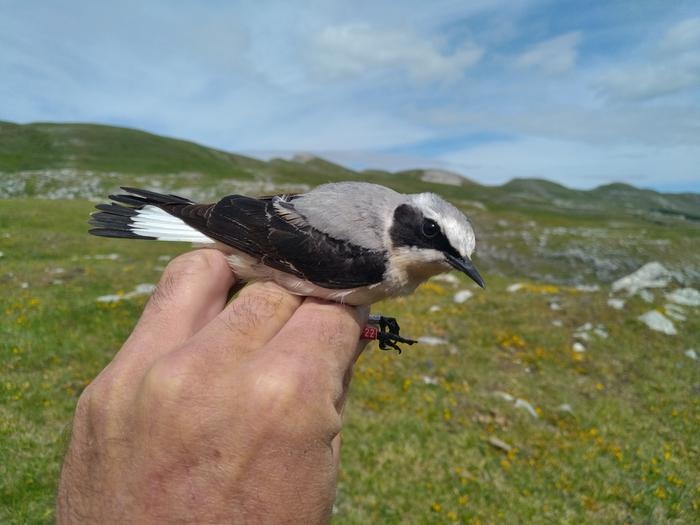
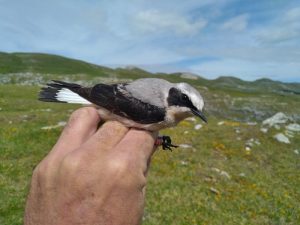
Northern Wheatear Oenanthe oenanthe equipped with a miniature multiple sensor. (Photo: iScience)

Northern Wheatear Oenanthe oenanthe equipped with a miniature multiple sensor. (Photo: iScience)

In contrast, sea crossings usually occur at much lower altitudes, sometimes probably just a few dozen metres above the water surface.

Naturally, the next question was why.

The researchers behind the study found that the reason birds climb so high over the Sahara is due to the heat.

“These small birds fly almost exclusively at night, but they sometimes extend their night flights into the following day when crossing the desert. When the sun rises, we have found that they fly higher,” senior researcher Jocelyn Champagnon from Tour du Valat explained. “This behaviour probably helps them avoid overheating by reaching cooler air at higher altitudes. Conversely, when crossing the seas, they descend, which puts them at risk of colliding with future offshore wind developments.”

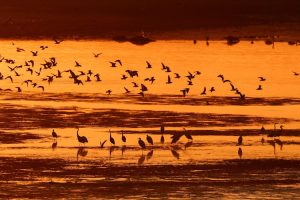
Cranes walk on the water as a flock of diving ducks flies at sunrise. (Photo: Reuters)

Cranes walk on the water as a flock of diving ducks flies at sunrise. (Photo: Reuters)

When it came to the role of a bird’s colour or its shape, the study became particularly fascinating.

Birds with larger wings tend to fly higher, likely because the larger wing area provides more lift in thinner air. Darker-plumaged species flew higher during daytime desert crossings, probably to reduce heat absorbed from solar radiation.

In other words, a bird’s feather colour is not just about appearance as it directly shapes its survival strategy across thousands of kilometres.

DOES THIS MATTER FOR BIRD CONSERVATION?

The findings will play a significant role in understanding birds and their behaviours, and thus, will inform the ongoing global efforts to protect endangered bird species.

Long distance migratory birds are declining. The findings, therefore, will also have implications for wind energy development in marine environments.
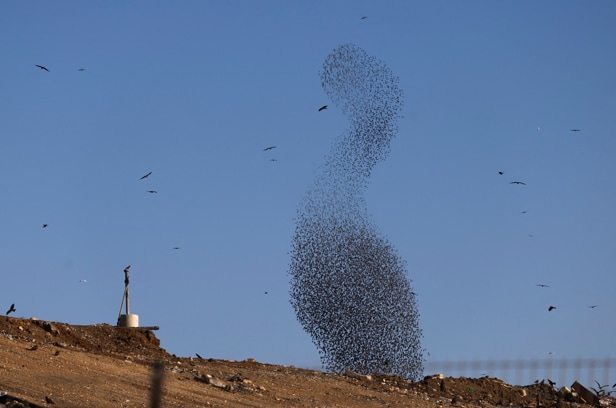
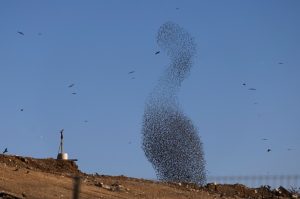
A murmuration of migrating starlings is seen across the sky at a landfill site near Beersheba, Israel. (Photo: Reuters)

A murmuration of migrating starlings is seen across the sky at a landfill site near Beersheba, Israel. (Photo: Reuters)

Many migratory birds cross seas at low altitudes, sometimes flying close to the water surface, which may bring them into the range of offshore wind turbines during long-distance flights.

Understanding when, where, and how high birds fly over marine areas can help improve the planning and operation of wind farms, reducing collision risks.

The study is a reminder of how finely tuned nature is, and how much we still have to learn before we build across its ancient flight paths.

Be it the popular Amur falcons flying from Asia to Africa, or other migratory birds like the Siberian Crane, the findings will help insulate their long journeys from human threats present at every corner.
Latest

Bomb cyclone looks monstrous from space as it charges toward New York. See pics

From space, the storm appears almost hurricane-like, a vast spiral of clouds wrapping around a dense center.

New York shuts down as historic bomb cyclone approaches: What’s happening?

The storm is slamming the Northeast, bringing heavy snow to areas from Virginia to Maine and putting more than 40 million people under blizzard warnings.

Comet to shine brighter than Venus over India: What is it?

Before you look up at the sky, it helps to understand what sungrazers actually are and what makes them a matter of interest for millions.

Your pet dog microbes make you a more empathetic person. Know the science behind

New research shows that dog microbes can alter human brain chemistry to increase empathy and social bonding. Discover why your pet might be the secret to your e

Nasa to remove Artemis-II Moon rocket from pad: What happens next?

Nasa’s quick decision to begin rollback preparations, rather than waiting, is seen as a deliberate move to protect the April launch window, which opens on Apr

Topics

Don’t play games: Trump warns countries against walking away from trade deals

Trump cautioned nations against reconsidering trade deals made with the US, saying that countries that 'play games' could face higher tariffs or licence fees. T

‘Any country that wants to play games…’: Trump issues ‘higher tariff’ threat

Amid continued scrutiny and with global allies like the EU and the United Kingdom reconsidering their trade deals with the US, Trump renewed tariff threats.

Stay on our side: Zelenskyy’s plea to Trump as Ukraine war enters 5th year

Zelenskyy publicly urged Trump to continue backing Kyiv and pressure Putin, warning that conceding to Russian demands would mean losing everything.

How much snow did Rhode Island and New York get on Monday amid severe blizzards?

New York saw up to 29.5 inches of snow on Feb 23, while Rhode Island set records with over 36 inches in Warwick and ongoing travel bans.

Trump administration steps up efforts to scrutinize foreign funding of universities

By Simon Lewis and Humeyra PamukWASHINGTON, - The Trump...

Supersub strikes again as Sesko gives Man United win at Everton

Supersub strikes again as Sesko gives Man United win at Everton

Pisces Horoscope Today for February 24, 2026: Avoid emotional confusion by staying clear in words

Pisces Daily Horoscope Today: You may review expenses and think about saving more.

Aquarius Horoscope Today for February 24, 2026: Your ideas can be helpful to others, so speak up politely

Aquarius Daily Horoscope Today: Teamwork brings positive results when you stay open-minded.
spot_img

Related Articles

Popular Categories

spot_imgspot_img