Eight lakh neurons played video games without a brain or body

On a shelf in a Melbourne laboratory, there is a small dish keeping something alive.

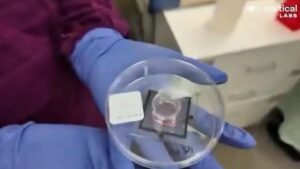
Not a plant. Not an animal. Something in between, and something entirely new. Roughly 8,00,000 living human brain cells, grown from stem cells, floating in a warm nutrient bath on a grid of microscopic electrodes.

No eyes, no ears, no nervous system, no brain. They have never experienced anything.

In 2022, scientists at Australian biotechnology company Cortical Labs gave them something to do.

The researchers connected the dish to Pong, one of the oldest video games ever made: a simple two-dimensional game where a paddle hits a ball back and forth across a screen.

When the neurons fired in patterns that moved the paddle toward the ball, the researchers sent back calm, ordered signals. When the neurons missed, the researchers sent back chaos. Pure noise. Disruption with no pattern to latch onto.

Within five minutes, the neurons had started to improve. Within hours, they were measurably better. The team, led by Brett Kagan, Chief Scientific Officer of Cortical Labs, published their findings in the journal Neuron and named their creation DishBrain.

Scientists have been quietly unsettled by it ever since.

THE PRINCIPLE BEHIND IT IS ELEGANT

Here is something most people do not know about the brain: it does not just receive information. It guesses constantly.

Before you even touch a doorknob, your brain has already predicted how cold it will feel, how much force your hand will need, and what sound it will make.

When reality matches the guess, nothing dramatic happens. When it does not, the brain notices the gap and adjusts. That gap is what scientists call prediction error.

The brain, in other words, is not a camera. It is more like a betting machine that is always trying to be right, and always updating when it is wrong.

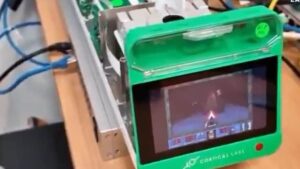
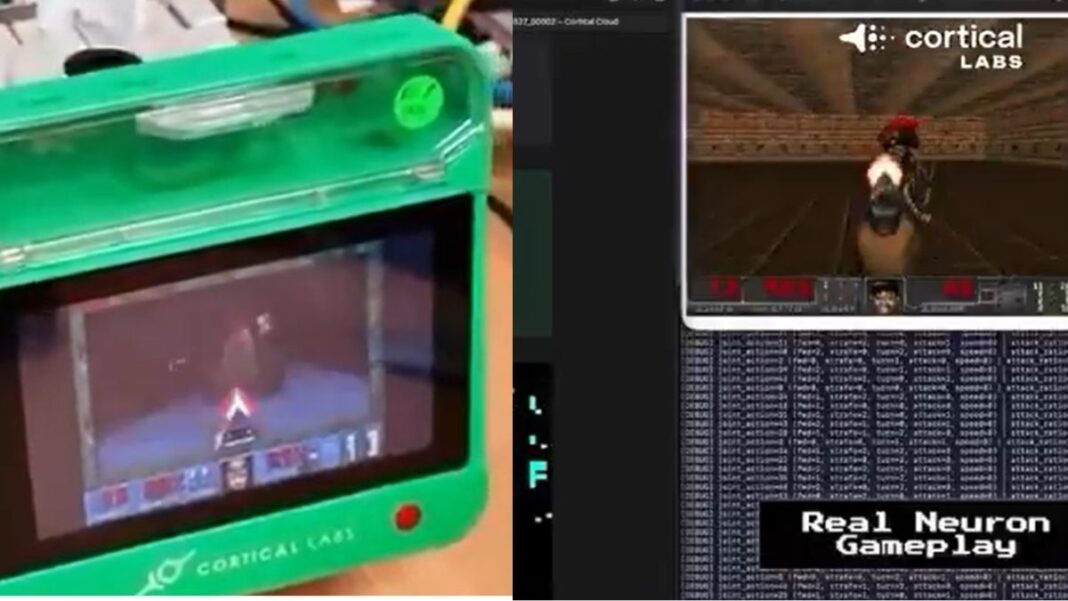
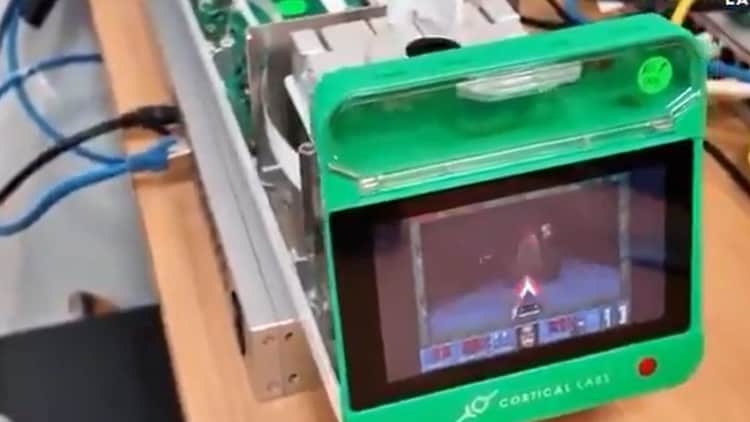
Cortical Labs' CL1 biocomputer, a commercial product housing living human neurons on silicon, moved from Pong to Doom by early 2026. Doom requires spatial navigation, enemy detection, and planning across a three-dimensional environment, a far more complex challenge than a bouncing ball. (Photo: X/@thecurioustales)

Cortical Labs’ CL1 biocomputer, a commercial product housing living human neurons on silicon, moved from Pong to Doom by early 2026. Doom requires spatial navigation, enemy detection, and planning across a three-dimensional environment, a far more complex challenge than a bouncing ball. (Photo: X/@thecurioustales)

This idea is known as the Free Energy Principle, developed by neuroscientist Karl Friston. The core of it is simple: the brain hates surprise. Not in an emotional sense, but in a biological one. Unpredictability is expensive for the brain to deal with. So the brain organises itself, over and over, to reduce it.

The Cortical Labs team used exactly this to build DishBrain. When the neurons missed the ball, the researchers sent chaotic, unpredictable noise. When they hit it, the scientists sent calm, stable signals.

The neurons had no instructions. But they had a powerful built-in drive: make the noise stop. And so they reorganised, again and again, until they found patterns that worked.

THE BODY DID NOT HELP

The neurons in DishBrain lacked several things.

No sensory history. No experience of moving through physical space. No motor memory. No childhood. They had never been part of a brain or body. They had no reason, in any framework we understand, to know what a ball or paddle was.

And the neurons learned anyway.
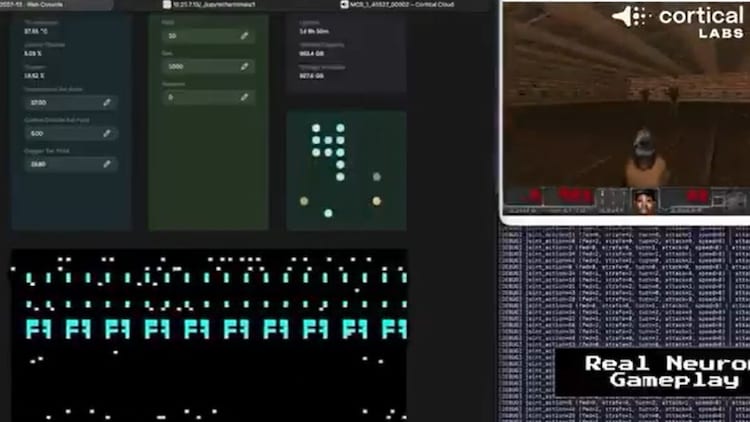
The neurons in DishBrain had no sensory history, no motor memory, and no evolutionary past, yet produced adaptive behaviour. Every existing theory of intelligence assumes learning requires experience to draw from. DishBrain had none, and it learned regardless. (Photo: X/@thecurioustales)

The neurons in DishBrain had no sensory history, no motor memory, and no evolutionary past, yet produced adaptive behaviour. Every existing theory of intelligence assumes learning requires experience to draw from. DishBrain had none, and it learned regardless. (Photo: X/@thecurioustales)

Every theory of intelligence has assumed that learning requires something to learn from: experience, feedback over time, and history. DishBrain had none of that. Yet it produced adaptive behaviour regardless.

The paper uses the word sentience, meaning the capacity for experience or feeling, which triggered significant scientific debate.

The authors clarified: they did not mean the neurons were conscious. They meant only that the system was responsive to its environment in ways resembling learning. That clarification matters. But it does not fully answer the question.

THE EXPERIMENT KEPT GROWING

By early 2026, Cortical Labs had built the CL1, a commercial biocomputer housing up to 8,00,000 living human neurons on a silicon chip with built-in life support.

The CL1 graduated from Pong to Doom, a first-person shooter video game where the player navigates a three-dimensional environment, identifies and shoots enemies, and maps corridors they have never entered before.

Unlike Pong, which requires only reacting to a moving object, Doom demands spatial reasoning, forward planning, and decision-making under genuine uncertainty.
The Free Energy Principle, developed by neuroscientist Karl Friston, proposes that biological systems are driven to minimise surprise and reduce internal disorder. The Cortical Labs team used this framework to design DishBrain, replacing dopamine-based rewards with simple electrical signals for order and chaos. (Photo: X/@thecurioustales)

The Free Energy Principle, developed by neuroscientist Karl Friston, proposes that biological systems are driven to minimise surprise and reduce internal disorder. The Cortical Labs team used this framework to design DishBrain, replacing dopamine-based rewards with simple electrical signals for order and chaos. (Photo: X/@thecurioustales)

The neurons learned it in one week. They play poorly by human standards. But they generalise, developing strategies for rooms and corridors they have not previously seen. That is not simple pattern-matching. That is closer to reasoning.

The energy numbers matter too. The CL1 runs on 20 watts, roughly the power of a standard light bulb. The large AI systems behind modern chatbots require megawatts to run. Biological neurons are extraordinarily efficient.

A QUIET DISPLACEMENT

The most unsettling thing about DishBrain is not what it can do. It is what it did without a body, senses and an evolutionary past: the standard prerequisites for intelligence, each one quietly set aside.

If learning can emerge from neurons in isolation, in a dish, in five minutes, then the story we have been telling about minds is incomplete in ways we have not yet begun to map.
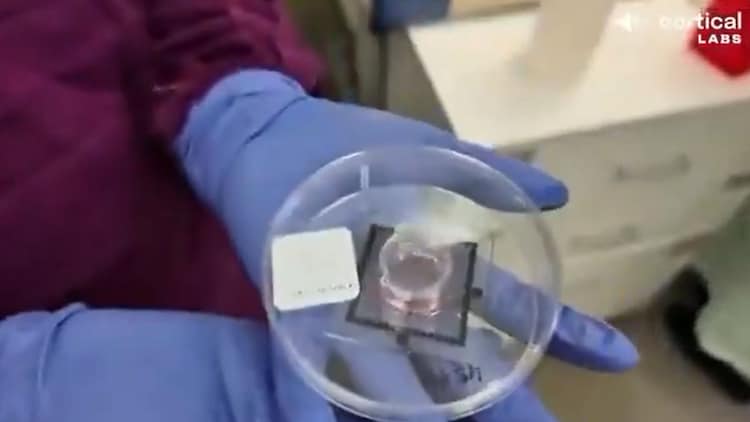
The DishBrain experiment set aside every standard prerequisite for intelligence: body, senses, evolutionary history, and memory. What remained was still enough. The neurons learned anyway. (Photo: X/@thecurioustales)

The DishBrain experiment set aside every standard prerequisite for intelligence: body, senses, evolutionary history, and memory. What remained was still enough. The neurons learned anyway. (Photo: X/@thecurioustales)

The neurons resolved disorder into patterns. They built, from nothing, a working model of their small world. They did what neurons simply do, given the right signal and nothing else at all.

What that means for consciousness, intelligence, and the ethics of what scientists are now building is a set of questions that 8,00,000 cells have quietly forced back open.

The question is not whether neurons can learn without a body. They already have. The question is how far that goes.

Latest

Nasa to launch Artemis-II mission to the Moon on April 1

Nasa said preparations are continuing at the Kennedy Space Centre, where engineers are completing final work on the rocket and spacecraft inside the Vehicle Ass

Assam is drowning every year. India’s nuclear plan wants to fix that, and much more

Every monsoon, floodwaters devastate Assam and poison drinking sources for millions. But atomic science may finally have a solution.

Isro reveals new details about SpadeX space docking mission

The satellites, SDX01, acting as the chaser, and SDX02, serving as the target, performed a series of precision manoeuvres to approach, dock, separate and manoeu

Too cold, too wet, too late: Baby birds are losing the climate game

A 60-year Oxford study tracking over 83,000 great tits finds that cold snaps and heavy rain stunt chick growth and cut survival odds. Breeding earlier in the se

Northwest India to face severe heat wave on Friday, Northeast to see rain

The IMD predicts severe heat wave conditions in Gujarat and Madhya Pradesh on March 13. Meanwhile, heavy rain and snowfall are expected in Arunachal Pradesh and

Topics

Planning to buy a 2-ton AC? Here are the top 10 options, starting at ₹33,000

Cooling large rooms during peak summer can be challenging. Here are 2-ton air conditioners that offer strong cooling, energy control, and useful features.

After 18 years, Shantanu Narayen prepares to hand over Adobe reins

The CEO who guided Adobe from boxed software to cloud subscriptions, wants to transition after laying the groundwork for an AI era

BuzzFeed flags ‘going-concern’ risks, explores options to stave off insolvency

In 2025, BuzzFeed had a loss of $57.3 million, as against its current market valuation of $27 million, meaning the company has negative net worth.

Adobe CEO Shantanu Narayen’s resignation shows how AI takes its toll

Adobe CEO Shantanu Narayen's resignation shows that guidance of steady revenue may no longer be enough to satisfy Wall Street without a clear AI agenda.

Dell agrees with Sam Altman on Pentagon, says: Any company doing business with the government can’t tell …

Tech News News: OpenAI CEO Sam Altman and Dell Technologies CEO Michael Dell may be on the "same page" about the Pentagon's decision to cancel Anthropic's dea

Kritika Kamra holds husband Gaurav Kapur close at their wedding reception; fans call them ‘classy, new favourite couple’

Kritika Kamra and Gaurav Kapur hosted a grand reception for industry friends on March 12. The newlyweds had fans praising their chemistry. 

Ashish Chanchlani admits Ekaki led to ‘huge loss’, reveals writing Stranger Things-like scene 3 years ago

Ashish Chanchlani's YouTube series Ekaki blends sci-fi, horror, and comedy, inspired by his fascination with aliens. 

Allu Sirish gushes about being in love with wife Nayanika Reddy: ‘Want to keep her as happy as her dad did’

In an interview with Hindustan Times, Allu Sirish speaks about his love for wife Nayanika Reddy, their honeymoon plans, and the kind of husband he wants to be.
spot_img

Related Articles

Popular Categories

spot_imgspot_img