

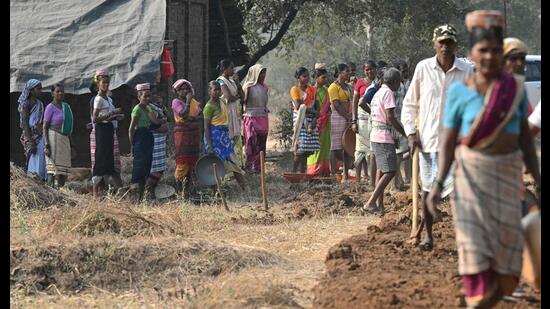
The future trajectory of rural development in India will depend on the extent to which it includes populations that remain excluded from the country’s economic progress. The National Rural Livelihoods Mission (NRLM) plays a pivotal role in this context. NRLM operates through an extensive network of women’s Self-Help Groups (SHGs). Impact assessments indicate that, when effectively implemented, NRLM has led to significant improvements in economic, social, and political outcomes for rural women.
The mission is entering a new phase — NRLM 2.0 — with addressing extreme poverty as one of the focus areas. It has already begun work through the Samaveshi Aajeevika Yojana (SAY), designed for the extremely vulnerable and “left-out” households. SAY aims to bring these households into the SHG network and relevant schemes, with a livelihoods pathway built on productive inclusion.
A critical consideration is whether NRLM 2.0 can transition from focusing solely on the number of people reached to achieving sustained reductions in extreme poverty. There are lessons from the Mission’s early days, from several State Rural Livelihoods Missions (SRLMs) — from Bihar’s decades-long work through Jeevika, and from Kerala’s approach through its broad network of local institutions.
Here are seven policy recommendations.
First, treat the extreme poverty agenda as a state-led capacity effort, with central guidance limited to a few key principles. States, in turn, allow districts the flexibility to administer the approach that best suits them. Kerala and Bihar demonstrate how to do this. In Kerala, local governments and frontline systems identified households and prepared micro-plans, with convergence around each family. This drew on foundations built over time through Kudumbashree, Kerala’s women’s community institutional architecture, and Ashraya, which focused on a destitute-free Kerala. In Bihar, Jeevika pursued a long-term agenda with local systems, adopting a graduation approach tailored to the context and carrying that learning into newer work.
Second, encourage each state to appoint a leader who combines mind, hands, and heart to lead the agenda. For a bureaucrat leading this effort, the incentives must be internal motivation and commitment. Kerala’s extreme poverty initiative and Bihar’s Jeevika reflect committed and sustained bureaucratic leadership, supported by political backing for this agenda.
Third, recognise that the quality of SRLMs varies widely, as does the strength of the community institutions meant to anchor these efforts. The primary constraints are the quality of last-mile support, accountability, and delivery integrity, especially in contexts where geographies and communities differ sharply within the same district. NRLM 2.0 should clarify how it will identify areas with higher concentrations of the extreme poor, and then provide additional support — both financial and human resources — to strengthen the quality of community institutions in those pockets. Where SRLM capacity is weak or overstretched, NRLM 2.0 should establish a framework to work with grassroots civil society organisations, with defined roles, accountability, and safeguards. Civil society organisations can contribute strengths in mobilisation, trust, and accompaniment. SRLMs can focus on convergence, entitlements, and links to State systems.
Fourth, design for household-level work alongside place-based, regional, sectoral, and sub-sectoral approaches. In many contexts, extreme poverty is linked to geographies, sectors, and structural conditions. Kerala’s Extreme Poverty Eradication Project identified 64,006 families — about 103,000 individuals — facing overlapping stresses across food security, housing, income, and health. The project used household micro-plans to coordinate existing programmes around each family. Long-term outcomes will also depend on developments in the local economy around those households and on how risks are managed in areas with concentrated deprivation. This remains a challenge for Kerala as well.
Fifth, build transparency into the design. Publish definitions, identification criteria, verification protocols, what is being measured, and how slippage will be tracked. Be explicit about whether the focus is on extreme poverty or destitution and clarify how overlaps will be addressed.
Sixth, treat entitlement access as urgent, but not as the endpoint. Use the same household-level work to assess how institutions are performing. Few programmes are better positioned than NRLM and its community platforms to document where systems break down at the margins and feed that diagnosis back into State action.
Seventh, treat this as a collective local effort. Ideally, this work should be carried out jointly by Panchayati Raj institutions, SHGs, ASHA and anganwadi workers, and credible non-profits. Some states might use this opportunity to organise it accordingly. Support for the extremely poor should be an ongoing national project. But NRLM 2.0 faces a choice — deliver numbers or build a sustained approach to extreme poverty reduction.
Balakrishnan Madhavan Kutty was with the World Bank and worked across multiple states in India in the rural development sector over the last two decades. The views expressed are personal


