
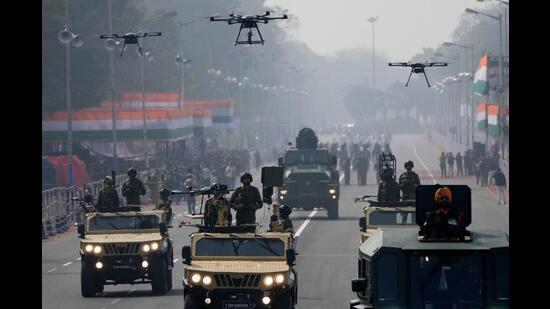
On March 10, defence minister Rajnath Singh released “Defence Forces Vision 2047: A Roadmap for a Future-Ready Indian Military”. By the centenary year of Independence, the armed forces aim to become an integrated, all-domain force, ready to respond across the full spectrum of conflict to protect and promote national interests, in concert with all elements of national power.
The newly-articulated vision is important because India faces a demanding security environment even as the character of conflict is being fundamentally transformed. The structure and doctrinal thinking that serve the military today will need to be reshaped for the battlespace of tomorrow.
The document gets the broad diagnosis right. It situates military transformation within the larger national ambition of building a Viksit Bharat (Developed India) and argues that this requires a Sashakt Bharat (Empowered India) that is strong economically, diplomatically, technologically and militarily. That is a useful starting point because military power is situated within the wider national security architecture.
Its central argument is that the line between war and peace is eroding. Adversaries increasingly operate through proxy conflict, grey-zone coercion, disinformation, and other forms of pressure below the threshold of open war. Future insecurity will spill across maritime, space, cyber and cognitive domains, leading to persistent, multi-domain contestation in which coercion may be more psychological than kinetic.
Some of the most concrete recommendations lie in the seven strategic priorities that give shape to the 2047 vision. On combat readiness, it calls for stronger deterrence through intelligent platforms and force multipliers, as well as the development of indigenous technologies under the Atmanirbharta initiative. A key focus area is tri-service jointness through integrated networks, a tri-service logistics and inventory system, raising of a joint headquarters for operations, and a clearer separation between force generation and force application through integrated command-and-control structures.
On capability development and strategic priorities, the recommendations are equally specific. The document proposes formalising an integrated capability development plan, reviewing the acquisition procedures, creating a technology perspective and capability roadmap, and building surge capacities for prolonged attritional conflict. Most notably, it recommends creating a defence geo-spatial agency, a data force, a drone force, a cognitive warfare action force, and raising space and cyber commands.
The document argues that technology-driven battlefields require agile and contemporary doctrines to provide strategic direction. It, therefore, calls for laying the doctrinal foundation for multi-domain operations, shifting from information superiority to decision superiority by moving from net-centric to data-centric warfare, and integrating cognitive warfare into conventional operations. This is a crucial point because technology adoption without intellectual adaptation will yield limited results.
Vision 2047 envisages a strategic culture aligned with Indian needs, promoting indigenous knowledge and establishing an Indian Defence University as a centre of excellence for strategic leadership, innovation, critical thinking, and creativity. On the human side, it calls for a technologically adept and mentally agile force, stronger specialist training in emerging technologies, digital infrastructure for large-scale learning, and strengthening the Agnipath scheme.
The vision also lays out a three-phase path to 2047. The period up to 2030 is described as the era of transition, focused on organisational restructuring for multi-domain operations and the creation of a policy framework. The years 2030 to 2040 form the era of consolidation, during which capability development for data-centric operations and higher levels of integration would take shape. The final period, from 2040 to 2047, is the era of excellence, when the Indian armed forces emerge as a world-class military.
The vision has been articulated, and the hard part begins now. A close reading shows that the paper itself is conscious of this. It acknowledges that it is a guideline, not a directive, and that many of its goals are aspirational and will require approvals at multiple levels. This caveat is the central implementation challenge. India has rarely lacked ambition in military planning. The more persistent problem has been the gap between strategic aspiration and institutional execution.
One example of that gap is the Indian Defence University (IDU). The proposal for the IDU was approved in 2010, the foundation stone laid in 2013, and the Indian National Defence University Act drafted in 2015. More than a decade later, the draft bill awaits cabinet and parliamentary approval.
The real question is not whether the vision is persuasive, but whether it is executable. Four tests will determine that. The first is the jointness test. Can India move from rhetorical integration to genuine theatre-level warfighting, common planning and interoperable systems? Notably, while the document emphasises integration, it makes no direct mention of integrated theatre commands. Unless the three services honestly embrace integration, the project could trip at the first hurdle.
The second is the technology test. How quickly can the armed forces absorb modern technologies like Artificial Intelligence, autonomous systems, cyber, and space-based systems? This will require considerably greater investment in defence research and development, and the adoption of a more agile acquisition process.
The third test is industrial. Can Atmanirbharta deliver the capabilities required to transform the defence forces into a world-class military? While policies must support the indigenous defence industry, self-reliance cannot become a rigid slogan that delays the induction of critical capabilities that cannot be developed in the country.
The final test is doctrinal. How quickly does the military shift from a platform-centric concept to a doctrine rooted in the changing character of warfare, based on Indian conditions and threat realities? The document notes that India cannot replicate existing doctrines and strategies imported from across the globe.
The real measure of success will lie in the will to execute. If the government backs these reforms with sustained political support, clear processes and adequate funding, it could reshape India’s military future. Otherwise, the vision risks remaining a powerful prose on paper.
Lieutenant General (retired) Deependra Singh Hooda is the co-founder of the Council for Strategic and Defence Research and a senior fellow at the Delhi Policy Group. The views expressed are personal


